Reform Support

Strengthening institutional capacity to produce learning at scale: Case studies from Jordan, Malawi, Nepal, and Uganda

Submitted by admin on
Description/Abstract
Case studies of RTI's work on strengthening institutional capacity in Nepal, Jordan, Malawi, and Uganda focusing on three core functions: (1) setting and communicating expectations; (2) monitoring against expectations; (3) providing targeted support to struggling schools.
Assoc. Photo (Port.)
bidemi cap assessment_port.jpg
Resource Type
Month and Year

Digital transformation: An opportunity for long-lasting improvement of quality of education service delivery in Kyrgyz Republic, Tajikistan, and Uzbekistan [CIES Presentation]

Submitted by admin on
Description/Abstract
Digital transformation: an opportunity for long-lasting improvement of quality of education service delivery in Kyrgyz Republic, Tajikistan, and Uzbekistan Over the past decade, Uzbekistan, Tajikistan, and Kyrgyz Republic have been consistently demonstrating their commitment to quality education, evidenced by the amount of GDP allocated to education. These education systems aim to produce world-class graduates capable of success both globally and at home. Various donors have stepped in to support these efforts in a coordinated way via direct funding of initiatives that enhance instructional skills, increase accountability for excellence, and improve formal and non-formal learning environments. In Uzbekistan, critical thinking, problem solving, and practical skills are at the forefront of the Ministry of Public Education (MPE)’s agenda. In the Kyrgyz Republic, performing well on the upcoming PISA survey in 2025 is a focal point for the Ministry of Education and Science (MOES) in recent years. And, in Tajikistan, COVID-19 provided an important opportunity to rethink the delivery of in-service teacher training from in-person to a blended learning format, resulting in impressive early grade learning gains. However, the COVID-19 crisis brought many education systems to a grinding halt, and these three countries were no exception. Nevertheless, the speed and efficiency with which their education systems adapted has been remarkable. It speaks to their resilience, rooted in the fact that these countries enjoy strong institutional, financial, and policy legacies that are strongly rooted and capable of weathering storms. Undoubtedly, the strongest driving force behind this change is the belief shared at all levels of their education systems – especially at the level of parents and teachers – that education is important. It comes as no surprise that when faced with the challenge of school closure due to a pandemic, their various systemic actors collaborated and adapted their approaches to continue delivering teacher professional development (TPD). In the Kyrgyz Republic, after less than a year following the outbreak of the pandemic, the majority of teachers reported accessing online learning resources, and 85% of teachers did so using smartphones. The USAID-funded Okuu Keremet! project had planned to deliver teacher training in person, but swiftly shifted to development of blended learning modules for reading and mathematics. It designed an online training platform that in a short period of time was accessed by 18,000 registered teachers and librarians. The online learning platform integrates Google Analytics that can allow the Ministry of Education and Science (MOES) to not only monitor progress towards certification of individual teachers, but to also detect, in real time, the teachers and schools that are lagging behind . In Uzbekistan, the Ministry of Public Education (MPE) has made significant investment in continuous professional development, and as part of its growth strategy, Avlonyi has created a Learning Management System (LMS) for teacher accreditation based on OECD teacher professional development standards. To aid Avlonyi in this significant undertaking, the USAID-funded Uzbekistan Education for Excellence Program (UEEP) project developed a blended TPD model comprised of synchronous and asynchronous in-person and online assessment-based learning events (with the focus to improve Information and Communication Technology (ICT) and English as a Foreign Language (EFL) instruction for grades 5–11 and 1-11, respectively). In addition to gaining skills through this opportunity, teachers will achieve career advancement through the accreditation of their efforts by Avlonyi. In Tajikistan, the impact evaluation data shows strong performance as a result of the USAID Read with Me project implemented in collaboration with the Ministry of Education. TPD in Tajikistan applies digital development principles, a multi-user coaching and training platform, which provides content and accountability for self-regulated learning, coaching, peer learning and performance monitoring, including uploading assignments and assessments, aligned with the National Teacher Competency Framework. The EGRA end line results clearly showed the benefit of effective teaching techniques correlating to oral reading fluency gains of more than thirteen correct words per minute. This panel brings together researchers and practitioners documenting the transformational change of Teacher Professional Development in the three Central Asian Republics – Kyrgyz Republic, Uzbekistan and Tajikistan. Panelists will discuss details about the effectiveness and utility of online learning platforms vis-à-vis TPD and student learning gains; the skills required to make this shift to digital, self-regulated learning; and lessons learned for getting these new platforms mainstreamed into educational systems.
Assoc. Photo (Port.)
Screenshot 2023-03-20 145843.png
Resource Type
Month and Year

Uganda LARA: Psychosocial Support training facilitators' guide

Submitted by admin on
Description/Abstract
In March 2020, the government of Uganda closed all schools and other educational institutions to mitigate the wide spread of COVID-19. This exposed significant risk especially to rural areas where there is limited access to reading materials or virtual learning platforms to continue learning. Ministry of Education and Sports’ (MoES) Preparedness and Response Plan for COVID-19 (April 2020) outlined measures of continuing learning through radio, take home packages and digital learning. MoES also decided to provide psychosocial support to minimize the adverse effects of COVID-19 on pupils, teachers and the education system at large, through support from USAID/Uganda Literacy Achievement and Retention Activity (LARA).The project planned to support MoES to enhance capacity of Primary Teachers college tutors and administrators to cascade psychosocial support training to head teachers and teachers in 43 districts. The objective of the training was to i) equip participants with knowledge and skills on psychosocial support, ii) identify psychosocial needs and discuss appropriate interventions and iii) apply psychosocial support intervention skills. The Facilitator guide provides information which will help reduce COVID-19 related stress, anxiety and prepare teachers for school reopening. In addition, teachers will be able to protect and provide counselling to pupils.
Assoc. Photo (Port.)
Screen Shot 2020-12-21 at 12.12.50 PM.png
Country
Resource Type
Resource Language
Month and Year
Publisher Or Client
USAID/Uganda Literacy Achievement & Retention Activity

Systems Implications for Core Instructional Support Lessons from Sobral (Brazil), Puebla (Mexico), and Kenya

Submitted by admin on
Author
Description/Abstract
In December 2019, the Bill and Melinda Gates Foundation convened a workshop examining four education systems that have worked to build coherence across their systems, as viewed by “insiders” who played a significant role in carefully studying, designing, or maintaining the systems. This information note summarizes the knowledge shared at the workshop and was produced at the request of key stakeholders at the meeting. It is intended for the benefit of the participants and those who may be designing systems interventions or research, especially around the issue of the "instructional core" and the coherence among the various elements of the instructional core. The note is presented as an informal contribution.
Assoc. Photo (Port.)
lcrouch photo.png
Resource (File)
Country
Resource Type
Month and Year

USAID Early Grade Reading (EGR) EGR Final Report

Submitted by admin on
Author
Description/Abstract
Improving early grade reading and writing outcomes has implications more far-reaching than simply raising scores on national and international assessments. Reading is a fundamental tool for thinking and learning, which has an integrated and cumulative effect on comprehension in all subject areas. Providing students with a strong foundation in reading increases the likelihood of future academic and workforce success. By providing Palestinian teachers with additional strategies and resources to build essential primary students’ reading and writing skills, the US Agency for International Development (USAID) Early Grade Reading (EGR) Project supported the goal of the USAID mission in the West Bank/Gaza of “providing a new generation of Palestinians with quality education and competencies that would enable them to thrive in the global economy and empower them to participate actively in a well-governed society.” Specifically, EGR addressed USAID’s strategic Sub-objective 3.1.5 to improve “service delivery in the education sector through increased access to quality education, especially in marginalized areas of the West Bank; a higher quality of teaching, learning and education management practices; and improved quality and relevancy of the education system at all levels.” EGR also directly supports USAID’s global goal to improve early grade reading skills. In support of the overarching goals, EGR’s project goal was to facilitate change in classroom delivery of early grade reading and writing instruction through three inter-connected component areas including evidence-based standards and curriculum revisions, instructional improvements, and parental engagement activities designed to improve student reading and writing competencies in Kindergarten (KG)–Grade 2 in the West Bank. EGR offered a scalable model of early grade reading instruction in 104 West Bank public schools among 351 teachers who taught 9,679 students. EGR collected data through reviews of curricular and standards’ documents, studies in schools, and assessments of students’ reading competencies. The project developed book leveling criteria to ensure the age- and grade-level appropriateness of reading materials, which facilitated the development or procurement of over 100,000 books for schools. EGR provided the Ministry of Education and Higher Education (MOEHE) with training modules in early grade reading and writing skills, a reading remediation manual, and a school-based professional development model. The project created innovative materials for parents to use to enhance their children’s reading skills. Despite its abbreviated timeframe, the project provided the MOEHE with a wealth of educational data, materials, and resources, including many interventions offered for the first time in the Palestinian educational system.
Assoc. Photo (Port.)
Final Report photo.JPG
Resource Type
Resource Language
Month and Year
Publisher Or Client
USAID/West Bank and Gaza

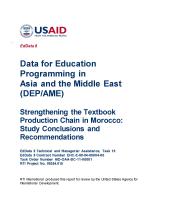
Strengthening the Textbook Production Chain in Morocco: Study Conclusions and Recommendations

Submitted by admin on
Description/Abstract
This is Part 1 of a four-part comprehensive evaluation of the public textbook procurement system in Morocco. It offers recommendations on how to improve textbook quality, how to strengthen the procurement system --including budgeting and financing--, and developing a policy for digital textbooks.
Assoc. Photo (Port.)
1_English_Textbooks Morocco_Main.jpg
Resource (File)
Country
Resource Type
Resource Language
Month and Year
Publisher Or Client
USAID/Morocco

Jordan Kindergarten Data for Decision Making

Submitted by admin on
Description/Abstract
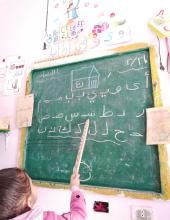
This report presents findings of a national survey of parents regarding enrollment in preprimary education (kindergarten) in Jordan. The findings are surprising because they suggest that the real enrollment rate is significantly higher than what government statistics indicate. The discrepancy seems to be due to a high level of kindergarten provision from private sector and civil society actors who are not licensed by the Ministry of Education.
Assoc. Photo (Port.)
Home-based KG Madaba girl at blackboard.jpg
Country
Resource Type
Featured projects
Resource Language
Month and Year

Worldwide Inequality and Poverty in Cognitive Results: Cross-sectional Evidence and Time-based Trends

Submitted by admin on
Description/Abstract
The Sustainable Development Goals (SDGs) for education represent a major departure from the Millennium Development Goals (MDGs) - at least if educational leaders act seriously in their pursuit - in at least two important respects. First, the goals now pertain to learning outcomes. Second, there is a great deal of focus on inequality in the SDGs. Taking note of this new dual emphasis of the SDGs, this paper assembles the largest database of learning outcomes inequality data that we know of, and explores key issues related to the measurement of inequality in learning outcomes, with a view to helping countries and international agencies come to grips with the key dimensions and features of this inequality. Two issues in particular are explored. First, whether, as countries improve their average cognitive performance (as measured by international learning assessments) from the lowest to middling levels, they typically reduce cognitive skill inequality or, more importantly perhaps, whether they reduce absolute lack of skills. Second, whether most of cognitive skills inequality is between or within countries. In dealing with these measurement issues, the paper also explores the degree to which measures of cognitive skills are “proper” cardinal variables lending themselves to generalizations from the field of income and wealth distribution—the field for which many measures of inequality and its decomposition were first applied. To do this, we look into whether using the item response theory (IRT) test scores of programmes such as TIMSS influence these types of findings, relative to the use of the underlying and more intuitive classical test scores. Patterns emerging from the classical scores are far less conclusive than those of the IRT scores, in part due to the greater ability of the IRT scores to discriminate between pupils at the bottom end of the performance spectrum. An important contribution of the paper is to examine the sensitivity of standard measures of inequality to different sets of test scores. The sensitivity is high, and the conclusion is that meaningful comparisons between test score inequality and, for instance, income inequality are not possible, at least not using the currently available toolbox of inequality statistics. Finally, the paper explores the practical use of school-level statistics from the test data to inform strategies for reducing inequalities.
Assoc. Photo (Port.)
12_Poverty_0.jpg
Country
Resource Type
Resource Language
Month and Year
Publisher Or Client
Research on Improving Systems of Education (RISE) Programme

Special Issue--Working to improve: seven approaches to quality improvement in education

Submitted by admin on
Description/Abstract
A collection of articles on Improvement Science, published in a special issue (Volume 25 Issue 1) of the journal "Quality Assurance in Education". Each article describes one of seven improvement methods, presents its history, and gives at least one example of it employed in the education sector. The seven improvement methods covered by these articles are: - Networked improvement communities - Design-based implementation research - Implementation science - Lean - Six Sigma - Positive Deviants - Deliverology
Assoc. Photo (Port.)
publications icon purchased sm.png
Country
Resource Type
Resource Language
Month and Year
Publisher Or Client
Quality Assurance in Education (Emerald Insight)

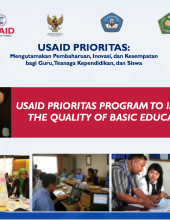
USAID PRIORITAS Program to Improve the Quality of Basic Education

Submitted by admin on
Author
Description/Abstract
This presentation describes the USAID/Indonesia PRIORTIAS program (2012-2017), including the development of leveled reading books for 13,000 schools.
Assoc. Photo (Port.)
prioritas presentation.png
Resource (File)
Country
Resource Type
Resource Language
Month and Year
Publisher Or Client
USAID