Sustainability

La quête du Sénégal pour améliorer les résultats d'apprentissage dans l'alphabétisation fondamentale bilingue

Submitted by admin on
Description/Abstract
Ce blog a été écrit et publié à l'origine par la Fondation Bill et Melinda Gates et la CONFENMEN à l'occasion de la conférence « Apprendre pour Demain » à Dakar, au Sénégal (janvier 2025). Il a été publié sur le site web de la conférence (https://linktr.ee/apprendrepourdemain) et dans le répertoire de documents (https://sites.google.com/view/apprendrepourdemain/resources-ressources/others?authuser=3). Cet article décrit comment l'activité « Renforcement de la Lecture Initiale pour Tous » (RELIT, 2021-2026) de l'USAID s'est efforcée de renforcer la capacité du système éducatif à dispenser un enseignement bilingue dans les premières années de la scolarité, en s'appuyant sur une pédagogie structurée et le renforcement des capacités institutionnelles.
Assoc. Photo (Port.)
COnf French port.png
Resource (File)
6. Blog USAID RELIT_FR.pdf
Country
Featured projects
Resource Language
Month and Year
Publisher Or Client
Gates Foundation, CONFENMEN

Senegal’s Quest for Improved Learning Outcomes in Bilingual Foundational Literacy

Submitted by admin on
Description/Abstract
This blog was written for and originally published by the Bill and Melinda Gates Foundation and CONFENMEN on the occasion of the "Apprendre pour Demain" conference in Dakar, Senegal (January 2025). It was published on the conference website (https://linktr.ee/apprendrepourdemain) document repository (https://sites.google.com/view/apprendrepourdemain/resources-ressources/others?authuser=3). This article describes how USAID's “Renforcement de la Lecture Initiale pour Tous” (RELIT, 2021-2025) activity has been working to strengthen the education system’s capacity to deliver bilingual education in the early grades, with structured pedagogy and institutional capacity-building as central pillars.
Assoc. Photo (Port.)
confenmen portrait.png
Resource (File)
6. Blog USAID RELIT_ENG.pdf
Country
Featured projects
Resource Language
Month and Year
Publisher Or Client
Gates Foundation, CONFENMEN

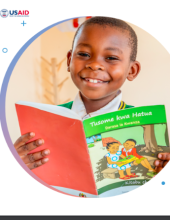
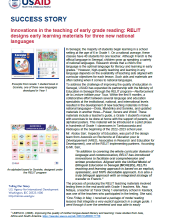
Senegal RELIT project Success Stories: 2022 (ENG)

Submitted by admin on
Description/Abstract
These Success Stories were prepared by the project team for the USAID Renforcement de la Lecture Initiale pour Tous program in Senegal in Calendar year 2022. SS001 : "Fifty resource persons from the MEN and the implementing partner put in place, together, the mechanisms for implementing RELIT." Describes the collaborative and locally-led co-launch of the program in 2022. SS002: "At Boly Diaw elementary school in Saint Louis, the RELIT program mobilizes a community of parents around reading and bilingual education." Describes a school that created a community-wide celebration for the launch of the RELIT program in 2022. SS003: "Innovations in the teaching of early grade reading: RELIT designs early learning materials for three new national languages" Describes the process and outputs of the first Grade 1 materials in 5 national languages that were developed in time for the new school year in Senegal. SS04: "A participatory approach to assessing the institutional capacity of Senegal’s education system" describes the approach to capacity assessment using the "Core Components" model of System Strengthening.
Assoc. Photo (Port.)
relit ss1 port.png
Country
Featured projects
Resource Language
Month and Year
Publisher Or Client
USAID

Kyrgyzstan: System Change in Primary Education: Liberating Learning through Revision of the National Standards Framework and Subject Standards in Kyrgyz Republic [CIES 2024 Presentation]

Submitted by admin on
Description/Abstract
The changes in the labor market, the re-organization of work worldwide, the increasing pressure to improve economic competitiveness in a context of global inter-connectedness, less job security and stagnant or dropping standards of living alongside accelerating climate change have led many countries to rethink education. A common starting point is to consider the relevance of curricular content against this backdrop of complexity, with particular attention to social-emotional skills, competencies and flexibility. Curriculum is fundamental to teaching and learning processes. Its various components have wide-ranging consequences on the quality of education. Over time, a range of successful educational systems have prioritized competence-based curricula, learner-centered pedagogy, and continuous assessment. Other countries, including Kyrgyz Republic, are looking to learn from these ‘global education policies’ in order to update their educational systems. With a competence-based educational framework already in place, Kyrgyz Republic used this as the starting point for reform. A competence-based curriculum was introduced in Kyrgyzstan in 2014 in the form of a State Standard Framework. However, primary grade standards were not revised afterwards to align with the framework. As part of its Okuu Keremet! project (2019-2024), USAID supported the Ministry of Education and Science (MOES) to develop a Road Map that would outline the process for arriving at robust standards. The process would then be used to actually revise primary grade subject standards. This presentation will cover: 1. The government-led collaboration that took place to develop subject standards, including data analysis, the broad-ranging discussions in the working group and the involvement of practitioners. 2. The process of using a Road Map to arrive at the standards that were ultimately approved by MOES 3. The lessons learned with respect to fostering institutional capacity, creating an institutional memory for future reference, and cultivating government ownership. 4. Next steps: how the standards will be put in practice and monitored; the need to develop textbooks aligned with standards; orienting teacher education and in-service teacher training in line with the standards. During 2021-2022, MOES and Okuu Keremet – together with various multi-stakeholder technical groups – revised four primary subject standards: Mathematics, Kyrgyz and Russian Language and Reading, and “Me and the World” (basic science). The process followed the Road Map plan through four stages: 1) analysis of existing educational standards in the country and international trends; 2) review of primary level learning outcomes; 3) alignment with the country’s competence-based educational framework, and 4) consultation with diverse education experts and a community of specialists. The subject standards define the expected learning outcomes and how they relate to competencies. Subsequently, a curriculum map was formulated which depicts how these competencies will shape and prepare students for the real world, such as the job market and life skills. The Kyrgyz Academy of Education – responsible for standards among other things – organized a series of working meetings among a range of stakeholders to arrive at the first four subject standards. It then followed the overall Road Map to develop standards for the remaining six primary school subjects. All of the standards produced were approved in October 2022 and slated for implementation in the 2023-2024 academic year. One of the challenges that arose during the process was related to the lack of experience among the KAE experts in the analysis of assessment data. Understanding the outcome of learning assessment is necessary to setting a level of standards that is ambitious yet feasible for where students currently are in terms of learning per grade. Assessment results also enable KAE staff to understand international and national trends in a context where the country explicitly aims to perform better with respect to international assessments such as PISA. The formulation of measurable and achievable learning outcomes per grade was also a challenge. One of the important decisions made by the working group was to define expected outcomes at the end of the primary cycle. as a starting point. There was attention given to ensuring consistency in the transition from preschool to primary school and from primary to secondary school. Subject standards are only the starting point for changing the content of education. It needs to be accompanied by a range of key components that support the competences, such as appropriate teaching materials, the education of new teachers and the training of existing teachers, and the importance of both formative and summative assessment to know if learning outcomes are going in the desired direction. Moreover, the learning outcomes need to be made clear to communities of parents in every-day language so that they can support the process at home. So far, this has not been done in Kyrgyz Republic. As outlined in the Road Map, once standards are developed, a plan of implementation is needed, followed by assessment and, if necessary, adjustments. This cycle is expected to take a five years before the next round of review according the MOES regulation. CONCLUSIONS The collaboration of the KAE together with Okuu Keremet! and a spectrum of actors and individuals over the past three years to liberate learning shows that: 1) learning outcomes are at the core of the competency-based curriculum and these outcomes need to be clear and achievable for teachers, students, and parents; 2) standards development, revision, implementation and assessment form a unified cycle in leveraging change in the primary education system hence all parts of the cycle must be aligned. Other parts of the education system will also need to be aligned over time with competences forming the core reference point. Continuing fragmentation and incoherence will not achieve the change that Kyrgyz Republic hopes for its students, even if one piece or another is well-designed on its own.
Assoc. Photo (Port.)
Resource (File)
Country
Resource Type
Featured projects
Month and Year

Education Sector Mechanism

Submitted by admin on
Author
Description/Abstract
Title: Philippine local governments using local solutions to tackle literacy and numeracy through the Education Sector Mechanism Presenter: Mayor Krisel Lagman of Tabaco City Launched under USAID funded Advancing Basic Education (ABC+) in the Philippines, the Education Sector Mechanism (ESM) brings stakeholders (private sector, government units, teachers, school leadership, parents and community) together at the local level to assess the education landscape using data and evidence. This process is led by local governments, but includes all stakeholders and aims to identify key issues and their underlying causes, agree on effective strategies to tackle these challenges, and translate the solutions into well-defined programs, projects, and activities. This process puts local leadership and ownership at the forefront of problem solving based on data, investment programming and results-based monitoring and evaluation. The local governments of Victorias City and Tabaco City in the Philippines lead the way in utilizing ESM, bringing private sector, local government units, and community together to look at education issues. This presentation will discuss the ESM process based on their experience and the results they are seeing, highlighting locally led and locally funded solutions and commitments.
Assoc. Photo (Port.)
ESM port.PNG
Resource (File)
Country
Resource Type
Resource Language
Month and Year
Publisher Or Client
USAID

Jordan - Arriving at a National Scale CPD Program [CIES 2024 Presentation]

Submitted by admin on
Description/Abstract
It was only over a decade ago that data on dismal learning outcomes in low- and middle-income countries (LMICs) shook the international education field out of its complacency with rising enrollment rates. The organizations and researchers that led this protest catalyzed a global shift toward prioritizing effective learning as the ultimate goal of education. However, acts of protest or disruption occur in a single point in time, whereas the transformations they advocate for are the labor of many years. Such is the case of the call to action to address the learning crisis. In the past decade, donor agencies like USAID have partnered with ministries of education in LMICs to design and implement programs at scale based on evidence of what works to improve foundational skills. A recent retrospective on the past ten years of USAID early grade reading programming (EnCompass LLC & MCI [2021]. Ten Years of USAID Early Grade Reading Programming: A Retrospective) estimates that USAID programs have improved reading outcomes for more than 7 million children and acknowledges tangible progress in the agency and its partners’ understanding of effective early reading instruction. The study also found that despite significant accomplishments, even the best-designed programs were hindered in their effectiveness by factors related to education systems’ low capacity to implement best practices at scale. Similarly, the Learning at Scale study, funded by the Bill & Melinda Gates Foundation, is examining some of the most effective large-scale early learning programs of the last ten years to understand the elements of their success. Learning at Scale researchers point out that improving learning at scale is hard because it usually requires working through the complex realities of government systems. Therefore, while the first chapter of the “learning crusade” yielded important lessons on what works to improve learning, there is still a lot to be learned about how to apply this knowledge to build effective government systems that ensure learning for all children. Case in point are government systems for continuous teacher professional development (TPD). It is well-known that better teaching is one of the fundamental interventions for improved learning outcomes. There is also a growing evidence base on the characteristics of effective TPD programs, as curated through initiatives like Learning at Scale and The Science of Teaching, also funded by the Gates Foundation. Among these characteristics are trainings that emphasize practice over theory and coaching programs based on structured coaching tools and frequent interaction with teachers. Another teacher support element that can be important to program success is school-based teacher communities-of-practice, which enable peer-to-peer feedback and opportunities to reflect on the ongoing application of instructional approaches. Both Learning at Scale and the retrospective study on USAID early reading programming observe a trend toward shorter but more frequent teacher training events that take place at the local level, in contrast to the massive national trainings of the past. The use of online content for teacher training is also on the rise, though preliminary findings from Learning at Scale suggest that an initial face-to-face training event continues to be essential. However, being able to identify the ingredients of effective teacher support does not automatically equate with an understanding of how to build a continuous TPD system that incorporates them. Neither does it mean that a TPD system built entirely on evidence-based best practices is guaranteed to succeed in improving learning outcomes. As more LMICs advance toward instituting standards and structured career ladders for the teaching profession, and toward developing mechanisms to increase the equity and efficiency of teacher training and support, it becomes increasingly important to identify effective models for implementing continuous TPD at scale. the panel will feature a USAID program in Jordan that exemplifies the desired result: a national-scale, comprehensive TPD model that is aligned with a broader policy on the teacher career path and is linked to a robust assessment data system that reinforces accountability for learning. It is the only program with solid evidence of positive changes in teaching practices that led to significant improvements in student outcomes.
Assoc. Photo (Port.)
jordan port.PNG
Resource (File)
RAMP 2024 CIES Jordan.pptx
Country
Resource Type
Featured projects
Month and Year

Jordan Early Grades Reading and Mathematics Initiative (RAMP) Sustainability Plan

Submitted by admin on
Author
Description/Abstract
The Reading and Mathematics Initiatives (RAMP), in close collaboration and coordination with the Ministry of Education (MOE), have developed a comprehensive sustainability plan. This plan was created through active engagement with MOE Directorates and extensive consultations with stakeholders, both within the initiative and the Ministry of Education. It outlines a detailed strategy for each of the four key areas: Curricula, Professional Development/Training, Support and Supervision, and Assessment. Additionally, it includes several overarching recommendations critical to achieving sustainability and enhancing educational outcomes. The plan contains two levels: Level 1 focuses on defining the specific elements of new concepts or activities introduced under RAMP; Level 2 focuses on ensuring that these concepts or activities are seamlessly integrated throughout the system, ensuring that each department understands its role and responsibility for implementation. Structure of the Sustainability Plan Level One: This level addresses the essential procedures and plans required to seamlessly integrate the methodologies and projects initiated by RAMP into the Ministry's educational framework. It focuses on both current and future methodologies and projects, ensuring their alignment with the phases of the educational process. Specific, measurable objectives have been established, and they are applied within predefined timelines to enhance and consolidate concepts, methods, tools, and information technology currently utilized by the Ministry of Education. For instance, the MOE has effectively sustained and improved the e-supervision system, a crucial tool for identifying underperforming schools and devising coaching plans to bolster their performance. This system has led to substantial enhancements in data collection, evidence-based decision-making, as well as monitoring and accountability systems. Level Two: At this level, procedures and plans are outlined to identify high-level recommendations aimed at fostering coherence, consistency, data flow, and accountability within the Ministry of Education. These recommendations are designed to enhance key procedures related to early-grade education in reading and mathematics, extending to ensure coordination among various MOE directorates and other stakeholders. It's important to note that the recommendations at this level are not limited to RAMP methodologies; they encompass all aspects of the Ministry's systems, procedures, and methodologies. For example, the MOE has established a committee comprising education experts from different MOE directorates. This committee collaboratively works to ensure coherence and consistency in early-grade education practices across diverse MOE directorates. Together, they have standardized the following elements mentioned in the sustainability plan related to early grades: 1. Student performance indicators have become essential components of the Education Strategic Plan (ESP). Simultaneously, the National Center for Curriculum Development (NCCD) has successfully incorporated RAMP's reading and mathematics instructional approaches into the newly developed curriculum framework and learning materials designed for early grades. 2. The Examination and Testing Directorate has played a vital role in institutionalizing the Early Grades National Assessment Framework, which includes the biannual Early Grade Reading Assessment (EGRA) and Early Grade Mathematics Assessment (EGMA), annual surveys based on the Lot Quality Assurance Sampling (LQAS) methodology, and the implementation of a class-level diagnostic assessment system with accompanying tools. Standard operating procedures were meticulously designed to ensure consistency and effectiveness in this process. 3. The Education and Training Center (ETC) has accredited the Continuing Professional Development (CPD) Program specifically tailored for Kindergarten (KG) and early grades teachers. The RAMP Sustainability Plan transcends mere documentation – it serves as a guiding compass steering the MOE towards sustained excellence in early-grade strategies and approaches within the broader education framework, system, and policies."
Assoc. Photo (Port.)
Sustainability workshop-MOE.jpg
Resource (File)
RAMP Sustainability Plan.pdf
Country
Sub-topic
Featured projects
Resource Language
Month and Year
Publisher Or Client
USAID and UKaid

Navigating Aid Alternatives: Government-to-Government funding partnerships in Jordan, Senegal, Nepal [CIES 2023 Panel Presentations]

Submitted by admin on
Description/Abstract
Since 2010, USAID has increased funding to partner country institutions by 50% [1], and the current administration’s localization agenda suggests that the government-to-government (G2G) modality may be increasingly frequent. Implementing partners operating in countries with a G2G arrangement, must pay careful attention to the meaning of technical assistance and system strengthening for scale and sustainability. This topic was covered by three presentations in a panel session, including: (1) Driving government ownership of a new language policy through a Government-to-Government partnership: The case of Senegal; (2) Government-to-Government programs to improve student learning: The case of Nepal; and (3) The case of Jordan
Assoc. Photo (Port.)
G2G portrait.JPG
Country
Resource Type
Month and Year

Read Liberia: Institutionalization of the DEMA-GALA

Submitted by admin on
Description/Abstract
It is essential that the Government of Liberia has the skills and resources to monitor and assess their schools, students, and teachers as part of an evidenced-based education system on the road to self-reliance. Read Liberia maintained a focus on assessment and data use—not only to improve classroom-based instruction and equip school leadership with the knowledge and tools they need to foster quality education, but also to build the capacity of county and district officers in USAID’s six priority counties.
Assoc. Photo (Port.)
DEMA_GALA.png
Resource (File)
Country
Resource Type
Featured projects
Resource Language
Month and Year

Strengthening institutional capacity to produce learning at scale: Case studies from Jordan, Malawi, Nepal, and Uganda

Submitted by admin on
Description/Abstract
Case studies of RTI's work on strengthening institutional capacity in Nepal, Jordan, Malawi, and Uganda focusing on three core functions: (1) setting and communicating expectations; (2) monitoring against expectations; (3) providing targeted support to struggling schools.
Assoc. Photo (Port.)
bidemi cap assessment_port.jpg
Resource Type
Month and Year