Briefs | 27 September 2023
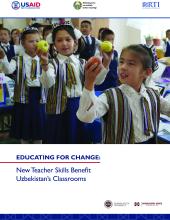
EDUCATING FOR CHANGE - New Teacher Skills Benefit Uzbekistan’s Classrooms
Educators are the critical link between learning materials and students. Their approach to instruction influences learning and classroom dynamics every day.
Briefs | 27 September 2023
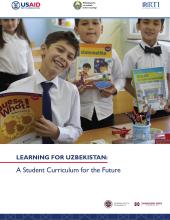
LEARNING FOR UZBEKISTAN - A Student Curriculum for the Future
A national curriculum and its learning materials are the backbone of an education system. At their best, they reflect student needs, a country’s aspirations for its youth, and a realistic path to gaining the knowledge that will bridge them.
Briefs | 27 September 2023
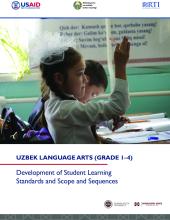
UZBEK LANGUAGE ARTS - Development of Student Learning Standards and Scope and Sequences
Central to the Ministry of Preschool and School Education (MoPSE) reform agenda is the shift to a modern standards-based education approach that aligns instruction and outcomes to specific competencies or standards.
Briefs | 27 September 2023
ENGLISH AS A FOREIGN LANGUAGE - DEVELOPMENT OF STANDARDS
Developing the standards for EFL education is a major step towards the Uzbekistan’s vision of an English-speaking nation by 2030. MoPSE experts and Program technical advisors developed a set of EFL standards as the basis of a standards-based curriculum.
Briefs | 27 September 2023
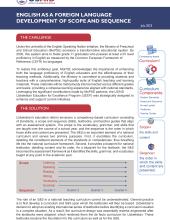
ENGLISH AS A FOREIGN LANGUAGE - DEVELOPMENT OF SCOPE AND SEQUENCE
Uzbekistan’s education reform envisions a competency-based curriculum consisting of standards, a scope and sequence (S&S), textbooks, and teacher guides that align with an assessment system.
In the News and Impact Stories | 24 September 2023
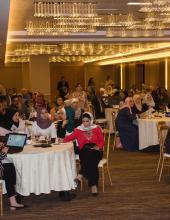
Jordan Early Grades Reading and Mathematics Initiative (RAMP) Sustainability Plan
The Reading and Mathematics Initiatives (RAMP), in close collaboration and coordination with the Ministry of Education (MOE), have developed a comprehensive sustainability plan.
In the News and Impact Stories | 24 September 2023
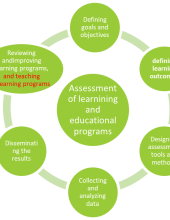
Jordan Early Grade Assessment Framework The Early Grade Reading and Math Initiative (RAMP)
In 2021, Jordan’s Ministry of Education (MOE) is committed to modernizing education assessment and enhancing learning outcomes.
Sample Teacher and Pupil Materials | 31 July 2023
Nigeria Hausa Teacher Guide, Grade 2
This early grade reading material is made possible through the United States Agency for International Development (USAID) under the Nigeria Reading and Access Research Activity (EdData Task Order Number 26, EHC-E-00-04-00004-00) implemented by RTI International.
Reports | 1 June 2023
Education Reform Support Today
Traditional projects in education introduce innovations at the school level, sometimes improving learning in a defined number of schools. The hope is that somehow piloted successes can be replicated or taken to scale. But too often they are not.

Presentations | 8 March 2023
Education system strengthening across Asia: a systematic review of USAID activities and critical discussion [CIES 2023 Panel Presentation]
The purpose of this formal group panel presentation is to hold an in-depth discussion on USAID’s investments into system strengthening across Asia over the past decade and how these efforts are situated within the broader global move to focus more intentionally and coherently on education system str