Presentations | 2 March 2023
Navigating Aid Alternatives: Government-to-Government funding partnerships in Jordan, Senegal, Nepal [CIES 2023 Panel Presentations]
Since 2010, USAID has increased funding to partner country institutions by 50% [1], and the current administration’s localization agenda suggests that the government-to-government (G2G) modality may be increasingly frequent.
Toolkits and Manuals | 1 March 2023
Mathematics Teacher Guide
A teacher's guide for mathematics instruction in the context of Jordan, developed by the Jordanian Ministry of Education.
Briefs | 12 September 2022
Read Liberia: Institutionalization of the DEMA-GALA
It is essential that the Government of Liberia has the skills and resources to monitor and assess their schools, students, and teachers as part of an evidenced-based education system on the road to self-reliance.
Reports | 22 June 2022
Strengthening institutional capacity to produce learning at scale: Case studies from Jordan, Malawi, Nepal, and Uganda
Case studies of RTI's work on strengthening institutional capacity in Nepal, Jordan, Malawi, and Uganda focusing on three core functions: (1) setting and communicating expectations; (2) monitoring against expectations; (3) providing targeted support to struggling schools.
Presentations | 4 May 2022
Digital transformation: An opportunity for long-lasting improvement of quality of education service delivery in Kyrgyz Republic, Tajikistan, and Uzbekistan [CIES Presentation]
Digital transformation: an opportunity for long-lasting improvement of quality of education service delivery in Kyrgyz Republic, Tajikistan, and Uzbekistan
Over the past decade, Uzbekistan, Tajikistan, and Kyrgyz Republic have been consistently demonstrating their commitment to quality education, ev
Kyrgyz Republic Teacher Professioal Development Digital Transformation CIES 2022_0.pptx (PPTX, 8.01 MB)
,
Tajkistian Teacher Professioal Development Digital Transformation CIES 2022_0.pptx (PPTX, 6.55 MB)
,
Uzbekistan Teacher Professional Development Digital Transformation CIES 2022.pptx (PPTX, 5.18 MB)
Briefs | 25 November 2021
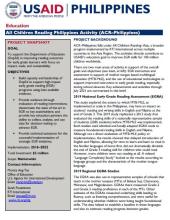
All Children Reading - Philippines: Project Background Brief
ACR–Philippines falls under All Children Reading–Asia, a broader program implemented by RTI International across multiple countries in the Asia Region. The activities directly contribute to USAID’s education goal to improve early grade reading (EGR) skills for 100 million children worldwide.
Briefs | 23 November 2021
Remote Learning in the Philippines During COVID [Briefs Series]
The Remote Learning Study was conducted during the 2020–2021 school year to investigate how mother-tongue-based multilingual education reading instruction proceeded in 20 schools around the country while classrooms were closed.
1. Strategies for Assisting HLPs_FINAL.pdf (PDF, 406.1 KB)
,
2. Teaching and Learning Materials_FINAL_0.pdf (PDF, 325.87 KB)
,
3. Use of Technology_FINAL_0.pdf (PDF, 214.77 KB)
,
4. Student Engagement_FINAL_0.pdf (PDF, 654.74 KB)
,
5. Challenges and Solutions to Learning Remotely_FINAL_0.pdf (PDF, 205.72 KB)
,
6. School Leadership_FINAL_0.pdf (PDF, 275.46 KB)
,
7. Literacy Instructional Practice_FINAL_0.pdf (PDF, 1.37 MB)
Multimedia | 22 November 2021
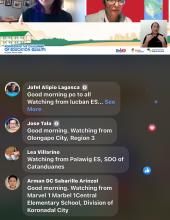
Reopening Classrooms Interview Series
This playlist was part of a knowledge sharing activity organized by the All Children Reading (ACR) Philippines project regarding countries' experiences re-opening schools on the occasion of the 4th education forum of the Department of Education.
Toolkits and Manuals | 7 March 2021
Monitoring, Evaluation, Research, Learning and Adapting Online course
RTI’s Monitoring, Evaluation, Research, Learning, and Adapting (MERLA) Community of Practice is proud to launch a free course geared towards the international development community.
Toolkits and Manuals | 18 December 2020
Uganda LARA: Psychosocial Support training facilitators' guide
In March 2020, the government of Uganda closed all schools and other educational institutions to mitigate the wide spread of COVID-19. This exposed significant risk especially to rural areas where there is limited access to reading materials or virtual learning platforms to continue learning.