Budget Analysis, Budgeting, and Finance

Mobile Learning and Numeracy: Filling gaps and expanding opportunities for early grade learning [Arabic]

Submitted by admin on
Description/Abstract
The present study on Mobile Learning and Numeracy examines how mobile learning (m-learning) could influence and improve numeracy education at early grade levels (ages 4-10) especially in low-income countries. Key questions to guide the research include: 1) What are the benefits and challenges of integrating mobile learning into early grade numeracy education? 2) What is the role of a teacher with regard to mobile learning and numeracy education? 3) How can the community and the parents actively contribute to/participate in the child’s numeracy education with the use of mobile devices? and 4) How can mobile technology be used effectively in measuring/assessing numeracy gains? The conclusions and recommendations of this study have been informed by an international working group that met over two days during the first International Numeracy Conference in Berlin in December 2012. We would like to acknowledge the following participants of this working group for their thoughtful contributions: Michaela Brinkhaus (BMZ); Dorothea Coppard (GIZ); Melanie Stilz (Konnektiv Büro für Bildung und Entwicklung); Jens von Roda-Pulkowski (KfW); Abigail Bucuvalas (Sesame Workshop); Mr. Kann Puthy (Primary Education Department, MoEYS Cambodia); Edward Barnett (DFID).
Assoc. Photo (Port.)
Screen Shot 2020-06-24 at 5.41.40 PM.png
Country
Resource Type
Resource Language
Month and Year
Publisher Or Client
GTZ
Mathematics from the Beginning: Evaluating the Tayari Preprimary Program’s Impact on Early Mathematics Skills

Submitted by admin on
Description/Abstract
Given the dearth of research on early numeracy interventions in low- and middle-income countries, this paper presents the instructional methodology and impact results of the Tayari program. Tayari is a preprimary intervention in Kenya (2014–2019) that prepares children aged four and five for entry into primary school by providing materials for students, training for teachers, and continuous in-classroom support. The Tayari methodology was built on the Kenyan government’s preprimary syllabus to produce instruction that was developmentally sequenced, linked to out-of-school experiences, and supportive of children’s number sense. Tayari was evaluated using a randomized controlled trial (RCT) and collection of longitudinal data from 2,957 children in treatment and control schools at three time points. Pupil assessment items were drawn from a growing body of research on preprimary numeracy in developing contexts, plus instruments and techniques from the Measuring Early Learning and Quality Outcomes (MELQO) program (UNESCO, UNICEF, Brookings Institution, & World Bank Group, 2017). The impact evaluation of the longitudinal RCT results showed statistically significant effects in the numeracy tasks of producing sets, identifying numbers, and naming shapes, while revealing no initial effects in the areas of oral and mental addition. We present recommendations for Tayari’s improvement in terms of mathematics instruction, as well as preprimary policy implications for Kenya and similar contexts.
Assoc. Photo (Port.)
Screen Shot 2019-01-04 at 11.31.14 AM.png
Country
Resource Type
Resource Language
Month and Year
Publisher Or Client
Global Education Review

Strengthening the Textbook Production Chain in Morocco: Study Conclusions and Recommendations Appendix C: A Cost-Effective Textbook Strategy

Submitted by admin on
Description/Abstract
This is Part 4 of a four-part comprehensive evaluation of the public textbook procurement system in Morocco. This final section of the Strengthening the Textbook Production Chain in Morocco series addresses the issue of how to ensure a long-term, sustainable system of textbook financing for all students in government schools. It also explores options available to the Ministry of Education of Morocco, based on examples from countries that have responded to the same challenges.
Assoc. Photo (Port.)
4_English_Textbooks Morocco_Financing.jpg
Resource (File)
Country
Resource Type
Resource Language
Month and Year
Publisher Or Client
USAID/Morocco

Strengthening the Textbook Production Chain in Morocco: Study Conclusions and Recommendations

Submitted by admin on
Description/Abstract
This is Part 1 of a four-part comprehensive evaluation of the public textbook procurement system in Morocco. It offers recommendations on how to improve textbook quality, how to strengthen the procurement system --including budgeting and financing--, and developing a policy for digital textbooks.
Assoc. Photo (Port.)
1_English_Textbooks Morocco_Main.jpg
Resource (File)
Country
Resource Type
Resource Language
Month and Year
Publisher Or Client
USAID/Morocco

Stumbling at the First Step: Efficiency implications of poor performance in the foundational first five years

Submitted by admin on
Description/Abstract
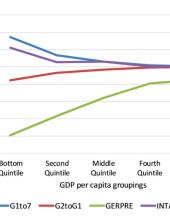
This paper highlights patterns in school enrollment indicators that affect the efficiency and effectiveness of education systems in a set of low-income countries: those that have expanded access quickly in the last decade or two, but have not yet absorbed that expansion efficiently. Although the patterns in these indicators are observable in the first few years of schooling, they could constitute a cause of low learning outcomes at the end of primary school. The data show strong empirical relationships between an early primary enrollment bulge, low levels of pre-primary participation, and poor performance on early grade cognitive skills. This work does not attribute causal precedence to these patterns but instead argues that the indicators are reflections of each other, constituting a ‘‘knot’’ of issues undermining the foundations of the affected education systems. The article presents some of the cost implications and suggests that many countries are already paying for pre-primary education without realizing it.
Assoc. Photo (Port.)
stumbling graph.jpg
Country
Resource Type
Resource Language
Month and Year
Publisher Or Client
Prospects

Implementing ECDE in response to policy change and research evidence in Kenya- CIES 2018 Presentation

Submitted by admin on
Author
Description/Abstract
CIES 2018 Presentation, given by Sam Ngaruiya. The Ministry of Education (MoE) with technical support from RTI International are collaborating with four county governments to pilot the Tayari ECDE programme. The objective of Tayari is to develop a cost- effective, scalable, low-cost and quality ECDE model. To maximize the impact of Tayari, the MoE intends to scale-up Tayari. However, the ability to take-up and sustain Tayari rests on the counties’ capacity to ensure a viable ECDE system and meet the critical cost of the model. The ability of the counties to take on a Tayari-type programme requires ample institutional, systemic, organizational and fiscal capacity of the counties to take-up and sustain the model. MoE statistics show that, whereas, access has improved, the quality is affected by non-provision of curriculum-aligned instructional materials in the counties and unclear policy in hiring and continuous professional development of the ECDE officers and teachers. Equally, there are policies at the national level that can be used as guidelines for implementation and management of ECD, but there are still some gaps in policy guidelines for implementation; a study mapping the four Tayari counties and three additional counties found increased investment in ECD infrastructure by the governments This presentation explores how the umbrella policy from the MOE as well as evidence from the Tayari pilot programme’s longitudinal study has informed practice within the four Tayari counties, enabling them to be more responsive to the dynamic policy environment. It also showcases initiatives put in place by the counties to sustain the Tayari implementation in pilot counties.
Assoc. Photo (Port.)
Pages from Ngaruiya, Sam_CIES2018_Impact and Policy Environment of Tayari.jpg
Country
Resource Type
Month and Year

Using the EGRA Calculator for Study Design and Budget Estimates

Submitted by admin on
Author
Description/Abstract
This presentation was prepared and presented at the USAID workshop/webinar “Release of the EGRA Toolkit, Second Edition: Updated Guidance and Tools for Conducting Early Grade Reading Assessments,” Bethesda, Maryland, April 27, 2016. It discusses the design and intended use of the EGRA Calculator.
Assoc. Photo (Port.)
Country
Resource Type
Month and Year
Publisher Or Client
USAID

User Guide for the EGRA Calculator

Submitted by admin on
Description/Abstract
This user guide accompanies the Excel-based EGRA Calculator to offer tips and suggestions for each step in the calculator to help the user enter appropriate and accurate information.
Assoc. Photo (Port.)
Resource (File)
Country
Resource Type
Month and Year
Publisher Or Client
USAID

EGRA Calculator

Submitted by admin on
Author
Description/Abstract
The EGRA Calculator is an Excel-based estimation tool that can produce an approximate budget reflecting the costs commonly associated with implementing an EGRA. The tool itself contains step-by-step instructions plus descriptions to guide the user to insert or adjust the parameters. Tips and suggestions for each step are also provided in an accompanying User Guide.
Assoc. Photo (Port.)
Resource (File)
Country
Resource Type
Month and Year
Publisher Or Client
USAID

Nigeria Education Data (NEDS) 2010 - State Report: Abia

Submitted by admin on
Description/Abstract
The 2010 Nigeria Education Data Survey (NEDS) was a nationally representative sample survey implemented primarily by the National Population Commission (NPC) in collaboration with the Federal Ministry Of Education (FMOE) and the Universal Basic Education Commission (UBEC). The 2010 NEDS has the following specific objectives: * Provide data on the schooling status of Nigerian children of basic education age, including factors influencing whether children ever enroll in school and why students drop out of school * Quantify household expenditures on children’s schooling by examining different patterns of expenditure by various background characteristics * Measure parents’ attitudes to schooling, including the quality of schooling and provide an understanding of attitudes that shape their willingness to send their children to school * Measure the frequency of student absenteeism and reasons for missing school in order to suggest possible approaches to maximizing attendance * Provide data that allows for trend analysis and State comparisons A very high overall response rate of 98% was achieved with interviews completed in 26,934 households.
Assoc. Photo (Port.)
Resource (File)
Abia_PDF_rev13.pdf
Country
Resource Type
Month and Year
Publisher Or Client
Federal Ministry of Education Annex