Nigeria

Country Code
NGA

Can the Middle Tier Drive Foundational Learning at Scale?

Submitted by admin on
Author
Description/Abstract
An integral part of a decentralized education system hierarchy is the “middle tier” comprising subnational actors in charge of education delivery at the regional, provincial, state, district, municipality, city, or circuit and cluster levels. The general roles and responsibilities of the middle tier are described in research on district leadership in OECD countries. Their responsibilities range from planning, monitoring, and implementing reforms at the subnational and school levels, to ensuring school-based accountability through data and evidence, to innovating, supporting, and monitoring improvements in teaching and learning in schools through instructional leadership and fostering professional learning communities at the district and school levels. While rigorous academic evidence may be lacking on the ability of middle managers to bring about improvements in foundational literacy and learning outcomes at scale in LMICs, we have theoretical and programmatic evidence on (1) their role in instructional leadership, (2) the importance of building their capacity to drive teaching and learning, and (3) the importance of trust and support within the education system that fosters learning at scale. Thumbnail Credit: Pakistan Reading Program/IRC
Assoc. Photo (Port.)
Picture4_0.jpg
Resource (File)
Resource Type
Resource Language
Month and Year
Publisher Or Client
Center for Global Development / Bill and Melinda Gates Foundation

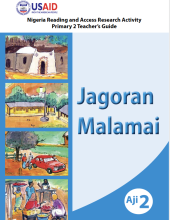
Nigeria Hausa Teacher Guide, Grade 2

Submitted by admin on
Description/Abstract
This early grade reading material is made possible through the United States Agency for International Development (USAID) under the Nigeria Reading and Access Research Activity (EdData Task Order Number 26, EHC-E-00-04-00004-00) implemented by RTI International. It was tested in a controlled experiment that demonstrated effectiveness of the approach on improving reading skills.There is a corresponding pupil book and a collection of read alouds with related activities.
Assoc. Photo (Port.)
Screenshot 2023-07-31 at 14.53.44.png
Resource (File)
Country
Resource Language
Month and Year
Publisher Or Client
USAID

What have we learned about improving learning at the system level? [CIES 2023 Presentation]

Submitted by admin on
Author
Description/Abstract
This presentation, given at the CIES 2023 Annual Conference, highlights the global shift in measurement and improvement in learning outcomes since the adoption of SDG 4.1.1, under which countries are asked to report on the “the proportion of children and young people…achieving at least a minimum proficiency level in reading and mathematics”. Building on these results, the World Bank and UIS estimate that eighty percent of children in poor countries cannot read a simple sentence by the end of primary school. In reviewing the results of multiple regional and systems-level learning improvement programs to better understand the distribution of learning outcomes and system-level impact we find that: 1) while some progress has been made, the massive changes required to move the needle on the share of children reaching minimum proficiency remains elusive and 2) a small share of schools account for the majority of the gains. Finally, the panelist will create a link between this challenge and the theme of the panel; that education change will only be successful if work is undertaken to better understand and diminish the restraining forces of mindsets and education system social norms.
Assoc. Photo (Port.)
Screenshot 2023-02-28 165526.png
Resource (File)
Gove CIES 2023.pptx
Resource Type
Month and Year
Publisher Or Client
RTI

System Supports for Effective Large-Scale Reading Interventions (Learning at Scale)

Submitted by admin on
Description/Abstract
Learning outcomes are low and instruction is poor in many low- and middle-income countries (LMICs). These shortcomings are particularly concerning given the substantial learning loss due to COVID-19 from which many systems are suffering. The Learning at Scale study identified eight of the most effective large-scale education programs in LMICs and now is examining what factors contribute to successful improvements in learning outcomes at scale (see list of programs on last page of this brief). These programs were selected based on their demonstrated gains in reading outcomes at-scale, from either midline or endline impact evaluations. The study addresses three overarching research questions, focused on understanding (1) the components of instructional practices (Brief 1), (2) instructional supports (Brief 2), and (3) system supports (Brief 3) that lead to effective instruction. This brief focuses specifically on system supports. It addresses the following research question: What system supports are required to deliver effective training and support to teachers and to promote effective classroom practices?
Assoc. Photo (Port.)
Brief3.png
Resource (File)
BRIEF-3- System Support.pdf
Resource Type
Resource Language
Month and Year
Publisher Or Client
Center for Global Development, Bill and Melinda Gates Foundation

Instructional Support for Effective Large-Scale Reading Interventions (Learning at Scale)

Submitted by admin on
Description/Abstract
Learning outcomes are low and instruction is poor in many low- and middle-income countries (LMICs). These shortcomings are particularly concerning given the substantial learning loss due to COVID-19 from which many systems are suffering. The Learning at Scale study identified eight of the most effective large-scale education programs in LMICs and now is examining what factors contribute to successful improvements in learning outcomes at scale (see list of programs on last page of this brief). These programs were selected based on their demonstrated gains in reading outcomes at-scale, from either midline or endline impact evaluations. The study addresses three overarching research questions, focused on understanding (1) the components of instructional practices (Brief 1), (2) instructional supports (Brief 2), and (3) system supports (Brief 3) that lead to effective instruction. This brief focuses specifically on instructional supports. It addresses the following research question: What methods of training and support lead to teachers adopting effective classroom practices in successful, large-scale literacy programs?
Assoc. Photo (Port.)
Brief2.png
Resource (File)
Resource Type
Resource Language
Month and Year
Publisher Or Client
Center for Global Development, Bill and Melinda Gates Foundation

Instructional Practices for Effective Large-Scale Reading Interventions (Learning at Scale)

Submitted by admin on
Description/Abstract
The Learning at Scale study aimed to investigate factors contributing to successful improvements in learning outcomes at scale in eight of the most effective large-scale education programs in LMICs (see the map of programs on the last page of this brief). These programs were selected based on their demonstrated gains in reading outcomes at-scale, from either midline or endline impact evaluations. The study addressed three overarching research questions, focused on understanding the components of instructional practices (Brief 1), instructional supports (Brief 2), and system supports (Brief 3) that lead to effective instruction. This brief focuses specifically on instructional practices. It addresses the following research question: What classroom ingredients (e.g., teaching practices, classroom environment) lead to learning in programs that are effective at scale?
Assoc. Photo (Port.)
Brief1.png
Resource (File)
Resource Type
Resource Language
Month and Year
Publisher Or Client
Center for Global Development, Bill and Melinda Gates Foundation

Learning at Scale Interim Report

Submitted by admin on
Description/Abstract
The Learning at Scale study was designed to identify existing early grade reading programs with demonstrated impact on basic skills at scale and to conduct in-depth investigations of these programs to determine what makes them successful. After an extensive search, eight programs (spanning seven countries) were selected for inclusion in the study. Research on these programs has been conducted in order to answer the three overarching research questions, focused on understanding the components of instructional practices, instructional supports, and system supports that lead to effective instruction. Learning at Scale data collection activities for some of these programs were delayed due to COVID-19. However, with demand for information about how to implement effective interventions at large scale at an all-time high, we believe that the timely sharing of findings from Learning at Scale is essential. Accordingly, this interim report provides preliminary findings from our study to date, highlighting key high-level findings across all eight programs, as well as quantitative and qualitative findings from primary research for select programs. The Learning at Scale study is led by RTI International, as part of the Center for Global Development (CGD) education research consortium, funded by the Bill and Melinda Gates Foundation.
Assoc. Photo (Port.)
Screen Shot 2021-11-15 at 11.34.28 AM.png
Resource Type
Resource Language
Month and Year

Effectiveness of Coaching as a Teacher Professional Development Strategy in Low-Income Countries [Conference Panel Recording]

Submitted by admin on
Author
Description/Abstract
Recording of #vCIES 2020 conference panel presentation entitled: Effectiveness of Coaching as a Teacher Professional Development Strategy in low-income countries

Assoc. Photo (Port.)
Slide1.JPG
Resource Type
Month and Year

Early Grade Reading Barometer

Submitted by admin on
Description/Abstract
The Early Grade Reading Barometer is an interactive dashboard that lets you: - SEE an overview of how well students are reading, the percentage of struggling readers, and how comprehension is associated with reading fluency. - VIEW information about student performance on EGRA subtasks. See how outcomes vary by key student and school characteristics. - EXPLORE how different EGRA subtasks are related to one another. View graphic displays of these relationships. - CHOOSE a target oral reading fluency benchmark, and see information on how many students are meeting the targeted benchmark now and how the percentage of students meeting the benchmark value could change over time. - SEE how countries compare with each other with respect to student outcomes on EGRA assessments and progress towards meeting UN SDG Goal 4. - REVIEW the impact of interventions aimed at improving the fundamental reading skills of students. - COMPARE how the distributions for selected EGRA subtasks have changed or remained the same over time.
Assoc. Photo (Port.)
Generic_icon_shared.rti_.org_.png
Resource Type
Resource Language
Month and Year
Publisher Or Client
USAID

Cultivating Dynamic Educators [CIES 2019 Presentation]

Submitted by admin on
Description/Abstract
This presentation introduces the panel of authors who presented at CIES 2019 about their chapter of the book.
Assoc. Photo (Port.)
Sarah CIES 2019 Panel Presentation.jpg
Resource (File)
Resource Type
Resource Language
Month and Year
Publisher Or Client
RTI International