Crouch, L.

Purpose-driven education system transformations: History Lessons from Korea and Japan [CIES 2023 Presentation]

Submitted by admin on
Author
Description/Abstract
The method used is a historical analysis of the route through which education in Japan and South Korea was framed, and then implemented, in the period starting in 1870 (approximately) in the former and 1945 (approximately but especially after the Korean war) or so in the latter. We analyze both policy intention as in various laws, decrees, and policies, as well as implementation. Debates around equality, the interpretation of Western ideas as filtered by each country’s history, are covered. Original policy documents are analyzed as well as literature on the educational history of both countries, including educational and pedagogical issues. Long-term historical statistics and cliometrics are also employed mostly to compare context and results, rather than methods. South Korea and Japan are chosen because they are, today, high performers both in terms of average achievement and, even more importantly, equality, who went about their reforms with clear intentionality and purpose, and where there were distinct historical pivots that can be pinned to a specific decade or even a single pivotal year. Other high-achieving countries in the West more or less evolved into their systems. Even countries that are often cited as examples for the lower-income countries to emulate, such as Finland, did not set about fundamental reforms with the clear purpose and intentionality that South Korea and Japan did. Side references are made to other cases where intentionality was key, and where there was a clear purpose and bureaucratic organizational effort, such as Prussia. Similar insights are raised through an analysis of speeches and writings of pan-African independence leaders in the 1960s regarding the centrality of education to the nation-building project. Emerging themes that could be of interest to lower-income countries today include: a) the focus on education as fundamental to national purpose, not just as an abstract commitment to numerical goals such as the MDGs and SDGs (without denying the utility of such goals), b) an intense focus on education as a way of redressing class (as in “education should not just be for the samurai class”) and colonization issues (as in “education is key to help us resist undue economic and military power from the West”) from the past, and hence a focus on equality, c) an intense questioning of what could be learned from the West rather than just acceptance and simple borrowing, and d) a relentless focus on bureaucratic efficiency, planning, and investment discipline in terms of not expanding higher levels until lower levels are universalized (for the sake of equality and quality). The focus is largely narrative and qualitative, but historical statistics are used to document the results obtained, such as the very high degree of equality and also efficiency achieved (in fact, signaling how efficiency and equality may have been helpful to each other), whereby even low-income segments of the population benefit from quality education. The contexts, not just the results, are analyzed both qualitatively and quantitatively.
Assoc. Photo (Port.)
Screenshot 2023-03-07 172553.png
Resource Type
Month and Year

Doing Reform Differently: Combining Rigor and Practicality in Implementation and Evaluation of System Reforms

Submitted by admin on
Description/Abstract
This paper brings together two promising intellectual trends in development: Doing Development Differently (DDD), and whole-system reform. In addition, it provides a framework for evaluating system reforms, as rigorously as possible. This paper adapts some concepts from the paper “A Practical Approach to In-Country Systems Research” written for the Research on Improving Systems of Education (RISE) Programme. This version turns more toward the Doing Development Differently movement rather than education systems reform. The original paper was presented at the first RISE conference in Washington, DC, June 18–19, 2015.
Assoc. Photo (Port.)
ddd.JPG
Resource (File)
Country
Resource Type
Resource Language
Month and Year
Publisher Or Client
RTI International

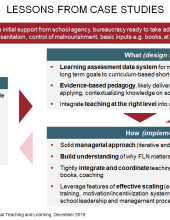
Systems Implications for Core Instructional Support Lessons from Sobral (Brazil), Puebla (Mexico), and Kenya

Submitted by admin on
Author
Description/Abstract
In December 2019, the Bill and Melinda Gates Foundation convened a workshop examining four education systems that have worked to build coherence across their systems, as viewed by “insiders” who played a significant role in carefully studying, designing, or maintaining the systems. This information note summarizes the knowledge shared at the workshop and was produced at the request of key stakeholders at the meeting. It is intended for the benefit of the participants and those who may be designing systems interventions or research, especially around the issue of the "instructional core" and the coherence among the various elements of the instructional core. The note is presented as an informal contribution.
Assoc. Photo (Port.)
lcrouch photo.png
Resource (File)
Country
Resource Type
Month and Year

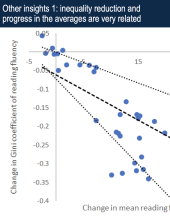
Measurement of Inequality in Learning Levels [Conference Presentation]

Submitted by admin on
Description/Abstract
The presentation summarizes a paper by Tim Slade and Luis Crouch on the measurement of learning inequality before and after a successful reading project. The paper concludes that at least for the case studied, the project improved not only the averages but also reduced the inequality. The paper was prepared under the auspices of a conference on "Learning at the Bottom of the Pyramid" organized by IIEP and Dan Wagner of U Penn. This is the presentation that was delivered at vCIES 2020.
Assoc. Photo (Port.)
Screen Shot 2020-05-06 at 10.03.24 PM.png
Resource (File)
Country
Resource Type
Resource Language
Month and Year
Publisher Or Client
NA

Benefits (and Costs) of improved data for tracking SDG4 [CIES 2019 Presentation]

Submitted by admin on
Author
Description/Abstract
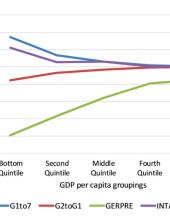
There is an abundance of research about the costs of measuring the SDGs. Institutions with the mandate to measure the SDGs are busy estimating costs and making plans to improve both reporting and capacity within countries. However, some observers and commentators are skeptical about the benefits of measurement. This CIES 2019 presentation takes a “value of information” approach to calculating the benefits of having and using information by asking: what is the social (monetary) benefit of running an education system with full information versus running the same education system with only limited information?
Assoc. Photo (Port.)
Screen Shot 2019-05-02 at 5.09.25 PM.png
Country
Resource Type
Month and Year

Stumbling at the First Step: Efficiency implications of poor performance in the foundational first five years

Submitted by admin on
Description/Abstract
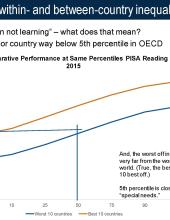
This paper highlights patterns in school enrollment indicators that affect the efficiency and effectiveness of education systems in a set of low-income countries: those that have expanded access quickly in the last decade or two, but have not yet absorbed that expansion efficiently. Although the patterns in these indicators are observable in the first few years of schooling, they could constitute a cause of low learning outcomes at the end of primary school. The data show strong empirical relationships between an early primary enrollment bulge, low levels of pre-primary participation, and poor performance on early grade cognitive skills. This work does not attribute causal precedence to these patterns but instead argues that the indicators are reflections of each other, constituting a ‘‘knot’’ of issues undermining the foundations of the affected education systems. The article presents some of the cost implications and suggests that many countries are already paying for pre-primary education without realizing it.
Assoc. Photo (Port.)
stumbling graph.jpg
Country
Resource Type
Resource Language
Month and Year
Publisher Or Client
Prospects

Can learning be measured universally? CIES 2018 presentation

Submitted by admin on
Author
Description/Abstract
CIES 2018 Presentation, given by Luis Crouch. Given the prominence of learning and quality in the SDGs, much discussion has gone into how to measure in a manner that is reasonably comparable. Some have argued (or feared) that this would necessitate a single, dominant, global assessment. Aside from the political or ethical acceptability of this kind of imposition, one has to wonder how meaningful this could be, psychometrically or pedagogically. The paper will argue that unless one were to increase the cost of assessment tremendously, or make children sit through lengthy assessments or until highly adaptive computerized assessments can be used, a single or a few dominant assessments are an unlikely approach. Instead, a variety of assessments is a more likely solution. These might have better psychometric “resolution” for poorer countries with greater cognitive inequality than the OECD countries, might be closer to the children’s actual levels, and might be psychometrically more reliable if done properly. The ability to make the results comparable or equitable in some sense need not be lost, however, if some sort of universal learning scale is created, so that countries can peg themselves, with reasonable rigorous, to that scale. A global neutral arbiter can “sponsor” the scale and compile country-based reports using it.
Assoc. Photo (Port.)
Pages from Crouch, Luis_CIES2018_Can Learning Be Measured Universally.jpg
Country
Resource Type
Resource Language
Month and Year

Uganda Early Years Study: Final Report

Submitted by admin on
Description/Abstract
The British Department for International Development (DFID) has partnered with the Ugandan Ministry of Education and Sports (MoES) to conduct empirical research on inefficiencies in the Ugandan education system. This research will help the Ministry better understand the severity, causes, and consequences of an enrolment bulge in early primary classes in Uganda. Specifically, this study is investigating the magnitude of repetition in primary 1. It encompasses a nationally representative sample of pupils, and uses information from interviews with pupils, parents/guardians, and teachers.
Assoc. Photo (Port.)
uganda school.jpg
Resource (File)
Country
Resource Type
Resource Language
Month and Year

Universal Assessment and the Bottom of the Pyramid

Submitted by admin on
Author
Description/Abstract
While the SDGs now officially call for global reporting on learning outcomes, many institutions and scholars had noticed, at least since the mid-2000s, that many children were not learning much, and were starting to respond by, as a first step, advocating and developing assessments that, they felt, was perhaps more appropriate to learning at the bottom of the pyramid, or at the left end of the cognitive distribution. The GMR sounded a clarion with their estimate that there are some 250 million children in the world hardly learning. This paper addresses an issue that can be put simply but is extremely hard to answer: “Is the array of assessments emerging helping researchers, policy-makers, and implementers get a more accurate sense of how much or how little the poorest children in the world know, and is it helpful in remediating the situation?” The paper specifically is not addressed at the question of global reporting—although it does touch upon the issue. The problem of interest here is what is most useful for countries to generate movement along the bottom of the pyramid.

Assoc. Photo (Port.)
Crouch Universal Assessment Feasibility.jpg
Resource (File)
Country
Resource Type
Resource Language
Month and Year

Worldwide Inequality and Poverty in Cognitive Results: Cross-sectional Evidence and Time-based Trends

Submitted by admin on
Description/Abstract
The Sustainable Development Goals (SDGs) for education represent a major departure from the Millennium Development Goals (MDGs) - at least if educational leaders act seriously in their pursuit - in at least two important respects. First, the goals now pertain to learning outcomes. Second, there is a great deal of focus on inequality in the SDGs. Taking note of this new dual emphasis of the SDGs, this paper assembles the largest database of learning outcomes inequality data that we know of, and explores key issues related to the measurement of inequality in learning outcomes, with a view to helping countries and international agencies come to grips with the key dimensions and features of this inequality. Two issues in particular are explored. First, whether, as countries improve their average cognitive performance (as measured by international learning assessments) from the lowest to middling levels, they typically reduce cognitive skill inequality or, more importantly perhaps, whether they reduce absolute lack of skills. Second, whether most of cognitive skills inequality is between or within countries. In dealing with these measurement issues, the paper also explores the degree to which measures of cognitive skills are “proper” cardinal variables lending themselves to generalizations from the field of income and wealth distribution—the field for which many measures of inequality and its decomposition were first applied. To do this, we look into whether using the item response theory (IRT) test scores of programmes such as TIMSS influence these types of findings, relative to the use of the underlying and more intuitive classical test scores. Patterns emerging from the classical scores are far less conclusive than those of the IRT scores, in part due to the greater ability of the IRT scores to discriminate between pupils at the bottom end of the performance spectrum. An important contribution of the paper is to examine the sensitivity of standard measures of inequality to different sets of test scores. The sensitivity is high, and the conclusion is that meaningful comparisons between test score inequality and, for instance, income inequality are not possible, at least not using the currently available toolbox of inequality statistics. Finally, the paper explores the practical use of school-level statistics from the test data to inform strategies for reducing inequalities.
Assoc. Photo (Port.)
12_Poverty_0.jpg
Country
Resource Type
Resource Language
Month and Year
Publisher Or Client
Research on Improving Systems of Education (RISE) Programme