Governance, Decentralization, and Accountability

Senegal RELIT project Success Stories: 2023 (ENG)

Submitted by admin on
Description/Abstract
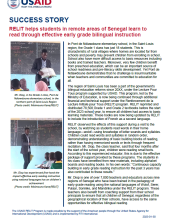
These Success Stories were prepared by the project team for the USAID Renforcement de la Lecture Initiale pour Tous program in Senegal in Calendar year 2023. SS005: "Improved listening comprehension in Pulaar garners enthusiasm from Grade 1 pupils and their teacher Mme Sané" SS011 " At the El Hadj Oumar Aidara school in Kédougou, student reading achievement in grade 1 is a milestone in adoption of bilingual education" and SS006: "RELIT helps students in remote areas of Senegal learn to read through effective early grade bilingual instruction" describe teachers' experiences using the newly-introduced RELIT materials in their classrooms. SS07 "Co-creation with the Ministry of Education results in capacity development plans to prepare personnel to provide Senegal’s children with high-quality bilingual education" describes the collaborative process of developing ministry capacity to provide sustainable and high quality bilingual education and SS08 "Language mapping of over 1,000 schools builds the capacity of the Ministry of Education staff to sustainably support implementation of bilingual instruction in Senegal" describes how talking to communities helped identify which of the local languages best serves classroom instruction.
Assoc. Photo (Port.)
ss06 port.png
Country
Featured projects
Resource Language
Month and Year
Publisher Or Client
USAID

Measurement and Use of Education Data across the Asia Region

Submitted by admin on
Description/Abstract
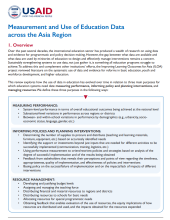
The Improving Learning Outcomes for Asia (ILOA) regional project works closely with USAID’s Asia Bureau and Missions across the region to identify key questions and challenges Mission staff face in their day-to-day work. An advisory group of USAID Mission colleagues raised an important question: how best to wade through the array of education data available? What are the types, how are they used, when are different data useful, etc.? Indeed, the use of different data to effectively partner with governments to make evidence-based decisions is a top priority. As a result, ILOA produced a brief summarizing the different sources and uses of data for basic education, youth and workforce development, and higher education. The brief recognizes how data sources and uses have evolved over time, enabling ministries, their partners, and stakeholders to measure performance, inform policy and plan interventions, and manage limited resources. The brief is designed to succinctly assist USAID staff and their partners in navigating the world of education data.
Assoc. Photo (Port.)
Iloa 1 port.png
Resource (File)
Country
Resource Type
Featured projects
Month and Year

Integrating and Aligning Education Investments with Government Priorities

Submitted by admin on
Description/Abstract
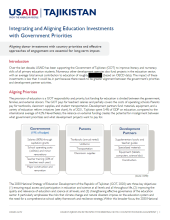
Aligning donor investment with country priorities and effective approaches of engagement are essential for long-term impact. Over the last decade, USAID has been supporting the Government of Tajikistan (GOT) to improve literacy and numeracy skills of all primary education students. Numerous other development agencies also fund projects in the education sector, with an average total annual contribution to education of roughly (based on OECD data). The impact of these investments is less than it could be, in part because there needs to be greater alignment between the government’s priorities and development partner activities.
Assoc. Photo (Port.)
Integrating and Aligning Education Investments with Government Priorities.png
Country
Resource Type
Featured projects
Month and Year

What We Are Learning About Learning Networks [CIES 2024 Presentation]

Submitted by admin on
Description/Abstract
The USAID Leading Through Learning Global Platform (LTLGP) and USAID Improving Learning Outcomes for Asia (ILOA) presented a panel at the 2024 CIES Conference on what each project has been learning about establishing and implementing learning networks. Presentations from three USAID learning networks (HELN, GRN, ECCN) and one regional hub managed by LTLGP along with a presentation from ILOA discuss how each learning network utilizes collaboration, learning, and adapting (CLA) to assess how well their networks are reaching and meeting the needs of their members and how they have adapted and adjusted their networks based on CLA fedback.
Assoc. Photo (Port.)
Networks.png
Resource (File)
Resource Type
Featured projects
Month and Year
Publisher Or Client
USAID

Education Sector Mechanism

Submitted by admin on
Author
Description/Abstract
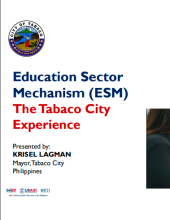
Title: Philippine local governments using local solutions to tackle literacy and numeracy through the Education Sector Mechanism Presenter: Mayor Krisel Lagman of Tabaco City Launched under USAID funded Advancing Basic Education (ABC+) in the Philippines, the Education Sector Mechanism (ESM) brings stakeholders (private sector, government units, teachers, school leadership, parents and community) together at the local level to assess the education landscape using data and evidence. This process is led by local governments, but includes all stakeholders and aims to identify key issues and their underlying causes, agree on effective strategies to tackle these challenges, and translate the solutions into well-defined programs, projects, and activities. This process puts local leadership and ownership at the forefront of problem solving based on data, investment programming and results-based monitoring and evaluation. The local governments of Victorias City and Tabaco City in the Philippines lead the way in utilizing ESM, bringing private sector, local government units, and community together to look at education issues. This presentation will discuss the ESM process based on their experience and the results they are seeing, highlighting locally led and locally funded solutions and commitments.
Assoc. Photo (Port.)
ESM port.PNG
Resource (File)
Country
Resource Type
Resource Language
Month and Year
Publisher Or Client
USAID

The role of Middle Tier Leadership in Supporting Improved Foundational Literacy and Numeracy [CIES 2024]

Submitted by admin on
Description/Abstract
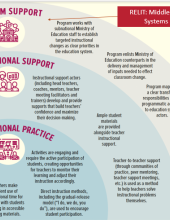
This presentation delivered at the CIES 2024 conference describes key implementation strategies used in USAID/MOE Government to Government Component of RELIT Program.
Assoc. Photo (Port.)
relit port.PNG
Country
Resource Type
Featured projects
Resource Language
Month and Year
Publisher Or Client
USAID

Breaking Norms, Accelerating Learning Recovery, Building a Case of Learning for All in the Philippines [CIES 2024 Presentation]

Submitted by admin on
Description/Abstract
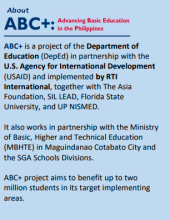
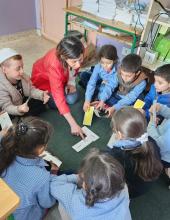
Education being recognized as a fundamental right plays a vital role in fostering better societies and ensuring fair access to quality education. In this panel, we will explore the significance of education protests concerning pedagogy, curriculum, and theories. The Philippines Department of Education (DepEd), with support from USAIDs project Advancing Basic education in the Philippines (ABC+), has taken innovative steps to improve learning outcomes and reach marginalized communicates beyond traditional methods. The 2018 Program for International Student Assessment (PISA) revealed that Filipino 15-year-old students scored low in reading comprehension and ranked near the bottom in math and science among 79 countries. This raised concern about curriculum, teaching practice, the learning environments of Philippines schools, and in general the quality of education in the Philippines. It is important to note that over 90% of the students in the Philippines reported speaking a language at home different from the language used in instruction and the PISA test (English). Such language disparity significantly impacts PISA scores, and the Philippines’ linguistic diversity adds to the complexity. The Philippines is one of 44 nations where no single language group exceeds 50% of the total population. Estimates of the number of native Philippine languages range from 110 to 185. The adoption of Mother Tongue Based-Multilingual Education (MTB-MLE) in 2009 recognized this and explicitly emphasized the socio-cultural value of children learning in their maternal languages and put a focus on the importance of language to expanding access to education and improving learning outcomes. This panel highlights the importance of utilizing data to advocate for Early Grade Learning (EGL) and exploring alternative investment pathways beyond traditional sources.
Assoc. Photo (Port.)
Phil port.PNG
Country
Resource Type
Resource Language
Month and Year
Publisher Or Client
USAID

Uncovering Risks During Compounded Crises [CIES 2024]

Submitted by admin on
Description/Abstract
The presentation summarizes findings from the Rapid Education Risk Analysis for Lebanon

Assoc. Photo (Port.)
Teacher using Arabic Portfolio ressources with the students.jpg
Resource (File)
CIES PPT_March 11.pdf
Country
Resource Type
Resource Language
Month and Year
Publisher Or Client
USAID

The Ant and the Grasshopper: Lessons for Collaborative Planning in a Changing World [CIES 2024 Presentation]

Submitted by admin on
Description/Abstract
As economies in the global-South mature and calls for decolonizing international assistance become louder, it becomes increasingly important to reimagine the design, planning and implementation of international assistance. This paper will explore the evolution of the relationship between an international funding agency and partner Ministry over a decade of program implementation. USAID has implemented three consecutive education projects in Tanzania since 2011 that focus on improving the quality of teaching to enhance learning outcomes, starting with the USAID Tanzania 21st Century activity. Over time, these programs have shifted the nature of implementation and engagement with Government with the goal of institutionalizing program activities within the administrative structure of the Tanzanian education system. This paper discusses the strategies used under the two most recent activities (Tusome Pamoja and Jifunze Uelewe) and the associated outcomes, providing options for future collaborative engagement. Education service delivery for basic education in Tanzania is a shared responsibility on the mainland, with Ministry of Education and Sports (MoEST) providing policy direction and quality assurance and the President’s Office – Regional Administration and Local Governance (PO-RALG) managing curriculum delivery through the schools. USAID has supported the provision of teaching and learning materials, teacher professional development, sub-national management and community engagement. In this paper we discuss the evolution of four strategies for collaboration: (i) alignment with Government policies; (ii) collaborative work planning; (iii) exploiting opportunities; (iv) consistent communication strategies. Projects, by nature, are perceived as short-term interventions independent of broader system administration. They are frequently perceived as an additional administrative burden but bringing the advantage of substitutive financing. This presentation discusses how Tusome Pamoja addressed these perceptions and expectations, by recognizing the need to demonstrate the alignment between Government initiatives and activity support. We further discuss how consistent and flexible communication led to significant achievement of Government approval of new national guidelines for school quality assurance, parent engagement, and teacher continuous professional development. We will highlight how the most recent activity (Jifunze Uelewe) made significant adjustments to its annual work planning process to address the mismatch between the work planning and budget cycles of the governments of US and Tanzania. We also discuss how clarity and coherence of communication internally between project management and USAID ensured a unified and consistent messaging strategy, with USAID communicating at the political level while project staff engaging at the technical level. This ensured that when important shifts in service delivery implementation were elevated from technical to political approval, the context and concept was already well understood. The presentation will conclude by highlighting that the path to successful collaboration rests upon several critical factors. These include a deep understanding of the political context, the relative power of personalities and positions with the extant institutional structures, consistent communication and an understanding of vested interests. Flexibility and coordination between funder and implementer is key to success.

Assoc. Photo (Port.)
ju port.PNG
Resource (File)
Resource Type
Month and Year
Publisher Or Client
USAID Jifunze Uelewe

Data-driven decentralized school support: the use of student learning data to direct management support in Tanzania [CIES 2024 Presentation]

Submitted by admin on
Description/Abstract
On mainland Tanzania, most resource allocation decisions are centralized. The President’s Office - Regional Administration and Local Government (PO-RALG) recruits and assigns teachers, supplies teaching and learning materials and funds capital construction projects. Local Governments are provided limited funds for training support or redeployment of teachers among schools. Their main resource, therefore, is to provide management attention and support to schools. With an average of 140 schools in a District and a staff of 5 individuals, only a few schools can be supported. In 2016, The Ministry of Education and Sports developed a School Quality Assurance Framework to guide local administrators on key areas of focus and guidance for school support. The framework focuses on six areas: school inputs, teacher practice, student learning outcomes, school environment, school leadership and community engagement. To facilitate the monitoring of these areas, USAID Tusome Pamoja project piloted a data collection tool that allowed measurement of progress through indicators. Of particular interest was the use of a group administered learning assessment that established benchmarks for success for grade 2 learners across six sub-tasks for reading, writing and mathematics. Due to limited resources, this assessment was only applied to a sample of schools in each district. Districts could assess their overall performance against these indicators and as a result developed somewhat generic district level support plans.. This presentation will explore how initial challenges of vague district plans were overcome through the critical data collection process leading to the establishment of benchmarks for success. o Under a subsequent activity, USAID Jifunze Uelewe, software was developed that allowed districts to capture group administered learning data for every grade 2 student and to aggregate this information at the school level. Districts were then able to rank order all schools in the district by scores on learning sub-tasks and then select the lowest performing schools for additional management attention. At the same time, districts were able to pair high-performing and low performing schools. The result of the access to school specific data was to allow districts to direct their attention to the development of plans at the school level to address low learning performance, and the ability to track progress of these schools over time. Schools enter data on Government provided tablets and the data can be synched when headteachers have access to Government provided wifi. Decentralized administrators have long been seen as critical for translating national policy into local action. However, they are frequently hampered by a combination of distracted management attention and unclear targets or benchmarks for key inputs, which encourages a laissez-faire status quo. In Tanzania, local governments in four regions have been able to contextualize data to meet their needs and use simple technology to prioritize their attention and decision-making. Our presentation showcases the significance of data driven decision making and continuous improvement of the system. We further highlight the important of simple and meaningful change and fostering proactive decision making at the local level.
Assoc. Photo (Port.)
ju port.PNG
Resource Type
Month and Year
Publisher Or Client
USAID Jifunze Uelewe