Governance, Decentralization, and Accountability

Uganda LARA: Ministry of Education and Sports Literacy and Numeracy Advisory Committee Terms of Reference

Submitted by admin on
Description/Abstract
The idea of the literacy and numeracy advisory committee started with “literacy” specifically, to offer advisory support on sustainability of EGR activities of Projects funded by USAID. During Basic Education Working Group meetings, members agreed to add numeracy, on the premise that developing children’s foundation skills of both literacy and numeracy is vital during the formative years. The purpose of the advisory committee is to ensure that organizational, systemic, and institutional capacity gaps and needs are identified and relevant organs receive guidance to act on measures to fill the gaps and ensure cost effective EGR/Numeracy activities are sustained. It is composed of senior and mid-level MoES official responsible for successful implementation of primary curriculum, with a specific focus on EGR and numeracy, drawn from BE and SE, DES, NCDC, TIET, SNE, Districts, Kyambogo University and development partners. The committee reports to the MoES PS and has authority to make recommendations for policy review and formulation of a new set of policy documents contributing to a new Sector Strategic Plan, including EGR and Numeracy. It also monitors programming, provides oversight and offers related guidance on interventions and strategies. The project supported MoES to develop a Terms of Reference to create a structure for the work of the Advisory Committee.
Assoc. Photo (Port.)
Screen Shot 2020-12-21 at 12.15.13 PM.png
Resource (File)
Country
Resource Language
Month and Year
Publisher Or Client
USAID/Uganda Literacy Achievement & Retention Activity

Reading Symposium Information Pack

Submitted by admin on
Description/Abstract
This information pack is based on the data pack developed and used by the MoES, UKAID and Cambride Education for their design confultation workshop held in April 2018. Many of the slides here were taken directly from that pack, with permission from Cambridge Education. We sincely appreciate being able to use their data pack as a starting point for this information pack. Selection of Data and Resources for the UKAID/Cambridge Education SESIL slides Data sources have been taken from a variety of sources and are referenced on each slide in the bottom left-hand corner. The dates referenced in the source information relate to when the data was collected (rather than published) to provide the most accurate picture possible of currently available and accessible information. Only data that was externally collected, validated from multiple sources and nationally or internationally published was included. Data for the USAID/RTI and GPE slides Data are from program monitoring records and other evaluative and survey efforts and provide more Uganda specific data to support and provide more depth to the national and international data.
Assoc. Photo (Port.)
Screen Shot 2020-12-16 at 4.42.47 PM.png
Country
Resource Type
Resource Language
Month and Year
Publisher Or Client
USAID

Systems Implications for Core Instructional Support Lessons from Sobral (Brazil), Puebla (Mexico), and Kenya

Submitted by admin on
Author
Description/Abstract
In December 2019, the Bill and Melinda Gates Foundation convened a workshop examining four education systems that have worked to build coherence across their systems, as viewed by “insiders” who played a significant role in carefully studying, designing, or maintaining the systems. This information note summarizes the knowledge shared at the workshop and was produced at the request of key stakeholders at the meeting. It is intended for the benefit of the participants and those who may be designing systems interventions or research, especially around the issue of the "instructional core" and the coherence among the various elements of the instructional core. The note is presented as an informal contribution.
Assoc. Photo (Port.)
lcrouch photo.png
Resource (File)
Country
Resource Type
Month and Year

Journey to Self-Reliance: Case Study of Capacity Development in Cambodia

Submitted by admin on
Author
Description/Abstract
What conditions make it possible to accomplish significant capacity development without running any workshops, without requiring any explicit project deliverables, and with only three short-term technical assistance trips over the course of 19 months? The All Children Reading–Cambodia Activity has been supporting the Education Quality Assurance Department (EQAD) of the education ministry in Cambodia since February 2017. An EQAD staffer, asked about the assistance, said, “The value of the support …is more than I can express… Through collaboration with [the project], EQAD has developed remarkably.” This case study examines how a different approach to providing technical assistance helped EQAD make those “remarkable” strides toward self-reliance.
Assoc. Photo (Port.)
Cambodia JSR.jpeg
Country
Resource Type
Featured projects
Month and Year

Kindergarten in Jordan: data for decision-making- CIES 2018 Presentation

Submitted by admin on
Author
Description/Abstract
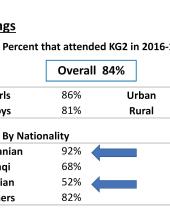
CIES 2018 Presentation, given by Katherine Merseth and Manar Shukri. The Minister of Education has requested that USAID Early Grades Reading and mathematics Project (RAMP) assist the Ministry of Education (MoE) to assess the overall KG situation in Jordan and to develop recommendations for how the Government of Jordan can expand quality kindergarten (specifically, the second year of kindergarten, or KG2) to serve all 5year old children by 2025. In response to the need, RAMP is conducting a study of KG2 with the objective of enabling the MoE to equitably expand and improve KG2.
Assoc. Photo (Port.)
Pages from Merseth, Katherine_CIES2018_Data-driven decision making in Jordan.jpg
Country
Resource Type
Month and Year

Early Grade Reading Sustainability Framework- CIES 2018 Presentation

Submitted by admin on
Author
Description/Abstract
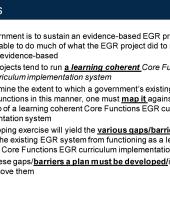
CIES 2018 presentation, given by Luis Crouch on behalf of Hank Healey. The EGR Sustainability Framework emanates from a) a general understanding of evidence-based EGR programs, b) the notion of a “learning coherent” education system (Pritchett, 2015), c) the notion of a “bare bones” or “core functions” system (Crouch and Destefano, 2015); and effective curriculum implementation. To this end, our proposed EGR sustainability framework maintains that one must a) map the existing education system’s institutional, systemic, cultural, and attitudinal capacity to function as an effective learning coherent core functions curriculum implementation system, b) identify the various gaps and barriers that prevent the system from working in this manner, c) develop a plan to address those gaps and barriers, and d) help the MOE to implement that plan.
Assoc. Photo (Port.)
Pages from Healey, Hank_CIES2018_EGR Sustainability Framework.jpg
Country
Resource Type
Resource Language
Month and Year

Implementing large-scale instructional technology in Kenya: Changing instructional practice and developing accountability in a National Education System

Submitted by admin on
Description/Abstract
Article published in the IJEDICT, Vol. 13, No. 3 (2017). Published Abstract: "Previous large-scale education technology interventions have shown only modest impacts on student achievement. Building on results from an earlier randomized controlled trial of three different applications of information and communication technologies (ICTs) on primary education in Kenya, the Tusome Early Grade Reading Activity developed the National Tablets Program. The National Tablets Program is integrated into the Tusome activity by providing tablets to each of more than 1,200 instructional coaches in the country to use when they visit teachers. This enables a national database of classroom instructional quality, which is used by the education system to monitor overall education quality. The tools provided on the tablets are designed to help coaches increase the quality of their instructional support to teachers, and deepen the shallow accountability structures in Kenya’s education system. Using results of a national survey, we investigated the ability of the National Tablets Program to increase the number of classroom observations done by coaches and to improve student learning outcomes. Survey results showed high levels of tablet program utilization, increased accountability, and improvements in learning outcomes. We share recommendations regarding large-scale ICT interventions and literacy programs.
Assoc. Photo (Port.)
ijedict.jpg
Country
Resource Type
Featured projects
Resource Language
Month and Year
Publisher Or Client
International Journal of Education and Development Using ICTs

The Equity Implications of Household Contributions to Education: Evidence from Nigeria's Education Household Survey 2015

Submitted by admin on
Author
Description/Abstract
Presentation delivered at CIES 2017 (Atlanta.) In 2004, the Federal Government of Nigeria passed the Universal Basic Education Act. In order to support State governments to implement this Act, a Federal Intervention Fund was established and financed by a 2% deduction from the Consolidated Revenue Fund. This UBE fund allocates funds equally to States, on a matching basis, to fund school construction, textbook provision, teacher training and other equity activities. This presentation looks at evidence from the 2010 and 2015 national household surveys on education to examine whether this Federal fund has improved educational opportunities for the poorest quintile and whether the fund has affected household expenditures on education. The presentation concludes that the middle quintiles have benefited most from the fund, that the richest quintile has opted out of Government education and into private education, whilst the poorest quintile remains financially unable to meet basic requirements of school uniforms and school supplies.
Assoc. Photo (Port.)
NEDS 2015 Learning by SES.jpg
Resource (File)
CIES_2017_Rodd(Final).pptx
Country
Resource Type
Resource Language
Month and Year

Using Data for Accountability and Transparency in Schools: Big Data Report

Submitted by admin on
Description/Abstract
The Kenya Big Data Activity is an operations research study to help the Kenya Ministry of Education, Science, and Technology (MoEST) identify the challenges, opportunities, and capacity requirements for implementing a school-based digital Education Management Information System (EMIS) at scale and sustainably. This activity was funded by the U.S. Agency for International Development’s Task Order 19, Data for Educational Research and Planning (DERP) in Africa, under the Education Data for Decision Making (EdData II) program. RTI International, in partnership with IBM Corp. Research Laboratory, Kenya and Digital Divide Data, implemented the study, the MoEST coordinated the effort, and the United Nations Children’s Fund (UNICEF) and other development partners provided collaboration and support.
Assoc. Photo (Port.)
data.png
Resource (File)
Country
Resource Type
Month and Year

Information for Education Policy, Planning, Management, and Accountability in West Bank and Gaza: Final Report of Findings of the Data Gap Analysis of the Palestinian Ministry of Education and Higher Education

Submitted by admin on
Description/Abstract
The purpose of the data gap analysis is to help the Palestinian Ministry of Education and Higher Education to identify ways to improve the integration and utilization of its data systems for policy, planning, and management, as well as reporting and feedback to the public and stakeholders. With funding through the United States Agency for International Development (USAID), RTI International (www.rti.org) fielded a three-person team to survey Ministry offices, assess existing data systems and applications, and debrief the Ministry and USAID on summary findings.
Assoc. Photo (Port.)
west bank.png
Resource (File)
Resource Type
Month and Year