Briefs

Guía sobre los Fondos del Conocimiento (Funds of Knowledge Guide)

Submitted by admin on
Description/Abstract
Esta es una guía informativa para maestros sobre Fondos del Conocimiento y su aplicación en el aula. Los Fondos del Conocimiento hacen referencia al cúmulo de habilidades, experiencias y conocimientos de los estudiantes adquiridos en la vida cotidiana. En esta guía se enfatiza que este tipo de referentes son significativos, pues ayudan a los maestros para aprender sobre sus estudiantes y sus hogares, para reconocer fundamentos particulares de conocimiento aplicables en un entorno escolar. Esta guía fue elaborada por el equipo técnico del Centro de Investigaciones Educativas de la Universidad del Valle de Guatemala, socio implementador de Educación Básica de Calidad para la Transición (Basic Education Quality and Transitions - BEQT, por sus siglas en inglés).
Assoc. Photo (Port.)
FdC Guía.PNG
Country
Resource Type
Featured projects
Resource Language
Month and Year
Publisher Or Client
USAID

Guía sobre el Diseño Universal para el Aprendizaje (DUA)

Submitted by admin on
Description/Abstract
Esta es una guía informativa para maestros sobre el Diseño Universal para el Aprendizaje (DUA). El término DUA alude a un marco científicamente válido para guiar la práctica educativa que: a) proporciona flexibilidad en las formas en las que se presenta la información y en las que el estudiante demuestra su conocimiento de acuerdo a su motivación; b) reduce las barreras adaptándose al estudiante y manteniendo altas expectativas para todos los estudiantes en el aula. Esta guía fue elaborada por el equipo técnico del Centro de Investigaciones Educativas de la Universidad del Valle de Guatemala, socio implementador de Educación Básica de Calidad para la Transición (Basic Education Quality and Transitions - BEQT, por sus siglas en inglés).
Assoc. Photo (Port.)
DUA Guide.PNG
Country
Resource Type
Featured projects
Resource Language
Month and Year
Publisher Or Client
USAID

Measurement and Use of Education Data across the Asia Region

Submitted by admin on
Description/Abstract
The Improving Learning Outcomes for Asia (ILOA) regional project works closely with USAID’s Asia Bureau and Missions across the region to identify key questions and challenges Mission staff face in their day-to-day work. An advisory group of USAID Mission colleagues raised an important question: how best to wade through the array of education data available? What are the types, how are they used, when are different data useful, etc.? Indeed, the use of different data to effectively partner with governments to make evidence-based decisions is a top priority. As a result, ILOA produced a brief summarizing the different sources and uses of data for basic education, youth and workforce development, and higher education. The brief recognizes how data sources and uses have evolved over time, enabling ministries, their partners, and stakeholders to measure performance, inform policy and plan interventions, and manage limited resources. The brief is designed to succinctly assist USAID staff and their partners in navigating the world of education data.
Assoc. Photo (Port.)
Iloa 1 port.png
Resource (File)
Country
Resource Type
Featured projects
Month and Year

USAID is Making Durable Contributions to Improved Education in Tajikistan

Submitted by admin on
Description/Abstract
Community-based methodological support, more accessible information on teacher professional development, and an app that builds students’ reading skills are helping improve learning outcomes in Tajikistan. Over the last 10 years, USAID has supported the Government of Tajikistan to improve the teaching of reading and math in the early grades of primary school. USAID has helped reinforce key features of how the education system supports classroom instruction. Three initiatives described below are particularly notable as lasting contributions to Ministry of Education and Science (MoES) capacity to continue to improve how teachers teach and how students learn to read.
Assoc. Photo (Port.)
USAID is Making Durable Contributions to Improved Education in Tajikistan.png
Country
Resource Type
Featured projects
Month and Year
Publisher Or Client
USAID

The Early Grade Reading Assessment (EGRA) in Tajikistan: Time for a New Approach?

Submitted by admin on
Description/Abstract
Over the last decade, USAID has been supporting the Government of Tajikistan (GOT) to improve learning outcomes in primary education. The GOT has not previously used a national objective assessment to measure those learning outcomes. USAID introduced the Early Grade Reading Assessment to measure the impact of its investments. An EGRA has been implemented about every two years since 2013.
Assoc. Photo (Port.)
The Early Grade Reading Assessment (EGRA) in Tajikistan Time for a New Approach.png
Country
Resource Type
Featured projects
Month and Year
Publisher Or Client
USAID

Integrating and Aligning Education Investments with Government Priorities

Submitted by admin on
Description/Abstract
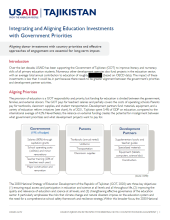
Aligning donor investment with country priorities and effective approaches of engagement are essential for long-term impact. Over the last decade, USAID has been supporting the Government of Tajikistan (GOT) to improve literacy and numeracy skills of all primary education students. Numerous other development agencies also fund projects in the education sector, with an average total annual contribution to education of roughly (based on OECD data). The impact of these investments is less than it could be, in part because there needs to be greater alignment between the government’s priorities and development partner activities.
Assoc. Photo (Port.)
Integrating and Aligning Education Investments with Government Priorities.png
Country
Resource Type
Featured projects
Month and Year

RELIT Infos : Newsletter 2024.1

Submitted by admin on
Author
Description/Abstract
A newsletter produced for the RELIT project in 2024
Assoc. Photo (Port.)
RELIT infos PortPNG.PNG
Resource (File)
Country
Resource Type
Featured projects
Resource Language
Month and Year
Publisher Or Client
USAID

The Role of Mother Tongue Language Complexity in Determining L2 and L3 Reading Outcomes in the Philippines (USAID ACR Asia)

Submitted by admin on
Description/Abstract
This study uses national Grade (G) 3 Early Grade Reading Assessment (EGRA) data from 2013, when G3 students learned to read in Filipino and English rather than a mother tongue, and comparable data from 2019, when G3 students would have, according to policy, first learned to read in their mother tongue. The data were used to better understand the role of L1 complexity in L2 and L3 reading acquisition. Sample: 241 schools; 232 schools were the same in 2013 and 2019. Final sample used for analysis: 2,264 G3 students in 2019 and 2,267 G3 students in 2013. Children were assessed in Filipino (L2) and English (L3). Secondary analysis of the data set looked at reading performance and changes in reading performance according to language complexity.
Assoc. Photo (Port.)
The Role of Mother Tongue Language Complexity in Determining L2 and L3 Reading Outcomes in the Philippines.png
Country
Resource Type
Featured projects
Resource Language
Month and Year

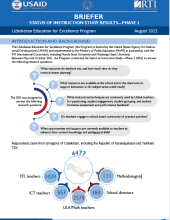
Status of Instruction Study : Phase 2 briefer (UEEP)

Submitted by admin on
Author
Description/Abstract
The Uzbekistan Education for Excellence Program (the Program) is funded by the United States Agency for International Development (USAID) and implemented by the Ministry of Public Education (MoPE) in partnership with the RTI International Consortium, including Florida State University and Mississippi State University. Between May and October 2021, the Program conducted the Status of Instruction Study—Phase 2 (SIS2) to answer the following research questions: -- What resources do teachers use, and how much time do they invest in lesson planning? -- What resources are available at the school and in the classroom to support instruction in the subject areas under study? -- What instructional techniques are commonly used by Uzbek teachers for questioning, student engagement, student grouping, and student formative assessment and performance feedback? -- Do teachers engage in school-based community of practice activities? What opportunities and support are currently available to teachers
Assoc. Photo (Port.)
SIS2 port.PNG
Resource (File)
SIS2 Briefer_final.pdf
Country
Resource Type
Featured projects
Month and Year

Teacher Support System Study

Submitted by admin on
Author
Description/Abstract
The Uzbekistan Education for Excellence Program funded by the United States Agency for International Development (USAID), conducted the Teacher Support System Study (TSSS) to examine the existing teacher support system in Uzbekistan and identify teacher support challenges and opportunities. The Program is implemented by the RTI International Consortium, which includes Florida State University and Mississippi State University.
Assoc. Photo (Port.)
TSSS port.PNG
Resource (File)
English - TSSS.pdf
Country
Resource Type
Featured projects
Resource Language
Month and Year