Briefs

Numeracy At Scale: TAFITA Program, Lessons From Madagascar

Submitted by admin on
Description/Abstract
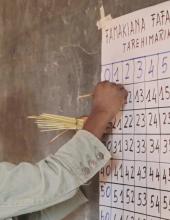
Children need a strong foundation in learning to succeed in their education and life. Yet, by the age of 10 years, nearly 9 out of 10 children in SSA cannot do basic mathematics. There is an urgent need to learn from success stories like the TAFITA program in Madagascar to accelerate results in numeracy to ensure that every child is ready to succeed at school. This short brief highlights some of the key successes from the program to provide policy makers and development practitioners with evidence-based strategies for improving instruction and learning in numeracy.
Assoc. Photo (Port.)
EPP Mangave CDR.jpg
Resource (File)
TAFITA Two-pager.pdf
Country
Resource Type
Resource Language
Month and Year
Publisher Or Client
Center for Global Development / Bill and Melinda Gates Foundation

Digital Transformation - Bringing New Resources to Educators and Students

Submitted by admin on
Description/Abstract
Uzbekistan is on an upward trajectory of digital transformation. Its Digital Uzbekistan 2030 Strategy includes ambitious policy goals to modernize and increase the competitiveness of a range of sectors, from telecommunications to healthcare and public services. For example, in the education sector, Uzbekistan has already achieved 100% coverage of high-speed Internet connections in preschool institutions and facilitated trainings for tens of thousands of students in technology-oriented skills. The USAID-funded Uzbekistan Education for Excellence Program supported the Government of Uzbekistan to accelerate digital transformation in education. In partnership with Florida State University (FSU) and the Ministry of Preschool and School Education (MoPSE) Republican Education Center (REC), RTI led two initiatives to support students and teachers with access to essential and supplementary resources.
Assoc. Photo (Port.)
Pages from 10_Brief_IMPACT_Digitalization_Final_ENG.jpg
Resource (File)
Country
Resource Type
Featured projects
Month and Year

UZBEK LANGUAGE ARTS - Development of Student Learning Standards and Scope and Sequences

Submitted by admin on
Author
Description/Abstract
Central to the Ministry of Preschool and School Education (MoPSE) reform agenda is the shift to a modern standards-based education approach that aligns instruction and outcomes to specific competencies or standards. Such an approach includes student learning standards — the knowledge, concepts, and skills that students need to acquire — and materials, assessments, instructional practices, and teacher professional development that align to the student standards. In 2019, the Republican Education Center defined learning objectives for each subject in the benchmark years and stated that improvement was needed to develop well-defined, wellarticulated, and grade-level appropriate standards for language arts skill areas of listening, speaking, reading, and writing for each grade. A move to a standards-based approach required that instructional materials aligned to standards and that teachers were equipped with the resources they need to bring standards-based instruction to life in their classroom.
Assoc. Photo (Port.)
Pages from 09_Brief_ULA_Stn_SnS_Final_ENG.jpg
Resource (File)
Country
Resource Type
Featured projects
Month and Year

CONTINUOUS TEACHER PROFESSIONAL DEVELOPMENT - Approaches that Foster Teacher Engagement

Submitted by admin on
Author
Description/Abstract
To improve the quality of instruction and learning, a challenge that many ministries must confront, is the need to provide teacher professional development at scale. Uzbekistan has approximately 10,104 schools, 502,687 teachers, and 6,336, 933 students.2 In 2022, when MoPSE rolled out the new EFL teacher and student books, it struggled to reach and train all teachers.
Assoc. Photo (Port.)
Pages from 08_Brief_TPD_Final_ENG.jpg
Resource (File)
Country
Resource Type
Featured projects
Resource Language
Month and Year

Mathematics - Development of Student Learning Standards and Scope and Sequences

Submitted by admin on
Author
Description/Abstract
Leveraging the significant contributions made by MoPSE partners, the US Agency for International Development’s (USAID) Uzbekistan Education for Excellence Program was strategically designed to enhance and support mathematics quality enhancement initiatives. Specifically, the Program crafted high-quality, research-based standards. Student learning standards are the foundation or core of an educational system, and every component of each subject is based on these standards. Once complete, student standards inform the development of scope and sequences, textbooks, and assessments
Assoc. Photo (Port.)
Pages from 07_Brief_Math_Stn_SnS_Final_ENG.jpg
Resource (File)
Country
Resource Type
Featured projects
Month and Year

ENGLISH AS A FOREIGN LANGUAGE - DEVELOPMENT OF STANDARDS

Submitted by admin on
Author
Description/Abstract
Developing the standards for EFL education is a major step towards the Uzbekistan’s vision of an English-speaking nation by 2030. MoPSE experts and Program technical advisors developed a set of EFL standards as the basis of a standards-based curriculum. This brief provides an overview of the development and review of EFL student learning standards for grades 1-11
Assoc. Photo (Port.)
Pages from 04_Brief_EFL_Stn_Final_ENG.jpg
Resource (File)
Country
Resource Type
Featured projects
Month and Year

ENGLISH AS A FOREIGN LANGUAGE - DEVELOPMENT OF SCOPE AND SEQUENCE

Submitted by admin on
Author
Description/Abstract
Uzbekistan’s education reform envisions a competency-based curriculum consisting of standards, a scope and sequence (S&S), textbooks, and teacher guides that align with an assessment system. The scope is the vocabulary, grammar, and skills that are taught over the course of a school year, and the sequence is the order in which those skills and content are presented. The S&S is an important element of a national curriculum and serves two primary purposes. First, it elucidates the curriculum, detailing the constituent elements of the standards or competencies, thus breathing life into the national curriculum framework. Second, it provides a blueprint for national textbooks, detailing content and its order. As a blueprint for the textbook, the S&S becomes the assessment framework as it identifies the skills, grammar, and vocabulary taught at any point in the academic year.
Assoc. Photo (Port.)
Pages from 03_Brief_EFL_SnS_ENG.jpg
Resource (File)
03_Brief_EFL_SnS_ENG.pdf
Country
Resource Type
Resource Language
Month and Year

ENGLISH AS A FOREIGN LANGUAGE - CUSTOMIZING INTERNATIONAL TEXTBOOK SERIES

Submitted by admin on
Author
Description/Abstract
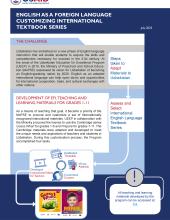
Uzbekistan has embarked on a new phase of English language instruction that will enable students to acquire the skills and competencies necessary for success in the 21st century. At the onset of the Uzbekistan Education for Excellence Program (UEEP) in 2019, the Ministry of Preschool and School Education (MoPSE) expressed its vision for Uzbekistan of becoming an English-speaking nation by 2030. English as an adopted international language can help open doors and opportunities for international cooperation, trade, and cultural exchanges with other nations.
Assoc. Photo (Port.)
Pages from 02_Brief_EFL_Customization_of_Textbooks_Final_ENG.jpg
Country
Resource Type
Resource Language
Month and Year

ENGLISH AS A FOREIGN LANGUAGE - TEXTBOOK APPRAISAL

Submitted by admin on
Author
Description/Abstract
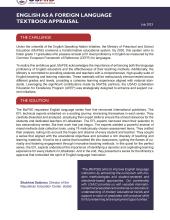
The Ministry of Preschool and School Education of the Republic of Uzbekistan requested English language series from five renowned international publishers. The EFL technical experts embarked on a exciting journey, immersing themselves in each series. They carefully dissected and analyzed, employing their expert skills to ensure the utmost relevance for the students and dedicated teachers of Uzbekistan. The EFL experts narrowed down their selection to two extraordinary series. But their work had just begun.
Assoc. Photo (Port.)
EFL_Textbook Appraisal_Final_ENG.jpg
Resource (File)
Country
Resource Type
Resource Language
Month and Year

Can the Middle Tier Drive Foundational Learning at Scale?

Submitted by admin on
Author
Description/Abstract
An integral part of a decentralized education system hierarchy is the “middle tier” comprising subnational actors in charge of education delivery at the regional, provincial, state, district, municipality, city, or circuit and cluster levels. The general roles and responsibilities of the middle tier are described in research on district leadership in OECD countries. Their responsibilities range from planning, monitoring, and implementing reforms at the subnational and school levels, to ensuring school-based accountability through data and evidence, to innovating, supporting, and monitoring improvements in teaching and learning in schools through instructional leadership and fostering professional learning communities at the district and school levels. While rigorous academic evidence may be lacking on the ability of middle managers to bring about improvements in foundational literacy and learning outcomes at scale in LMICs, we have theoretical and programmatic evidence on (1) their role in instructional leadership, (2) the importance of building their capacity to drive teaching and learning, and (3) the importance of trust and support within the education system that fosters learning at scale. Thumbnail Credit: Pakistan Reading Program/IRC
Assoc. Photo (Port.)
Picture4_0.jpg
Resource (File)
Resource Type
Resource Language
Month and Year
Publisher Or Client
Center for Global Development / Bill and Melinda Gates Foundation