Salieva, Z.

Teachers Guide Math -Uzbekistan

Submitted by admin on
Description/Abstract
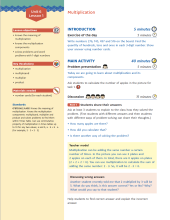
One week sample of the 2nd grade teacher's guide and embedded student textbook for Uzbekistan under the UEEP project.
Assoc. Photo (Port.)
Screenshot 2023-10-18 at 9.08.07 AM.png
Resource (File)
Country
Month and Year
Publisher Or Client
RTI

Mathematics - Development of Student Learning Standards and Scope and Sequences

Submitted by admin on
Author
Description/Abstract
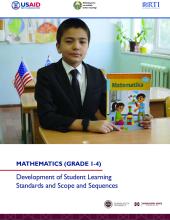
Leveraging the significant contributions made by MoPSE partners, the US Agency for International Development’s (USAID) Uzbekistan Education for Excellence Program was strategically designed to enhance and support mathematics quality enhancement initiatives. Specifically, the Program crafted high-quality, research-based standards. Student learning standards are the foundation or core of an educational system, and every component of each subject is based on these standards. Once complete, student standards inform the development of scope and sequences, textbooks, and assessments
Assoc. Photo (Port.)
Pages from 07_Brief_Math_Stn_SnS_Final_ENG.jpg
Resource (File)
Country
Resource Type
Featured projects
Month and Year

Using the GPF to create mathematics student standards in Uzbekistan [CIES 2023 Presentation]

Submitted by admin on
Description/Abstract
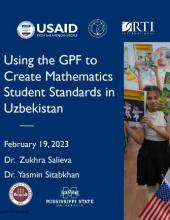
To support the Ministry of Public Education (MoPE) in achieving its reform agenda, USAID initiated the Uzbekistan Education for Excellence Program (UEEP) to improve the quality of education and enable all students to be proficient in 21st century skills such as problem solving and critical thinking. UEEP is implemented by a Consortium of partners including RTI International, Florida State University, and Mississippi State University. The Program aims to achieve three overarching results: improved Uzbek language (UL) reading and mathematics outcomes in grades 1–4; enhanced information and communication technology (ICT) instruction for grades 1–11, and improved English as a foreign language (EFL) instruction in grades 1–11. In this presentation, we will describe the process of revising the student standards for Grades 1-4 in mathematics, led by Florida State University and UEEP math experts, with ongoing review and feedback from MoPE representatives. The revision of student standards was the first step of the country’s curricular reform, followed by the creation of TLMs and a corresponding teacher professional development package. This process consisted of several stages, beginning with comparing current MoPE standards with the GPF, student math standards from South Korea and the TIMSS framework for assessment. These three resources were chosen for specific purposes. The TIMSS framework reflected the Government of Uzbekistan’s priority to prepare children in Grade 4 to take TIMSS assessment and perform well. This framework only reflected Grade 4 learning, so it was used primarily to backwards map other standards in Grades 1-3 to ensure that all content on the TIMSS framework was adequately covered by the end of Grade 4. The GPF was the most detailed reference, and was used to map the current standards and identify gaps in the progression. However, there was concern from the Government of Uzbekistan that the GPF might be targeting skills that are too easy for children in Uzbekistan. Because of this, we also brought in the South Korea standards, which provided us with a reference from a country that is seen as a model in Uzbekistan, and we were able to use the South Korea standards to make decisions about certain skills. This process allowed us to ensure that the standards development process met national priorities (i.e. Presidential Decree on Improving Math Education, 2020), reflected best international practices in mathematics, created standards that were age appropriate and measurable, and was logically organized. We will discuss how we used a quantitative comparative analysis of Uzbekistan's existing standards for different grade levels with the GPF and South Korea standards to identify revisions needed to facilitate more alignment. The rigor of that exercise allowed us to revise and to create a set of standards that could be approved by MoPE. The rigorous student standards development process described in this presentation allowed us to create a set of standards that were approved by MoPE. These standards were the cornerstone of further reforms including creating a scope and sequence and Teacher/Learning Materials (TLMs) for Grades 1-4, currently being piloted with 10,000 teachers across Uzbekistan.
Assoc. Photo (Port.)
GPFportrait.JPG
Resource (File)
GPF_CIES_2023_FINAL.pdf
Country
Resource Type
Month and Year

Using teaching and learning materials in Uzbekistan: Lessons from observations and interviews [CIES 2023 Presentation]

Submitted by admin on
Description/Abstract
The purpose of this panel presentation is to present the results of two uptake studies to understand how mathematics, Uzbek language arts, ICT, and EFL teachers in Uzbekistan are using and applying newly developed teaching and learning materials in the classroom.
Assoc. Photo (Port.)
uzbek portrait.JPG
Resource (File)
TLM Uptake Panel.pdf
Country
Resource Type
Resource Language
Month and Year
Publisher Or Client
USAID