Briefs

Policy Brief: MTB-MLE in Regions V and VI

Submitted by admin on
Description/Abstract
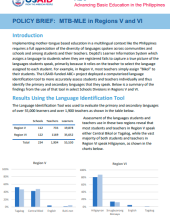
Implementing mother-tongue based education in a multilingual context like the Philippines requires a full appreciation of the many languages spoken across communities and schools and among students and their teachers. DepEd’s Learner Information System which assigns a language to students when they are registered fails to capture a true picture of the languages students speak, primarily because it relies on the teacher to select the language assigned to each student. For example, in Region V, most teachers simply assign “Bikol” to their students. The USAID-funded ABC+ project deployed a computerized language identification tool in region V and VI to more accurately assess students and teachers individually and thus identify the primary and secondary languages that they speak.
Assoc. Photo (Port.)
PhilBrief1_port.PNG
Country
Resource Type
Month and Year

Policy Brief: What Languages Do Filipino Students and Teachers Speak?

Submitted by admin on
Description/Abstract
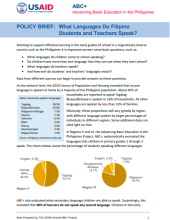
Wanting to support effective learning in the early grades of school in a linguistically diverse country such as the Philippines it is important answer some basic questions, such as: • What languages do children come to school speaking? • Do children have more than one language that they can use when they start school? • What languages do teachers speak? • And how well do students’ and teachers’ languages match? Data from different sources is used to answers these questions.
Assoc. Photo (Port.)
PhilBrief2_port.PNG
Resource (File)
Country
Resource Type
Month and Year

Policy Brief: Mother Tongue-Based Multilingual Education (MTB-MLE)
Submitted by admin on
Description/Abstract
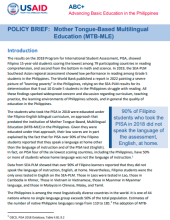
POLICY BRIEF: Mother Tongue-Based Multilingual Education (MTB-MLE)
Assoc. Photo (Port.)
PhilBrief3_port.PNG
Resource (File)
Country
Resource Type
Month and Year
Publisher Or Client
USAID

Read Liberia: Institutionalization of the DEMA-GALA

Submitted by admin on
Description/Abstract
It is essential that the Government of Liberia has the skills and resources to monitor and assess their schools, students, and teachers as part of an evidenced-based education system on the road to self-reliance. Read Liberia maintained a focus on assessment and data use—not only to improve classroom-based instruction and equip school leadership with the knowledge and tools they need to foster quality education, but also to build the capacity of county and district officers in USAID’s six priority counties.
Assoc. Photo (Port.)
DEMA_GALA.png
Resource (File)
Country
Resource Type
Featured projects
Resource Language
Month and Year

Why Benchmarks Matter

Submitted by admin on
Description/Abstract
Setting benchmarks or standards that clearly state expectations about how well students or teachers should be performing on various skills at each stage of education and then collecting data to monitor these skills enables governments to see how individuals and education systems overall are progressing toward the goal of improved learning. This information allows governments to identify where improvements are needed and to chart progress year-to-year and against global standards. So how did Read Liberia do it? Read this brief to find out more!
Assoc. Photo (Port.)
benchmarks.png
Resource (File)
Why Benchmarks Matter.pdf
Country
Sub-topic
Resource Type
Featured projects
Resource Language
Month and Year

Sustaining and Extending Reading Improvements in Liberia

Submitted by admin on
Description/Abstract
Read Liberia has had considerable positive impact on students’ reading performance. This success story outlines the key activities Read Liberia has undertaken with the MOE to sustain EGR results beyond the life of the Activity.
Assoc. Photo (Port.)
Sustaining Reading Gains.png
Resource (File)
Country
Resource Type
Featured projects
Month and Year

Promoting social and emotional learning during school closures: lessons from Read Liberia

Submitted by admin on
Description/Abstract
How to effectively promote SEL development among children and their parents during school closures was a challenge for Read Liberia and implementing partners across the world. Read this brief to learn about the innovative ways Read Liberia fostered social and emotional development during COVID through its Teach by Radio Program.
Assoc. Photo (Port.)
SEL brief.png
Country
Sub-topic
Resource Type
Featured projects
Month and Year

Using radio to promote learning in Liberia during COVID-19

Submitted by admin on
Description/Abstract
Liberian public schools closed in March 2020, and the MOE Teach by Radio program ran from March 30 through June 30, 2020. Drawing upon its existing materials, Read Liberia developed and recorded a series of 30-minutes lessons covering key components of early grade literacy and language arts instruction, including phonological awareness, phonics, vocabulary, listening comprehension, reading comprehension, and grammar. In response to an MOE initiative to support students’ psychosocial needs during this global pandemic, Read Liberia also wove into these radio lessons opportunities for students to reflect on their feelings and find productive ways to handle them. Read this brief to learn more!
Assoc. Photo (Port.)
evaluating radio programs.png
Country
Resource Type
Featured projects
Resource Language
Month and Year

Read Liberia's use of technology

Submitted by admin on
Description/Abstract
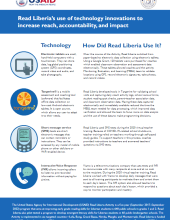
This material discusses the various technological innovations the USAID/Read Liberia Activity employed for data collection, teacher training, assessment, coaching and even virtual support to teachers during COVID.
Assoc. Photo (Port.)
use of technology.png
Resource (File)
Country
Resource Type
Featured projects
Resource Language
Month and Year

Anatomy of a Read Liberia Coach

Submitted by admin on
Description/Abstract
This material highlights the eleven tasks Read Liberia coaches performed to support teachers and schools.
Assoc. Photo (Port.)
Anatomy of a Coach.png
Resource (File)
Country
Sub-topic
Resource Type
Featured projects
Resource Language
Month and Year