Briefs

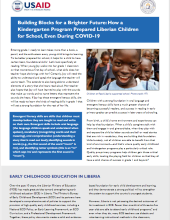
Building blocks for a brighter future: how Read Liberia prepared kindergarten students for school, even during COVID-19

Submitted by admin on
Description/Abstract
Children with a strong foundation in oral language and emergent literacy skills have a much greater chance of becoming successful readers, and success in reading in early primary grades can predict success in later years of schooling. Read this brief to learn about how Read Liberia partnered with the MOE to improve KG students' emergent literacy skills!
Assoc. Photo (Port.)
KG Pilot.png
Resource (File)
Country
Resource Type
Featured projects
Resource Language
Month and Year

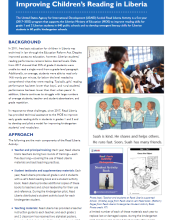
Improving children's reading in Liberia: results from the NORC impact evaluation of the Read Liberia Activity

Submitted by admin on
Description/Abstract
This brief highlights data from Read Liberia's external impact evaluation conducted by NORC
Assoc. Photo (Port.)
improving reading.png
Resource (File)
Country
Resource Type
Featured projects
Resource Language
Month and Year

Increasing caregiver and community support for early grade reading: results from Read Liberia

Submitted by admin on
Description/Abstract
Read this brief to learn more about Read Liberia's community engagement component and the data from its evaluation.
Assoc. Photo (Port.)
Increasing Caregiver.png
Country
Resource Type
Featured projects
Resource Language
Month and Year

Supporting children to learn during forced school closures: Lessons from Read Liberia

Submitted by admin on
Description/Abstract
In Liberia, as elsewhere around the world, recent school closures disrupted learning for all students. The effects of the COVID-19 pandemic have exacerbated pre-existing education inequality, especially disadvantaging girls, students with disabilities, people living in extreme poverty, and other marginalized groups. For Read Liberia’s technical team, the recent pandemic was a catalyst for innovation. The project quickly adapted to a new virtual implementation model to continue trainings, community engagement, and teacher instructional coaching. Read this brief to learn more about what the Activity did to ensure Liberia's students continued to learn during the pandemic.
Assoc. Photo (Port.)
support children 1.jpeg
Country
Resource Type
Resource Language
Month and Year

Developing and publishing early grade teaching and learning materials: lessons from Read Liberia

Submitted by admin on
Description/Abstract
This briefer provides ten lessons learned from developing, printing and distributing teaching and learning materials for the early grades in Liberia
Assoc. Photo (Port.)
TLMs.PNG
Country
Resource Type
Featured projects
Month and Year

Mobile money: A new way to compensate teachers in Liberia

Submitted by admin on
Description/Abstract
In 2019, Read Liberia transitioned to the use of mobile money to remit per diem payments to teachers upon completion of twice-yearly trainings. Mobile money had a significant impact on Read Liberia's operations, training continuity, and its teachers. Read this brief to find out how.
Assoc. Photo (Port.)
Mobile Money.png
Country
Resource Type
Featured projects
Resource Language
Month and Year

Using non-monetary incentives to motivate schools and teachers: innovation from Read Liberia

Submitted by admin on
Description/Abstract
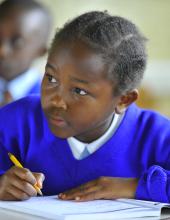
Motivated teachers are vital for successful and effective classroom instruction. They show up consistently and inspire and engage their students. Enthusiastic teachers assess students’ abilities, give feedback, and collaborate with other teachers. They are passionate about the important role they play and enjoy what they do. Many factors affect a teacher’s motivation to work. Read this brief to find out what Read Liberia learned about motivating and inspiring teachers.
Assoc. Photo (Port.)
non-monetary incentives.png
Country
Resource Type
Featured projects
Resource Language
Month and Year

What Works to Improve Learning at Scale? Key Findings from Learning at Scale and the Kenya Tusome Early Grade Reading Activity

Submitted by admin on
Author
Description/Abstract
This brief presents findings on what worked to improve learning outcomes at scale under 8 successful early grade literacy programs, with a focus on findings from the Tusome program in Kenya.1 These findings were generated as part of the Learning at Scale study, conducted by RTI International with the Center for Global Development and funded by the Bill and Melinda Gates Foundation.
Assoc. Photo (Port.)
_AGK8749.jpeg
Resource (File)
Kenya_Findings_FINAL.pdf
Country
Sub-topic
Resource Type
Month and Year
Publisher Or Client
RTI International, Center for Global Development, Bill and Melinda Gates Foundation

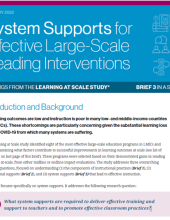
System Supports for Effective Large-Scale Reading Interventions (Learning at Scale)

Submitted by admin on
Description/Abstract
Learning outcomes are low and instruction is poor in many low- and middle-income countries (LMICs). These shortcomings are particularly concerning given the substantial learning loss due to COVID-19 from which many systems are suffering. The Learning at Scale study identified eight of the most effective large-scale education programs in LMICs and now is examining what factors contribute to successful improvements in learning outcomes at scale (see list of programs on last page of this brief). These programs were selected based on their demonstrated gains in reading outcomes at-scale, from either midline or endline impact evaluations. The study addresses three overarching research questions, focused on understanding (1) the components of instructional practices (Brief 1), (2) instructional supports (Brief 2), and (3) system supports (Brief 3) that lead to effective instruction. This brief focuses specifically on system supports. It addresses the following research question: What system supports are required to deliver effective training and support to teachers and to promote effective classroom practices?
Assoc. Photo (Port.)
Brief3.png
Resource (File)
BRIEF-3- System Support.pdf
Resource Type
Resource Language
Month and Year
Publisher Or Client
Center for Global Development, Bill and Melinda Gates Foundation

Instructional Support for Effective Large-Scale Reading Interventions (Learning at Scale)

Submitted by admin on
Description/Abstract
Learning outcomes are low and instruction is poor in many low- and middle-income countries (LMICs). These shortcomings are particularly concerning given the substantial learning loss due to COVID-19 from which many systems are suffering. The Learning at Scale study identified eight of the most effective large-scale education programs in LMICs and now is examining what factors contribute to successful improvements in learning outcomes at scale (see list of programs on last page of this brief). These programs were selected based on their demonstrated gains in reading outcomes at-scale, from either midline or endline impact evaluations. The study addresses three overarching research questions, focused on understanding (1) the components of instructional practices (Brief 1), (2) instructional supports (Brief 2), and (3) system supports (Brief 3) that lead to effective instruction. This brief focuses specifically on instructional supports. It addresses the following research question: What methods of training and support lead to teachers adopting effective classroom practices in successful, large-scale literacy programs?
Assoc. Photo (Port.)
Brief2.png
Resource (File)
Resource Type
Resource Language
Month and Year
Publisher Or Client
Center for Global Development, Bill and Melinda Gates Foundation