Pakistan

Country Code
PAK

What We Are Learning About Learning Networks [CIES 2024 Presentation]

Submitted by admin on
Description/Abstract
The USAID Leading Through Learning Global Platform (LTLGP) and USAID Improving Learning Outcomes for Asia (ILOA) presented a panel at the 2024 CIES Conference on what each project has been learning about establishing and implementing learning networks. Presentations from three USAID learning networks (HELN, GRN, ECCN) and one regional hub managed by LTLGP along with a presentation from ILOA discuss how each learning network utilizes collaboration, learning, and adapting (CLA) to assess how well their networks are reaching and meeting the needs of their members and how they have adapted and adjusted their networks based on CLA fedback.
Assoc. Photo (Port.)
Networks.png
Resource (File)
Resource Type
Featured projects
Month and Year
Publisher Or Client
USAID

2022 Higher Education in Asia: Strategic Review: Improving Learning Outcomes for Asia (ILOA) Mechanism

Submitted by admin on
Description/Abstract
The United States Agency for International Development's (USAID's) Bureau for Asia conducted a strategic review to examine the depth and breadth of USAID higher education (HE) programming in Asia over the five-year period from 2016 through 2021. The review highlights ways in which USAID's HE programming has been a vehicle for all sectors, not only education, to achieve USAID development objectives. The review's findings and recommendations should inform continued USAID HE investment in Asia. USAID investments in HE support the 2022 lndo-Pacific Strategy (IPS). Within USAID and the interagency, there is a growing interest in HE programming opportunities. This recognition of the role of HE in driving economic development is reflected in its inclusion in the lndo-Pacific Strategy of the United States (White House, 2022), which highlights education as key to regional economic prosperity and security, as well as regional resilience to transnational threats. Unlike in previous strategies, HE is now explicitly noted in the 2022 version of the strategy as a vehicle to advance the United States Government's (USG's) vision for a "free and open lndo-Pacific" (p. 6). This review details examples of how USAID HE investments could support the IPS by countering malign influence, strengthening democratic systems, conducting cutting-edge research to fight the COVID-19 pandemic, and building diverse and equitable partnerships between U.S. and Asian partners. USAID is forging lasting transpacific partnerships through HE investments. In 2021, this engagement included partnerships among 270 higher education institutions (HEls) from across the region and with more than 20 HEls from across the U.S. Programs are aligned with USAID's Education Policy and achieving outcomes in all USAID sectors by "advancing knowledge and research; providing quality and relevant education and workforce training; and engaging and strengthening networks and communities" (Dockser et al., 2020, p. 5) in food security and agriculture; democracy, governance, and human rights; peace and security; economic growth and workforce development; and global health. These investments are advancing locally led development, producing the next generation of leaders, laying the groundwork for more resilient economies and future trade partners, and sustainably advancing American values in a region wary of malign influence.
Assoc. Photo (Port.)
HEactivities_GIS.png
Resource Type
Featured projects
Month and Year

ILOA Fact Sheet

Submitted by admin on
Author
Description/Abstract
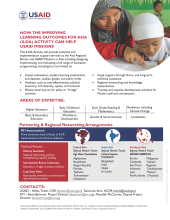
One-page fact sheet describing the Improving Learning Outcomes for Asia (ILOA) Activity.
Assoc. Photo (Port.)
ILOA One Pager_updated 2023.10.05.png
Resource (File)
Resource Type
Featured projects
Month and Year

Can the Middle Tier Drive Foundational Learning at Scale?

Submitted by admin on
Author
Description/Abstract
An integral part of a decentralized education system hierarchy is the “middle tier” comprising subnational actors in charge of education delivery at the regional, provincial, state, district, municipality, city, or circuit and cluster levels. The general roles and responsibilities of the middle tier are described in research on district leadership in OECD countries. Their responsibilities range from planning, monitoring, and implementing reforms at the subnational and school levels, to ensuring school-based accountability through data and evidence, to innovating, supporting, and monitoring improvements in teaching and learning in schools through instructional leadership and fostering professional learning communities at the district and school levels. While rigorous academic evidence may be lacking on the ability of middle managers to bring about improvements in foundational literacy and learning outcomes at scale in LMICs, we have theoretical and programmatic evidence on (1) their role in instructional leadership, (2) the importance of building their capacity to drive teaching and learning, and (3) the importance of trust and support within the education system that fosters learning at scale. Thumbnail Credit: Pakistan Reading Program/IRC

Assoc. Photo (Port.)
Picture4_0.jpg
Resource (File)
Resource Type
Resource Language
Month and Year
Publisher Or Client
Center for Global Development / Bill and Melinda Gates Foundation

Education system strengthening across Asia: a systematic review of USAID activities and critical discussion [CIES 2023 Panel Presentation]

Submitted by admin on
Description/Abstract
The purpose of this formal group panel presentation is to hold an in-depth discussion on USAID’s investments into system strengthening across Asia over the past decade and how these efforts are situated within the broader global move to focus more intentionally and coherently on education system strengthening. The panel will discuss a 2022 empirical research study (the USAID System Strengthening Review, hereafter “the Review”) conducted by two international research organizations for the USAID Asia Bureau which reviews USAID system strengthening work in 11 Asian countries. This Review offers a qualitative evidence-based analysis relevant to the field of comparative and international education (CIE) and analyzes new data collected from a desk review of relevant project documents, reports, and evaluations, key informant interviews, multi-stakeholder survey, and three deep-dive case studies in Nepal, Cambodia, and the Philippines. The group panel will include three presentations on different aspects of the Review and include discussant commentary and critique to elicit group and audience discussion. The first panel presentation discusses a theoretical framework drawn from the RISE Programme (Pritchett 2015 and Spivak 2021) and recent analysis from the Brookings Institution’s Center for Universal Education. The Review’s central research questions are guided by these broader global trends, as well as its own analysis framework developed specifically for this study, discussed in Presentation 3. Conclusions are drawn based on this framework, and the overall discussion in Presentations 2 and 3 considers the context of USAID programming in Asia and how new knowledge provides new insights.
Assoc. Photo (Port.)
Resource (File)
Resource Type
Featured projects
Month and Year
Publisher Or Client
USAID

Return to Learning- Pakistan Case Study [CIES Presentation]

Submitted by admin on
Description/Abstract
In the past two years, the COVID 19 pandemic and the ensuing and repeated school closures has caused an unprecedented upheaval to the education of children world-wide. With the onset of the pandemic, actors in education systems responded in myriads of ways to ensure children continued to learn while at home and when schools reopened. The purpose of this case study is to explore how educational stakeholders in the federal and provincial governments in Pakistan – Balochistan, Islamabad Capital Territory (ICT), Kyber Pakhtunkhwa (KP), and Sindh, responded to school closures and re-openings during the COVID 19 pandemic in 2020 and 2021. As such, the research questions for the study are 1. How did actors in education respond to the COVID 19 pandemic in Pakistan? 2. What types of resilience capacities did actors in education exhibit? To answer these questions, the case study delves into how the education actors - communities, parents, teachers, federal and provincial government education officials, private schools, non-governmental organizations, and international development partners responded and collaborated to support children’s learning, psycho-social support and well-being. The case study draws on resilience, and social ecological frameworks to explore the response of Pakistani education system to the pandemic. A social ecological lens enables the examination of the interaction and relationships of the individual, the community, the learning environment and educational systems and policies (Bronfenbrenner, (1986). Resilience frameworks explore the practices of education actors which promote resilience during and after disasters. (Reyes, 2013; Shah, Paulson, Couch, 2020; Shah, 2019). A qualitative case study method was best suited for this research study as it allows for an in-depth, descriptive and analytical study of how these education stakeholders responded to the challenges of the pandemic (Merriam, 1998). Data collection comprised semi structured interviews with purposive sampling of 34 individuals and 11 focus groups with public and private school teachers and parents. Emerging themes include the digital divide, strength in community, parent engagement and a lack of focus on marginalized populations. The emerging themes give examples of resilience capacities of stakeholder responses and illustrate positive, and promising practices as well as areas which need considerable reflection, and change in and implementation of federal and provincial policies. References Bronfenbrenner, U. (1986) Ecology of the family as a context for human development. American Psychologist.32:513–531. Merriam, S. B. (1998). Qualitative Research and Case Study Applications in Education. Revised and Expanded from" Case Study Research in Education." Jossey-Bass Publishers, 350 Sansome St, San Francisco, CA 94104. Reyes, J. (2013). What matters the most for education resilience. A framework paper. World Bank Shah, R. (2019). Transforming systems in times of adversity. White Paper, USAID Education and Conflict Network.
Assoc. Photo (Port.)
pakistan_port.JPG
Resource (File)
Country
Resource Type
Featured projects
Resource Language
Month and Year

System Supports for Effective Large-Scale Reading Interventions (Learning at Scale)

Submitted by admin on
Description/Abstract
Learning outcomes are low and instruction is poor in many low- and middle-income countries (LMICs). These shortcomings are particularly concerning given the substantial learning loss due to COVID-19 from which many systems are suffering. The Learning at Scale study identified eight of the most effective large-scale education programs in LMICs and now is examining what factors contribute to successful improvements in learning outcomes at scale (see list of programs on last page of this brief). These programs were selected based on their demonstrated gains in reading outcomes at-scale, from either midline or endline impact evaluations. The study addresses three overarching research questions, focused on understanding (1) the components of instructional practices (Brief 1), (2) instructional supports (Brief 2), and (3) system supports (Brief 3) that lead to effective instruction. This brief focuses specifically on system supports. It addresses the following research question: What system supports are required to deliver effective training and support to teachers and to promote effective classroom practices?
Assoc. Photo (Port.)
Brief3.png
Resource (File)
BRIEF-3- System Support.pdf
Resource Type
Resource Language
Month and Year
Publisher Or Client
Center for Global Development, Bill and Melinda Gates Foundation

Instructional Support for Effective Large-Scale Reading Interventions (Learning at Scale)

Submitted by admin on
Description/Abstract
Learning outcomes are low and instruction is poor in many low- and middle-income countries (LMICs). These shortcomings are particularly concerning given the substantial learning loss due to COVID-19 from which many systems are suffering. The Learning at Scale study identified eight of the most effective large-scale education programs in LMICs and now is examining what factors contribute to successful improvements in learning outcomes at scale (see list of programs on last page of this brief). These programs were selected based on their demonstrated gains in reading outcomes at-scale, from either midline or endline impact evaluations. The study addresses three overarching research questions, focused on understanding (1) the components of instructional practices (Brief 1), (2) instructional supports (Brief 2), and (3) system supports (Brief 3) that lead to effective instruction. This brief focuses specifically on instructional supports. It addresses the following research question: What methods of training and support lead to teachers adopting effective classroom practices in successful, large-scale literacy programs?
Assoc. Photo (Port.)
Brief2.png
Resource (File)
Resource Type
Resource Language
Month and Year
Publisher Or Client
Center for Global Development, Bill and Melinda Gates Foundation

Instructional Practices for Effective Large-Scale Reading Interventions (Learning at Scale)

Submitted by admin on
Description/Abstract
The Learning at Scale study aimed to investigate factors contributing to successful improvements in learning outcomes at scale in eight of the most effective large-scale education programs in LMICs (see the map of programs on the last page of this brief). These programs were selected based on their demonstrated gains in reading outcomes at-scale, from either midline or endline impact evaluations. The study addressed three overarching research questions, focused on understanding the components of instructional practices (Brief 1), instructional supports (Brief 2), and system supports (Brief 3) that lead to effective instruction. This brief focuses specifically on instructional practices. It addresses the following research question: What classroom ingredients (e.g., teaching practices, classroom environment) lead to learning in programs that are effective at scale?
Assoc. Photo (Port.)
Brief1.png
Resource (File)
Resource Type
Resource Language
Month and Year
Publisher Or Client
Center for Global Development, Bill and Melinda Gates Foundation

Learning at Scale Interim Report

Submitted by admin on
Description/Abstract
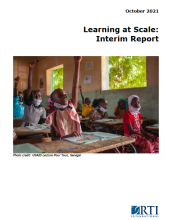
The Learning at Scale study was designed to identify existing early grade reading programs with demonstrated impact on basic skills at scale and to conduct in-depth investigations of these programs to determine what makes them successful. After an extensive search, eight programs (spanning seven countries) were selected for inclusion in the study. Research on these programs has been conducted in order to answer the three overarching research questions, focused on understanding the components of instructional practices, instructional supports, and system supports that lead to effective instruction. Learning at Scale data collection activities for some of these programs were delayed due to COVID-19. However, with demand for information about how to implement effective interventions at large scale at an all-time high, we believe that the timely sharing of findings from Learning at Scale is essential. Accordingly, this interim report provides preliminary findings from our study to date, highlighting key high-level findings across all eight programs, as well as quantitative and qualitative findings from primary research for select programs. The Learning at Scale study is led by RTI International, as part of the Center for Global Development (CGD) education research consortium, funded by the Bill and Melinda Gates Foundation.
Assoc. Photo (Port.)
Screen Shot 2021-11-15 at 11.34.28 AM.png
Resource Type
Resource Language
Month and Year