Ghana

Country Code
GHA

Additional Analysis for Self-Administered EGRA (Ghana, English)

Submitted by admin on
Description/Abstract
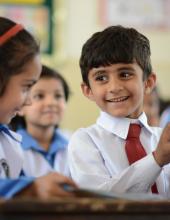
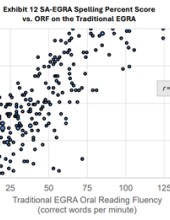
This report summarizes the findings of additional analyses conducted to delve deeper and develop more insight into the piloting of the Self-Administered Early Grade Reading Assessment (SA-EGRA) and the Self-Administered Early Grade Mathematics Assessment (SA-EGMA). These tools were developed and tested by RTI International with the support and direction of Imagine Worldwide. Children complete these assessments independently on tablet-based software while in a classroom with their peers. An adult supervises the process.
Assoc. Photo (Port.)
sa egra draft dev 6.PNG
Resource (File)
Country
Resource Type
Month and Year
Publisher Or Client
Imagine Worldwide

Can the Middle Tier Drive Foundational Learning at Scale?

Submitted by admin on
Author
Description/Abstract
An integral part of a decentralized education system hierarchy is the “middle tier” comprising subnational actors in charge of education delivery at the regional, provincial, state, district, municipality, city, or circuit and cluster levels. The general roles and responsibilities of the middle tier are described in research on district leadership in OECD countries. Their responsibilities range from planning, monitoring, and implementing reforms at the subnational and school levels, to ensuring school-based accountability through data and evidence, to innovating, supporting, and monitoring improvements in teaching and learning in schools through instructional leadership and fostering professional learning communities at the district and school levels. While rigorous academic evidence may be lacking on the ability of middle managers to bring about improvements in foundational literacy and learning outcomes at scale in LMICs, we have theoretical and programmatic evidence on (1) their role in instructional leadership, (2) the importance of building their capacity to drive teaching and learning, and (3) the importance of trust and support within the education system that fosters learning at scale. Thumbnail Credit: Pakistan Reading Program/IRC
Assoc. Photo (Port.)
Picture4_0.jpg
Resource (File)
Resource Type
Resource Language
Month and Year
Publisher Or Client
Center for Global Development / Bill and Melinda Gates Foundation

Understanding Teachers’ Attitudes towards Learning through Play and their Classroom Practice in Kenya, Rwanda and Ghana [CIES 2023 Presentation]

Submitted by admin on
Description/Abstract
This presentation focused on learning through play-based pedagogies in Kenya, Rwanda and Ghana. Some key findings discussed are: (1) Teachers in general support the concept of play and employing play-based teaching in the classroom, but far fewer are okay with students directing their own learning. (2) In practice, teachers spend the most time explaining/lecturing and monitoring the class. (3) At midline, significant changes were detected in some aspects of teacher practice in Kenya and Ghana, but overall, the frequency of play-based approaches is low.
Assoc. Photo (Port.)
Lego Portrait.JPG
Resource (File)
Country
Resource Type
Month and Year

Examining teacher support and play-based practice in Kenya, Rwanda and Ghana [CIES 2023 Presentation]

Submitted by admin on
Author
Description/Abstract
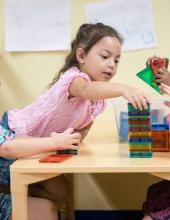
While there is growing evidence of the impact of learning through play (LtP) on student outcomes in high-income countries, there is little research linking LtP to learning outcomes in low-and middle-income contexts in primary schools. This presentation focuses on the midline evaluation findings from an education improvement initiative that is seeking to expand playful pedagogies into primary schools in five low and middle-income countries (LMICs). In this presentation, we examine the different approaches taken by projects to support teachers to test, adapt, and adopt LtP in their classroom. We link these findings to classroom observation data on the frequency with which teachers employ more collaborative, interactive, creative, exploratory, and student-driven play-based approaches. We also discuss the impacts of these activities on student outcomes (EGRA, EGMA and SEL).
Assoc. Photo (Port.)
play based practice portrait.JPG
Resource (File)
Country
Resource Type
Month and Year

Measuring support for children’s engagement in learning: psychometric properties of the PLAY toolkit [CIES 2023 Presentation]

Submitted by admin on
Description/Abstract
Despite the growing interest in supporting learning through play across many low and middle-income countries, measures of how contexts can support learning through play are lacking. As part of the Playful Learning Across the Years (PLAY) project, the concept of “self-sustaining engagement” was identified as central to learning through play. That is, learning through play is effective because children are deeply engaged in their learning and are self-motivated to learn. The PLAY toolkit was designed to measure how settings – particularly adult-child interactions in those settings – support children’s self-sustaining engagement in learning. The toolkit was developed for use in multiple age-groups across different settings. For the 0-2 age-group, the toolkit assessed support for children’s engagement in the home, largely through interactions between the caregiver and child. These interactions were assessed through observations and through an interview with the caregiver. In the 3-5 age-group, tools were developed to measure support for engagement in the home and the classroom. Tools for the 6-12 age-group were focused only on the classroom. The classroom-based tools had several components. Teacher-child interactions were assessed through observations, a teacher survey and – for the 6-12 age-group only – a student survey. There was also a classroom inventory to assess physical aspects of the classroom – such as materials on the walls – which might support self-sustaining engagement in learning. The toolkit was developed in three phases – the Build phase used qualitative data to understand local concepts of self-sustaining engagement. The Adapt phase used cognitive interviewing and small-scale (approx. 25 schools, centers or homes) quantitative data to refine the tools. In the Test Phase we used large-scale (approx. 150 schools, centres or homes) quantitative data to assess the psychometric properties of the tool. This presentation focuses on these psychometric analyses. Data were collected for the 6-12 age group from Kenya, Ghana and Colombia; for the 3-5 age group from Colombia, Jordan and Ghana; and from Colombia only for the 0-2 age group. Results indicate how the concept of “support for self-sustaining engagement” can be divided into constituent sub-scales and how the different methods of assessment – observation, teacher report and student report – relate to one another. We will discuss plans to develop a final toolkit, based on these analyses, which can help strengthen the evidence base on learning through play.
Assoc. Photo (Port.)
LegoPort.JPG
Resource (File)
Resource Type
Month and Year

Report of Self-Administered EGRA/EGMA Pilot (Ghana, English)

Submitted by admin on
Description/Abstract
This report summarizes the findings of an effort to develop and validate tablet-based, self-administered assessments of English-language foundational literacy and numeracy in the early grades. The tools described in the report were developed at the request of Imagine Worldwide with the support of the Jacobs Foundation. RTI carried out field testing and a pilot study to assess the tools' internal consistency, test-retest reliability, and concurrent validity with respect to "traditional" EGRA and EGMA. RTI International developed the two assessments, known respectively as the Self-Administered Early Grade Reading Assessment (SA-EGRA) and the Self-Administered Early Grade Mathematics Assessment (SA-EGMA), with the support and at the direction of Imagine Worldwide. The assessments are deemed “self-administered,” because children complete the assessments independently in response to instructions and stimuli imbedded in the tablet-based software. However, adults typically supervise the organization and conduct of the assessment as well as the collection of individual data from the tablets for analysis. The tools have been developed under an open-source license. The code can be viewed and downloaded for reuse or modification at https://github.com/ICTatRTI/SE-tools/blob/main/README.md. Users of RTI's Tangerine software may request that the SA-EGRA and SA-EGMA tools be added to their Tangerine groups via https://www.tangerinecentral.org/contact
Assoc. Photo (Port.)
SA EGRA.png
Resource (File)
Country
Resource Type
Resource Language
Month and Year
Publisher Or Client
RTI International

Principles for adapting playful pedagogies to context [CIES Presentation]

Submitted by admin on
Author
Description/Abstract
Efforts to promote playful pedagogies in low- and middle-income countries face many challenges. Among these challenges are the norms of teacher-child interaction that have a strong cultural basis. These norms include children’s reluctance to speak in front of adults, teachers’ desire to avoid embarrassing children and to promote a sense of fairness and togetherness in the classroom (Jukes et al, 2021a). In this paper I suggest an approach for adapting pedagogy to cultural context. The approach involves designing teaching activities to achieve two goals. Building on the work of others (O’Sullivan, 2004; Schweistfurth, 2013), the first is the cognitive learning goal of the activity. The second is the culturally appropriate social goal of the activity. This framing helps to design instructional approaches that promote learning and can be readily taken up by teachers. This approach is particularly effective when teaching activities are co-constructed with teachers (Randolph et al, 2020). In this paper I will discuss 3 studies of teacher perceptions and classroom behaviours in Tanzania that led to the development of this approach (Jukes et al, 2021b). I will also present one example of a teacher co-creation workshop in Tanzania based on the suggested approach to contextualising teaching activities. I will also illustrate the application to the contextualisation of playful pedagogies, based on qualitative research in Kenya and Ghana.
Assoc. Photo (Port.)
Screenshot 2022-05-04 at 15.05.53 (2)_0.png
Resource Type
Month and Year

Measuring the impact of play on social and emotional learning across countries [CIES Presentation]

Submitted by admin on
Author
Description/Abstract
This presentation was part of a CIES 2022 panel on measuring learning through play and child SEL outcomes across humanitarian and LMIC contexts. The presentation focuses primarily on the development of a new SEL tool that is being used as part of impact evaluations for five learning through play implementation programs across five countries.
Assoc. Photo (Port.)
the-benefits-of-learning-through-play-1200x900_0.jpeg
Resource (File)
Resource Type
Resource Language
Month and Year

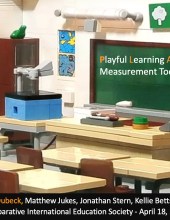
PLAY overview CIES (Dubeck et al., 2022)

Submitted by admin on
Description/Abstract
Play has the potential to transform the global learning crisis. In infancy and early childhood, play builds a strong foundation for later learning by improving brain development and growth (Goldstein, 2012). In education systems that lack capacity to support children effectively, play brings its own powerful engine to drive learning—the joyful, engaged intrinsic motivation of children themselves (Zosh et al., 2017). In this way, play contributes to the holistic development of children, helping to prepare them for the challenges of the current and future world. Accordingly, there is an urgent need to improve measurement of playful learning, to be able to add to the evidence base on what the benefits of play are, how playful learning takes place, and how it can be promoted at home and at school across the lifespan. This presentation focuses on a renewed conceptualization of playful learning and describes an innovative approach to measuring how settings contribute to playful learning for children ages 0 to 12, supported by the Lego Foundation. The settings we examine include homes, classrooms and ECD centers. Following Tseng and Seideman (2007), we view settings as consisting of social interactions (i.e. between teachers or caregivers and children) and the organization of resources (e.g. learning materials, games). First, we will present our conceptual framework which identifies six constructs to guide our measurement strategy. The constructs, such as ‘support for exploration’, represent the ways in which a setting supports playful learning. Next, we will present our contextualization framework which guides how we are adapting and modifying the measurement tools to different contexts. The tool consists of a protocol to observe adult-child interactions and survey measures conducted with teachers, caregivers and primary school pupils. As part of the development process for these measurement tools, observation and survey measures will go through a three-phase development process in Kenya, Ghana, Colombia, and Jordan. The Build phase involved collecting qualitative data from teachers, caregivers and students to understand their perception of playful learning and how it is supported at home and at school. Next, an Adapt phase took place where the initial versions of the measurement tools underwent cognitive interviewing, field adaptation, and a small pilot to adjust and extend the items in the tool. The third Test phase is a full pilot of the instruments, and the data will undergo rigorous psychometric analyses to review the validity and reliability of the tools in the four country contexts. We will use the results to adjust the instruments and to finalize the conceptual framework and contextualization strategies. The final toolkit will be publicly available towards the end of 2022 with supporting materials for contextualization, piloting, training and analysis. The toolkit will be available on a public platform designed to promote sharing of data collected using the tool and to collaborate to continually improve approaches to measuring support for playful learning.
Assoc. Photo (Port.)
Screen Shot 2022-04-28 at 1.16.28 PM.png
Resource (File)
Resource Type
Month and Year
Publisher Or Client
The Lego Foundation

System Supports for Effective Large-Scale Reading Interventions (Learning at Scale)

Submitted by admin on
Description/Abstract
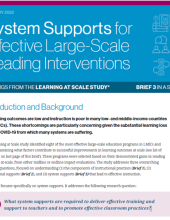
Learning outcomes are low and instruction is poor in many low- and middle-income countries (LMICs). These shortcomings are particularly concerning given the substantial learning loss due to COVID-19 from which many systems are suffering. The Learning at Scale study identified eight of the most effective large-scale education programs in LMICs and now is examining what factors contribute to successful improvements in learning outcomes at scale (see list of programs on last page of this brief). These programs were selected based on their demonstrated gains in reading outcomes at-scale, from either midline or endline impact evaluations. The study addresses three overarching research questions, focused on understanding (1) the components of instructional practices (Brief 1), (2) instructional supports (Brief 2), and (3) system supports (Brief 3) that lead to effective instruction. This brief focuses specifically on system supports. It addresses the following research question: What system supports are required to deliver effective training and support to teachers and to promote effective classroom practices?
Assoc. Photo (Port.)
Brief3.png
Resource (File)
BRIEF-3- System Support.pdf
Resource Type
Resource Language
Month and Year
Publisher Or Client
Center for Global Development, Bill and Melinda Gates Foundation