Governance, Decentralization, and Accountability

Ведущая роль правительства и принятие программ

Submitted by admin on
Author
Description/Abstract
Ни одна крупномасштабная программа по основам грамотности и счета (ОГС) не может быть эффективной без ведущей роли правительства. Учитывая данный основополагающий принцип, вызывает сожаление тот факт, что доноры, технические консультанты и исполнительные агентства зачастую не создают условий, необходимых для того, чтобы правительства взяли на себя ведущую роль. Подобная несостоятельность, как правило, с самого начала исключает вероятность обеспечения устойчивости принимаемых мер. Результаты обучения сложно изменить, так как для этого требуется, чтобы десятки тысяч учителей изменили свою педагогическую практику, однако в тех случаях, когда правительство возглавляет программу и большинство учителей внедряют ее в свою деятельность, воздействие на процесс обучения становится возможным. В данном руководстве описываются поэтапные процессы, призванные обеспечить, чтобы заинтересованное правительство могло возглавить и активизировать процесс принятия программ.
Assoc. Photo (Port.)
01. Ведущая роль правительства и принятие программ.jpg
Country
Resource Type
Resource Language
Month and Year

How Teacher Social Networks Might be Leveraged to Enhance Diffusion and Implementation of New Pedagogies

Submitted by admin on
Description/Abstract
The conventional ways that new pedagogies are taught and supported in low- and middle-income countries rarely leverage the social networks and relationships that are paramount for individuals to shift their beliefs and make positive decisions about adopting new methodologies, and for them to sustain these behavior changes in the long run. The purpose of this study was to apply social network analysis (SNA) and qualitative inquiry to understand the composition and structure of primary school teacher social networks to inform policy basic education programming about how to improve the diffusion and support for implementation of new pedagogies through these social networks. This study used a mixed model design to study the compositional and structural properties of teacher social networks in sub-district administrative areas or “wards” in Tanzania. Using data from completed socio-metric inventories, separate teacher social networks were generated for Mbawala, Madimba, Milangominne, and Nitekela wards in the Mtwara Region of Tanzania. Researchers used SNA to calculate quantitative measurements and generate teacher sociograms (i.e., network graphs) for each of the ward-level teacher social networks. We combined these data with data from teacher informant interviews that described the content, context, and benefit of educators’ interactions in the different wards and to help explain the SNA findings.

Assoc. Photo (Port.)
TZ report shared.png
Resource Type
Resource Language
Month and Year

Can the Middle Tier Drive Foundational Learning at Scale?

Submitted by admin on
Author
Description/Abstract
An integral part of a decentralized education system hierarchy is the “middle tier” comprising subnational actors in charge of education delivery at the regional, provincial, state, district, municipality, city, or circuit and cluster levels. The general roles and responsibilities of the middle tier are described in research on district leadership in OECD countries. Their responsibilities range from planning, monitoring, and implementing reforms at the subnational and school levels, to ensuring school-based accountability through data and evidence, to innovating, supporting, and monitoring improvements in teaching and learning in schools through instructional leadership and fostering professional learning communities at the district and school levels. While rigorous academic evidence may be lacking on the ability of middle managers to bring about improvements in foundational literacy and learning outcomes at scale in LMICs, we have theoretical and programmatic evidence on (1) their role in instructional leadership, (2) the importance of building their capacity to drive teaching and learning, and (3) the importance of trust and support within the education system that fosters learning at scale. Thumbnail Credit: Pakistan Reading Program/IRC
Assoc. Photo (Port.)
Picture4_0.jpg
Resource (File)
Resource Type
Resource Language
Month and Year
Publisher Or Client
Center for Global Development / Bill and Melinda Gates Foundation

Education Reform Support Today

Submitted by admin on
Description/Abstract
Traditional projects in education introduce innovations at the school level, sometimes improving learning in a defined number of schools. The hope is that somehow piloted successes can be replicated or taken to scale. But too often they are not. Dissatisfied with this, donors may choose policy-level interventions that promote resource reallocations, specific policy reforms, and investments in administrative and management capacity to effect system-wide change. But the record of policy reforms having impact on learning at the school level is disappointing. If we fund school-level projects, the challenge lies in how to create policy and institutional reforms that support replicable school-level success. If we support policy-level interventions, the challenge lies in how to ensure that national reforms lead to changes in the day-to-day practice of schools. Both approaches require effective programs of what we call reform support. Why is reform support needed? Ten years ago USAID published the Education Reform Support (ERS) series to answer just this question. ERS recognizes that the existing arrangements in the education sector—urban-rural inequities, management environments skewed by bureaucratic concerns, teaching improvements constrained by union prerogatives—are not accidental. Powerful political forces benefit from, shape, and defend the current situation. Changes within the system cannot realistically be implemented without first dealing with the preexisting institutional environment. Altering that environment means recognizing who stands to win or lose from pro-posed reforms, and what incentives signal them to either work for change or defend the status quo. The literature supporting such an understanding of education reform is rich. ERS draws on that literature and goes one step further to outline the tools and techniques for sup-porting and strategically managing the reform process.
Assoc. Photo (Port.)
Screenshot 2023-06-01 093329.png
Resource (File)
Country
Resource Type
Month and Year
Publisher Or Client
USAID

Strengthening sector capacity for Student Learning Assessment in the context of bilingualism in Senegal [CIES 2023 Presentation]

Submitted by admin on
Description/Abstract
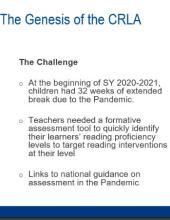
This presentation on development of an assessment system under Senegal's new bilingual policy includes an explanation of the bilingual policy in Senegal and plans for development of a national assessment system including use of the ANLAS methodology (Analysis of National Learning Assessment Systems)
Assoc. Photo (Port.)
INEADE portrait.JPG
Resource (File)
Country
Resource Type
Month and Year
Publisher Or Client
RTI International

Nepal: Assessing Early Grade Reading Outcomes the Cost-effective Way [CIES 2022 Presentation]

Submitted by admin on
Author
Description/Abstract
Policy linking is a standard-setting methodology, long used in many countries, to set benchmarks (or cut scores) on learning assessments that allow those countries to determine what percentage of students in their country are meeting minimum proficiency requirements for key skills such as reading and math. While it is an old standard-setting methodology, its use has been extended to help countries set benchmarks that will allow reporting against global standards. Policy linking allows countries to use their existing national and/or regional assessments to report against Sustainable Development Goal (SDG) 4.1.1: “Proportion of children and young people in Grade 2 or 3 (4.1.1a), at the end of primary education (4.1.1b), and at the end of lower secondary education (4.1.1c) who achieve at least a minimum proficiency level in reading and mathematics.” It works by linking assessments to the Global Proficiency Framework (GPF), a framework developed by global reading and math content experts based on current national content and assessment frameworks across more than 25 countries. The GPF provides performance expectations/ standards for learners in Grades 1-9 in reading and mathematics. By linking existing national and regional assessments to the GPF, countries and donors are able to compare learning outcomes across language groups in countries as well as across countries and over time, assuming all new assessments are subsequently linked to the GPF. In this roundtable, we will share learning from policy linking work that has taken place this past year. Following a brief introduction to Policy Linking for Measuring Global Learning Outcomes by Dr. Saima Malik, from USAID in Washington DC, Dr. Asumpta Matei from the Kenya National Examinations Council and Dr. Enos Radeny of USAID Kenya will present the model of a Policy Linking workshop that was designed and implemented in order to build ministry capacity as well as set benchmarks for grades 2 and 3 in English and Kiswahili in Kenya, Dr. Abdullah Ferdous and Dr. Jeff Davis of AIR (co-developers of the policy linking approach) will discuss the importance of feedback in establishing defensible global benchmarks during the policy linking process and Dr. Jodie Fonseca from RTI will share practical example from Nepal where policy linking was used to align the national assessment to the Global Proficiency Framework and proved to be a more cost-effective way to measure early grade reading outcomes than an EGRA. Melissa Chiappetta of Sage Perspectives will serve as discussant of the panel.
Assoc. Photo (Port.)
Screenshot 2022-05-04 091524.png
Country
Resource Type
Month and Year

Return to Learning- Pakistan Case Study [CIES Presentation]

Submitted by admin on
Description/Abstract
In the past two years, the COVID 19 pandemic and the ensuing and repeated school closures has caused an unprecedented upheaval to the education of children world-wide. With the onset of the pandemic, actors in education systems responded in myriads of ways to ensure children continued to learn while at home and when schools reopened. The purpose of this case study is to explore how educational stakeholders in the federal and provincial governments in Pakistan – Balochistan, Islamabad Capital Territory (ICT), Kyber Pakhtunkhwa (KP), and Sindh, responded to school closures and re-openings during the COVID 19 pandemic in 2020 and 2021. As such, the research questions for the study are 1. How did actors in education respond to the COVID 19 pandemic in Pakistan? 2. What types of resilience capacities did actors in education exhibit? To answer these questions, the case study delves into how the education actors - communities, parents, teachers, federal and provincial government education officials, private schools, non-governmental organizations, and international development partners responded and collaborated to support children’s learning, psycho-social support and well-being. The case study draws on resilience, and social ecological frameworks to explore the response of Pakistani education system to the pandemic. A social ecological lens enables the examination of the interaction and relationships of the individual, the community, the learning environment and educational systems and policies (Bronfenbrenner, (1986). Resilience frameworks explore the practices of education actors which promote resilience during and after disasters. (Reyes, 2013; Shah, Paulson, Couch, 2020; Shah, 2019). A qualitative case study method was best suited for this research study as it allows for an in-depth, descriptive and analytical study of how these education stakeholders responded to the challenges of the pandemic (Merriam, 1998). Data collection comprised semi structured interviews with purposive sampling of 34 individuals and 11 focus groups with public and private school teachers and parents. Emerging themes include the digital divide, strength in community, parent engagement and a lack of focus on marginalized populations. The emerging themes give examples of resilience capacities of stakeholder responses and illustrate positive, and promising practices as well as areas which need considerable reflection, and change in and implementation of federal and provincial policies. References Bronfenbrenner, U. (1986) Ecology of the family as a context for human development. American Psychologist.32:513–531. Merriam, S. B. (1998). Qualitative Research and Case Study Applications in Education. Revised and Expanded from" Case Study Research in Education." Jossey-Bass Publishers, 350 Sansome St, San Francisco, CA 94104. Reyes, J. (2013). What matters the most for education resilience. A framework paper. World Bank Shah, R. (2019). Transforming systems in times of adversity. White Paper, USAID Education and Conflict Network.
Assoc. Photo (Port.)
pakistan_port.JPG
Resource (File)
Country
Resource Type
Featured projects
Resource Language
Month and Year

System Supports for Effective Large-Scale Reading Interventions (Learning at Scale)

Submitted by admin on
Description/Abstract
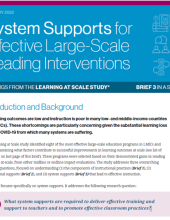
Learning outcomes are low and instruction is poor in many low- and middle-income countries (LMICs). These shortcomings are particularly concerning given the substantial learning loss due to COVID-19 from which many systems are suffering. The Learning at Scale study identified eight of the most effective large-scale education programs in LMICs and now is examining what factors contribute to successful improvements in learning outcomes at scale (see list of programs on last page of this brief). These programs were selected based on their demonstrated gains in reading outcomes at-scale, from either midline or endline impact evaluations. The study addresses three overarching research questions, focused on understanding (1) the components of instructional practices (Brief 1), (2) instructional supports (Brief 2), and (3) system supports (Brief 3) that lead to effective instruction. This brief focuses specifically on system supports. It addresses the following research question: What system supports are required to deliver effective training and support to teachers and to promote effective classroom practices?
Assoc. Photo (Port.)
Brief3.png
Resource (File)
BRIEF-3- System Support.pdf
Resource Type
Resource Language
Month and Year
Publisher Or Client
Center for Global Development, Bill and Melinda Gates Foundation

Instructional Support for Effective Large-Scale Reading Interventions (Learning at Scale)

Submitted by admin on
Description/Abstract
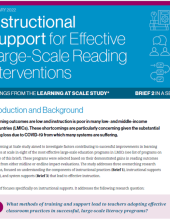
Learning outcomes are low and instruction is poor in many low- and middle-income countries (LMICs). These shortcomings are particularly concerning given the substantial learning loss due to COVID-19 from which many systems are suffering. The Learning at Scale study identified eight of the most effective large-scale education programs in LMICs and now is examining what factors contribute to successful improvements in learning outcomes at scale (see list of programs on last page of this brief). These programs were selected based on their demonstrated gains in reading outcomes at-scale, from either midline or endline impact evaluations. The study addresses three overarching research questions, focused on understanding (1) the components of instructional practices (Brief 1), (2) instructional supports (Brief 2), and (3) system supports (Brief 3) that lead to effective instruction. This brief focuses specifically on instructional supports. It addresses the following research question: What methods of training and support lead to teachers adopting effective classroom practices in successful, large-scale literacy programs?
Assoc. Photo (Port.)
Brief2.png
Resource (File)
Resource Type
Resource Language
Month and Year
Publisher Or Client
Center for Global Development, Bill and Melinda Gates Foundation

Instructional Practices for Effective Large-Scale Reading Interventions (Learning at Scale)

Submitted by admin on
Description/Abstract
The Learning at Scale study aimed to investigate factors contributing to successful improvements in learning outcomes at scale in eight of the most effective large-scale education programs in LMICs (see the map of programs on the last page of this brief). These programs were selected based on their demonstrated gains in reading outcomes at-scale, from either midline or endline impact evaluations. The study addressed three overarching research questions, focused on understanding the components of instructional practices (Brief 1), instructional supports (Brief 2), and system supports (Brief 3) that lead to effective instruction. This brief focuses specifically on instructional practices. It addresses the following research question: What classroom ingredients (e.g., teaching practices, classroom environment) lead to learning in programs that are effective at scale?
Assoc. Photo (Port.)
Brief1.png
Resource (File)
Resource Type
Resource Language
Month and Year
Publisher Or Client
Center for Global Development, Bill and Melinda Gates Foundation