Toolkits and Manuals | 1 October 2024
Supported Peer Assisted Remediation (SPAR) Guide
Remediation -- providing additional support to help students catch up to and/or master the content being taught in class -- is needed by many students but is often challenging to implement.
Presentations | 19 March 2024
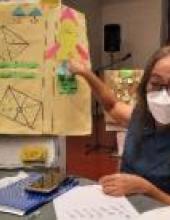
Locally Driven Prototypes of Future Learning Spaces in the Philippines [CIES 2024 Presentation]
We are indeed dealing with a volatile, uncertain, complex, and ambiguous (VUCA) environment. The Philippines suffers natural and man-made vulnerabilities such as typhoons that occur throughout the year, earthquakes, and more recently, the coronavirus disease 2019 (COVID-19) pandemic.
Reports | 29 November 2023
How Teacher Social Networks Might be Leveraged to Enhance Diffusion and Implementation of New Pedagogies
The conventional ways that new pedagogies are taught and supported in low- and middle-income countries rarely leverage the social networks and relationships that are paramount for individuals to shift their beliefs and make positive decisions about adopting new methodologies, and for them to sustain
Reports | 10 January 2023
Co-designing Prototypes for Future Learning Spaces: A Field Guide for Scaling Future Learning Spaces Innovation in the Philippines
The purpose of this field guide is to introduce concepts, tools, and group activities that can be used to
guide educators in co-creating locally defined prototypes of future learning spaces that will not only
enhance social, emotional, and academic learning for all Filipino learners, but will ensure
Reports | 12 September 2022
Philippines Remote Learning Study Report
In June 2020 the Philippines Department of Education (DepEd) adopted the Basic Education Learning Continuity Plan (BE-LCP), a framework to guide the 2020–2021 school year in light of school closures that started in March 2020, during the final weeks of the 2019–2020 school year.
Reports | 22 June 2022
Strengthening institutional capacity to produce learning at scale: Case studies from Jordan, Malawi, Nepal, and Uganda
Case studies of RTI's work on strengthening institutional capacity in Nepal, Jordan, Malawi, and Uganda focusing on three core functions: (1) setting and communicating expectations; (2) monitoring against expectations; (3) providing targeted support to struggling schools.

Presentations | 4 May 2022
Agent-based modeling: Understanding influence of teacher-student interactions on learning and equity [CIES Presentation]
“Agent based modeling: A method for understanding individual, social, and environmental influences on learning and equality in the classroom.”
Learning science in the past decade has provided considerable evidence that learning is at once emotional, social, and cognitive (MH Immordino-Yang, et al 20
Presentations | 26 April 2022
Teacher well-being as a critical element to success of remote learning during the pandemic [Presentation]
This presentation describes findings from a study of the remote learning experience of school actors; school heads, teachers, parents and other HLPs, and learners during the first year of COVID-19 school closures in the Philippines.
Briefs | 23 November 2021
Remote Learning in the Philippines During COVID [Briefs Series]
The Remote Learning Study was conducted during the 2020–2021 school year to investigate how mother-tongue-based multilingual education reading instruction proceeded in 20 schools around the country while classrooms were closed.
1. Strategies for Assisting HLPs_FINAL.pdf (PDF, 406.1 KB)
,
2. Teaching and Learning Materials_FINAL_0.pdf (PDF, 325.87 KB)
,
3. Use of Technology_FINAL_0.pdf (PDF, 214.77 KB)
,
4. Student Engagement_FINAL_0.pdf (PDF, 654.74 KB)
,
5. Challenges and Solutions to Learning Remotely_FINAL_0.pdf (PDF, 205.72 KB)
,
6. School Leadership_FINAL_0.pdf (PDF, 275.46 KB)
,
7. Literacy Instructional Practice_FINAL_0.pdf (PDF, 1.37 MB)
Instruments and Questionnaires | 18 December 2020
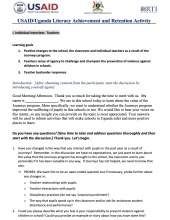
Uganda/LARA: Journeys Impact Qualitative Assessment instruments
LARA developed a set of qualitative tools to learn about the successes and challenges related to the implementation of Journeys and to understand what changes staff and pupils had observed since Journeys started in the program schools.
3. Individual qualitative interview guide for Head teachers and teachers -November 1 2019.docx (DOCX, 52.63 KB)
,
2. FGD Guidelines for Pupils November 1 2019.docx (DOCX, 53.12 KB)
,
4. Focus Group Discussion Guidelines - Teaching and non Teaching staff - November 1 2019.docx (DOCX, 51.65 KB)
,
5. Focus Group Discussion Guidelines - Head teachers and Change Agents - November 1 2019.docx (DOCX, 51.11 KB)