Tajikistan

Country Code
TJK

USAID is Making Durable Contributions to Improved Education in Tajikistan

Submitted by admin on
Description/Abstract
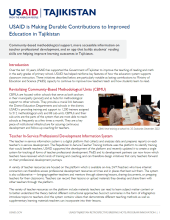
Community-based methodological support, more accessible information on teacher professional development, and an app that builds students’ reading skills are helping improve learning outcomes in Tajikistan. Over the last 10 years, USAID has supported the Government of Tajikistan to improve the teaching of reading and math in the early grades of primary school. USAID has helped reinforce key features of how the education system supports classroom instruction. Three initiatives described below are particularly notable as lasting contributions to Ministry of Education and Science (MoES) capacity to continue to improve how teachers teach and how students learn to read.
Assoc. Photo (Port.)
USAID is Making Durable Contributions to Improved Education in Tajikistan.png
Country
Resource Type
Featured projects
Month and Year
Publisher Or Client
USAID

The Early Grade Reading Assessment (EGRA) in Tajikistan: Time for a New Approach?

Submitted by admin on
Description/Abstract
Over the last decade, USAID has been supporting the Government of Tajikistan (GOT) to improve learning outcomes in primary education. The GOT has not previously used a national objective assessment to measure those learning outcomes. USAID introduced the Early Grade Reading Assessment to measure the impact of its investments. An EGRA has been implemented about every two years since 2013.
Assoc. Photo (Port.)
The Early Grade Reading Assessment (EGRA) in Tajikistan Time for a New Approach.png
Country
Resource Type
Featured projects
Month and Year
Publisher Or Client
USAID

Integrating and Aligning Education Investments with Government Priorities

Submitted by admin on
Description/Abstract
Aligning donor investment with country priorities and effective approaches of engagement are essential for long-term impact. Over the last decade, USAID has been supporting the Government of Tajikistan (GOT) to improve literacy and numeracy skills of all primary education students. Numerous other development agencies also fund projects in the education sector, with an average total annual contribution to education of roughly (based on OECD data). The impact of these investments is less than it could be, in part because there needs to be greater alignment between the government’s priorities and development partner activities.
Assoc. Photo (Port.)
Integrating and Aligning Education Investments with Government Priorities.png
Country
Resource Type
Featured projects
Month and Year

What We Are Learning About Learning Networks [CIES 2024 Presentation]

Submitted by admin on
Description/Abstract
The USAID Leading Through Learning Global Platform (LTLGP) and USAID Improving Learning Outcomes for Asia (ILOA) presented a panel at the 2024 CIES Conference on what each project has been learning about establishing and implementing learning networks. Presentations from three USAID learning networks (HELN, GRN, ECCN) and one regional hub managed by LTLGP along with a presentation from ILOA discuss how each learning network utilizes collaboration, learning, and adapting (CLA) to assess how well their networks are reaching and meeting the needs of their members and how they have adapted and adjusted their networks based on CLA fedback.
Assoc. Photo (Port.)
Networks.png
Resource (File)
Resource Type
Featured projects
Month and Year
Publisher Or Client
USAID

2022 Higher Education in Asia: Strategic Review: Improving Learning Outcomes for Asia (ILOA) Mechanism

Submitted by admin on
Description/Abstract
The United States Agency for International Development's (USAID's) Bureau for Asia conducted a strategic review to examine the depth and breadth of USAID higher education (HE) programming in Asia over the five-year period from 2016 through 2021. The review highlights ways in which USAID's HE programming has been a vehicle for all sectors, not only education, to achieve USAID development objectives. The review's findings and recommendations should inform continued USAID HE investment in Asia. USAID investments in HE support the 2022 lndo-Pacific Strategy (IPS). Within USAID and the interagency, there is a growing interest in HE programming opportunities. This recognition of the role of HE in driving economic development is reflected in its inclusion in the lndo-Pacific Strategy of the United States (White House, 2022), which highlights education as key to regional economic prosperity and security, as well as regional resilience to transnational threats. Unlike in previous strategies, HE is now explicitly noted in the 2022 version of the strategy as a vehicle to advance the United States Government's (USG's) vision for a "free and open lndo-Pacific" (p. 6). This review details examples of how USAID HE investments could support the IPS by countering malign influence, strengthening democratic systems, conducting cutting-edge research to fight the COVID-19 pandemic, and building diverse and equitable partnerships between U.S. and Asian partners. USAID is forging lasting transpacific partnerships through HE investments. In 2021, this engagement included partnerships among 270 higher education institutions (HEls) from across the region and with more than 20 HEls from across the U.S. Programs are aligned with USAID's Education Policy and achieving outcomes in all USAID sectors by "advancing knowledge and research; providing quality and relevant education and workforce training; and engaging and strengthening networks and communities" (Dockser et al., 2020, p. 5) in food security and agriculture; democracy, governance, and human rights; peace and security; economic growth and workforce development; and global health. These investments are advancing locally led development, producing the next generation of leaders, laying the groundwork for more resilient economies and future trade partners, and sustainably advancing American values in a region wary of malign influence.

Assoc. Photo (Port.)
HEactivities_GIS.png
Resource Type
Featured projects
Month and Year

Education system strengthening across Asia: a systematic review of USAID activities and critical discussion [CIES 2023 Panel Presentation]

Submitted by admin on
Description/Abstract
The purpose of this formal group panel presentation is to hold an in-depth discussion on USAID’s investments into system strengthening across Asia over the past decade and how these efforts are situated within the broader global move to focus more intentionally and coherently on education system strengthening. The panel will discuss a 2022 empirical research study (the USAID System Strengthening Review, hereafter “the Review”) conducted by two international research organizations for the USAID Asia Bureau which reviews USAID system strengthening work in 11 Asian countries. This Review offers a qualitative evidence-based analysis relevant to the field of comparative and international education (CIE) and analyzes new data collected from a desk review of relevant project documents, reports, and evaluations, key informant interviews, multi-stakeholder survey, and three deep-dive case studies in Nepal, Cambodia, and the Philippines. The group panel will include three presentations on different aspects of the Review and include discussant commentary and critique to elicit group and audience discussion. The first panel presentation discusses a theoretical framework drawn from the RISE Programme (Pritchett 2015 and Spivak 2021) and recent analysis from the Brookings Institution’s Center for Universal Education. The Review’s central research questions are guided by these broader global trends, as well as its own analysis framework developed specifically for this study, discussed in Presentation 3. Conclusions are drawn based on this framework, and the overall discussion in Presentations 2 and 3 considers the context of USAID programming in Asia and how new knowledge provides new insights.
Assoc. Photo (Port.)
Resource (File)
Resource Type
Featured projects
Month and Year
Publisher Or Client
USAID

Digital transformation: An opportunity for long-lasting improvement of quality of education service delivery in Kyrgyz Republic, Tajikistan, and Uzbekistan [CIES Presentation]

Submitted by admin on
Description/Abstract
Digital transformation: an opportunity for long-lasting improvement of quality of education service delivery in Kyrgyz Republic, Tajikistan, and Uzbekistan Over the past decade, Uzbekistan, Tajikistan, and Kyrgyz Republic have been consistently demonstrating their commitment to quality education, evidenced by the amount of GDP allocated to education. These education systems aim to produce world-class graduates capable of success both globally and at home. Various donors have stepped in to support these efforts in a coordinated way via direct funding of initiatives that enhance instructional skills, increase accountability for excellence, and improve formal and non-formal learning environments. In Uzbekistan, critical thinking, problem solving, and practical skills are at the forefront of the Ministry of Public Education (MPE)’s agenda. In the Kyrgyz Republic, performing well on the upcoming PISA survey in 2025 is a focal point for the Ministry of Education and Science (MOES) in recent years. And, in Tajikistan, COVID-19 provided an important opportunity to rethink the delivery of in-service teacher training from in-person to a blended learning format, resulting in impressive early grade learning gains. However, the COVID-19 crisis brought many education systems to a grinding halt, and these three countries were no exception. Nevertheless, the speed and efficiency with which their education systems adapted has been remarkable. It speaks to their resilience, rooted in the fact that these countries enjoy strong institutional, financial, and policy legacies that are strongly rooted and capable of weathering storms. Undoubtedly, the strongest driving force behind this change is the belief shared at all levels of their education systems – especially at the level of parents and teachers – that education is important. It comes as no surprise that when faced with the challenge of school closure due to a pandemic, their various systemic actors collaborated and adapted their approaches to continue delivering teacher professional development (TPD). In the Kyrgyz Republic, after less than a year following the outbreak of the pandemic, the majority of teachers reported accessing online learning resources, and 85% of teachers did so using smartphones. The USAID-funded Okuu Keremet! project had planned to deliver teacher training in person, but swiftly shifted to development of blended learning modules for reading and mathematics. It designed an online training platform that in a short period of time was accessed by 18,000 registered teachers and librarians. The online learning platform integrates Google Analytics that can allow the Ministry of Education and Science (MOES) to not only monitor progress towards certification of individual teachers, but to also detect, in real time, the teachers and schools that are lagging behind . In Uzbekistan, the Ministry of Public Education (MPE) has made significant investment in continuous professional development, and as part of its growth strategy, Avlonyi has created a Learning Management System (LMS) for teacher accreditation based on OECD teacher professional development standards. To aid Avlonyi in this significant undertaking, the USAID-funded Uzbekistan Education for Excellence Program (UEEP) project developed a blended TPD model comprised of synchronous and asynchronous in-person and online assessment-based learning events (with the focus to improve Information and Communication Technology (ICT) and English as a Foreign Language (EFL) instruction for grades 5–11 and 1-11, respectively). In addition to gaining skills through this opportunity, teachers will achieve career advancement through the accreditation of their efforts by Avlonyi. In Tajikistan, the impact evaluation data shows strong performance as a result of the USAID Read with Me project implemented in collaboration with the Ministry of Education. TPD in Tajikistan applies digital development principles, a multi-user coaching and training platform, which provides content and accountability for self-regulated learning, coaching, peer learning and performance monitoring, including uploading assignments and assessments, aligned with the National Teacher Competency Framework. The EGRA end line results clearly showed the benefit of effective teaching techniques correlating to oral reading fluency gains of more than thirteen correct words per minute. This panel brings together researchers and practitioners documenting the transformational change of Teacher Professional Development in the three Central Asian Republics – Kyrgyz Republic, Uzbekistan and Tajikistan. Panelists will discuss details about the effectiveness and utility of online learning platforms vis-à-vis TPD and student learning gains; the skills required to make this shift to digital, self-regulated learning; and lessons learned for getting these new platforms mainstreamed into educational systems.
Assoc. Photo (Port.)
Screenshot 2023-03-20 145843.png
Resource Type
Month and Year

Early Childhood Education: Considerations for Programming in Educator Quality

Submitted by admin on
Description/Abstract
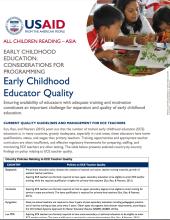
Training opportunities and appropriate teacher curriculum are often insufficient, and effective regulatory frameworks for preparing, staffing, and monitoring ECE teachers are often lacking. This brief presents selected country-by-country findings on policy relating to ECE teacher quality in six countries in Asia.
Assoc. Photo (Port.)
ece educators.jpeg
Resource (File)
Resource Type
Featured projects
Month and Year

Early Childhood Education: Considerations for Programming in Sustainability

Submitted by admin on
Description/Abstract
Governance and financing of early childhood education (ECE) are complex, involving multiple actors, levels, objectives, and approaches, from general expansion of education access to targeted coverage of the most underserved. Coordination of actors and local community engagement in ECE are important dimensions in the governance and sustainability of ECE, above and beyond specific financing sources and arrangements. More than policies or systems alone, the quality and nature of governance is directly linked to a program’s chances for sustainability.
Assoc. Photo (Port.)
ece sustain.jpeg
Resource (File)
Resource Type
Featured projects
Month and Year