Workforce Skills

Guía Pedagógica para tutores educativos de cuarto a sexto primaria y primero básico

Submitted by admin on
Description/Abstract
Esta Guía Pedagógica para tutores educativos de cuarto a sexto primaria y primero básico fue elaborada por la Asociación de Cooperación para el Desarrollo Rural de Occidente (CDRO) en Guatemala, como parte del programa de subvenciones ¡Éxito! de Educación Básica de Calidad para la Transición (Basic Education Quality and Transitions -BEQT). El propósito de esta Guía pedagógica es ser un instrumento orientador a las y los tutores educativos, para reforzar los aprendizajes en las áreas de lectoescritura y matemáticas de niños y niñas de cuarto a sexto primaria y de primero básico, con el propósito de ir mejorando y nivelando las competencias de aprendizaje para que tengan éxito en el proceso de transición al ciclo básico.
Assoc. Photo (Port.)
Guía Pedagógica para Tutores_CDRO.PNG
Country
Resource Type
Featured projects
Resource Language
Month and Year
Publisher Or Client
USAID
Guía sobre los Fondos del Conocimiento (Funds of Knowledge Guide)

Submitted by admin on
Description/Abstract
Esta es una guía informativa para maestros sobre Fondos del Conocimiento y su aplicación en el aula. Los Fondos del Conocimiento hacen referencia al cúmulo de habilidades, experiencias y conocimientos de los estudiantes adquiridos en la vida cotidiana. En esta guía se enfatiza que este tipo de referentes son significativos, pues ayudan a los maestros para aprender sobre sus estudiantes y sus hogares, para reconocer fundamentos particulares de conocimiento aplicables en un entorno escolar. Esta guía fue elaborada por el equipo técnico del Centro de Investigaciones Educativas de la Universidad del Valle de Guatemala, socio implementador de Educación Básica de Calidad para la Transición (Basic Education Quality and Transitions - BEQT, por sus siglas en inglés).
Assoc. Photo (Port.)
FdC Guía.PNG
Country
Resource Type
Featured projects
Resource Language
Month and Year
Publisher Or Client
USAID
Guía sobre el Diseño Universal para el Aprendizaje (DUA)

Submitted by admin on
Description/Abstract
Esta es una guía informativa para maestros sobre el Diseño Universal para el Aprendizaje (DUA). El término DUA alude a un marco científicamente válido para guiar la práctica educativa que: a) proporciona flexibilidad en las formas en las que se presenta la información y en las que el estudiante demuestra su conocimiento de acuerdo a su motivación; b) reduce las barreras adaptándose al estudiante y manteniendo altas expectativas para todos los estudiantes en el aula. Esta guía fue elaborada por el equipo técnico del Centro de Investigaciones Educativas de la Universidad del Valle de Guatemala, socio implementador de Educación Básica de Calidad para la Transición (Basic Education Quality and Transitions - BEQT, por sus siglas en inglés).
Assoc. Photo (Port.)
DUA Guide.PNG
Country
Resource Type
Featured projects
Resource Language
Month and Year
Publisher Or Client
USAID
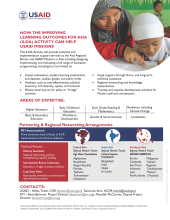
ILOA Fact Sheet

Submitted by admin on
Author
Description/Abstract
One-page fact sheet describing the Improving Learning Outcomes for Asia (ILOA) Activity.
Assoc. Photo (Port.)
ILOA One Pager_updated 2023.10.05.png
Resource (File)
Resource Type
Featured projects
Month and Year

Uganda LARA: Psychosocial Support training facilitators' guide

Submitted by admin on
Description/Abstract
In March 2020, the government of Uganda closed all schools and other educational institutions to mitigate the wide spread of COVID-19. This exposed significant risk especially to rural areas where there is limited access to reading materials or virtual learning platforms to continue learning. Ministry of Education and Sports’ (MoES) Preparedness and Response Plan for COVID-19 (April 2020) outlined measures of continuing learning through radio, take home packages and digital learning. MoES also decided to provide psychosocial support to minimize the adverse effects of COVID-19 on pupils, teachers and the education system at large, through support from USAID/Uganda Literacy Achievement and Retention Activity (LARA).The project planned to support MoES to enhance capacity of Primary Teachers college tutors and administrators to cascade psychosocial support training to head teachers and teachers in 43 districts. The objective of the training was to i) equip participants with knowledge and skills on psychosocial support, ii) identify psychosocial needs and discuss appropriate interventions and iii) apply psychosocial support intervention skills. The Facilitator guide provides information which will help reduce COVID-19 related stress, anxiety and prepare teachers for school reopening. In addition, teachers will be able to protect and provide counselling to pupils.
Assoc. Photo (Port.)
Screen Shot 2020-12-21 at 12.12.50 PM.png
Country
Resource Type
Resource Language
Month and Year
Publisher Or Client
USAID/Uganda Literacy Achievement & Retention Activity

Towards the Development of An Assessment of Employability Skills

Submitted by admin on
Author
Description/Abstract
As the world faces higher and higher unemployment rates among its youth, there is increasing interest in evaluating whether schools are adequately preparing their youth to enter the workforce. Do early school leavers (those leaving by Grade 9) possess the “foundational” and “employability” skills needed to effectively enter the workforce? Assessment instruments for literacy and mathematics appropriate to the end of the primary cycle do exist. However these tend to be in depth, large scale, regional or national assessments and not the rapid assessments that EGRA/EGMA are. In addition, these tools only measure some foundational skills, such as reading and math. Previous investigation on employability skills identified three “clusters” of commonly cited skills in the international literature: cognitive, interpersonal, and intrapersonal skills. These three clusters align favorably with the three domains specified by the Committee on Deeper Learning and 21st Century Skills, convened by the US-based National Research Council, as well as other prominent models. A subset of these skills could be assessed, in combination with foundational skills such as literacy and mathematics, in order to ascertain whether or not youth of secondary school age (i.e. around 15–18 years of age) are finishing their tenure in formal schooling with at least a modicum of “work readiness” skills. This report describes a framework for understanding and measuring employability skills.
Assoc. Photo (Port.)
employability_port.png
Resource (File)
Country
Resource Type
Resource Language
Month and Year
Publisher Or Client
RTI International

"Break Time is Over!" - Forum/Community Theatre Drama Skit Script

Submitted by admin on
Description/Abstract
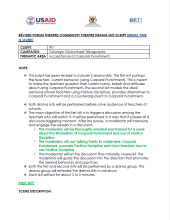
Forum Theatre / Community Theatre Drama Skit Script titled "Break Time is Over!" created by USAID/Uganda's Literacy Achievement and Retention Activity (LARA) as part of their Social and Behavior Change Communication (SBCC) materials to reduce primary teachers' use of corporal punishment in school.
Assoc. Photo (Port.)
BreakTime.PNG
Country
Resource Type
Resource Language
Month and Year

Can big data save labor market information systems?

Submitted by admin on
Author
Description/Abstract
Labor markets desperately need information to function effectively and efficiently, making labor market information systems critical public investments. Yet government systems face significant challenges in collecting quality data, turning it into useable market intelligence, and disseminating it in a timely, relevant manner, a situation more acute in developing countries. The rise of private, real-time labor market information (LMI), such as web-based job posting analytics, social network inferences, crowdsourcing, and mobile phone polling, has garnered interest and questioned the dominance of traditional approaches. This brief explores the use of real-time LMI and presents interviews conducted with international donor officials to gain their perspectives on its applicability in developing countries. I suggest that real-time LMI is unlikely to supplant traditional LMI collection anytime soon, and I dispel notions that these new approaches might leapfrog current data collection challenges. Real-time LMI can provide useful in special cases and for supplemental analysis, an additional lubricant for labor markets that suffer from weak data. Policy that supports the improvement of traditional LMI and promotes access to real-time LMI is warranted.
Assoc. Photo (Port.)
rti press 2.png
Resource (File)
Country
Sub-topic
Resource Type
Month and Year

Linking Learning to Employment: An Answer to the Global Search for Education Quality and Relevance?

Submitted by admin on
Description/Abstract
Current approaches to secondary school are producing high numbers of dropouts and low numbers of students well prepared for college and careers. Given global demand for better education quality and relevance, a reform movement in the US that blends rigorous academic learning and applied technical study may be of interest to other countries. Yet the transport of a successful approach from one country to another must be carefully considered and implemented, with attention paid to local political economy and education system variables. This policy brief discusses the successful US approach—called Linked Learning—and RTI International's approach to adapting it for other country contexts.
Assoc. Photo (Port.)
rti press 1.png
Resource (File)
Country
Sub-topic
Resource Type
Month and Year