Lao People's Democratic Republic

Country Code
LAO

COVID-19 Education Response Mapping Study: Building Resilience in Lao PDR: Readiness, Response, and Recovery

Submitted by admin on
Description/Abstract
This report presents the findings of a document review focused on the Lao People’s Democratic Republic (Lao PDR). This report forms part of a broader study that aims to explore the system and school-level practices that have supported learning continuity in Asia during the pandemic. The report will focus on the practices of policymakers that have the potential to support teaching and learning. Rather than comparing the responses of countries in Asia, this study will identify areas of opportunity and innovations in the system and school policies and programs in Lao PDR and make recommendations for those working to support Lao PDR’s education system.
Assoc. Photo (Port.)
COVID-19 Education Response Mapping Study in Laos_Portrait.png
Resource Type
Featured projects
Month and Year

COVID-19 Education Response Mapping Study in Asia: Full Report

Submitted by admin on
Description/Abstract
This document provides a summary of research exploring the systems, policies, and school-level practices that have supported learning continuity in Asia during and after the COVID-19 pandemic. Based on a review of policy documents on COVID-19 responses in Asia and a deep dive analysis of system and school-level responses in the Philippines and the Kyrgyz Republic, the findings from this study provide policymakers and education stakeholders with evidence of promising practices that could be leveraged to support learning recovery and education system resilience. In addition, a policy review was conducted on the Lao People’s Democratic Republic (Lao PDR), which focused on the practices of policymakers that have the potential to support teaching and learning. The study's intent is not to compare and contrast countries' responses but to highlight innovations in the system and school practices and make recommendations based on insights from system leaders and educators.
Assoc. Photo (Port.)
COVID-19 Education Response Mapping Study in Asia_Portrait.png
Resource (File)
Resource Type
Featured projects
Month and Year

What We Are Learning About Learning Networks [CIES 2024 Presentation]

Submitted by admin on
Description/Abstract
The USAID Leading Through Learning Global Platform (LTLGP) and USAID Improving Learning Outcomes for Asia (ILOA) presented a panel at the 2024 CIES Conference on what each project has been learning about establishing and implementing learning networks. Presentations from three USAID learning networks (HELN, GRN, ECCN) and one regional hub managed by LTLGP along with a presentation from ILOA discuss how each learning network utilizes collaboration, learning, and adapting (CLA) to assess how well their networks are reaching and meeting the needs of their members and how they have adapted and adjusted their networks based on CLA fedback.
Assoc. Photo (Port.)
Networks.png
Resource (File)
Resource Type
Featured projects
Month and Year
Publisher Or Client
USAID

2022 Higher Education in Asia: Strategic Review: Improving Learning Outcomes for Asia (ILOA) Mechanism

Submitted by admin on
Description/Abstract
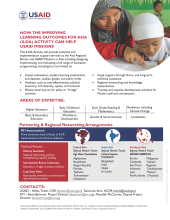
The United States Agency for International Development's (USAID's) Bureau for Asia conducted a strategic review to examine the depth and breadth of USAID higher education (HE) programming in Asia over the five-year period from 2016 through 2021. The review highlights ways in which USAID's HE programming has been a vehicle for all sectors, not only education, to achieve USAID development objectives. The review's findings and recommendations should inform continued USAID HE investment in Asia. USAID investments in HE support the 2022 lndo-Pacific Strategy (IPS). Within USAID and the interagency, there is a growing interest in HE programming opportunities. This recognition of the role of HE in driving economic development is reflected in its inclusion in the lndo-Pacific Strategy of the United States (White House, 2022), which highlights education as key to regional economic prosperity and security, as well as regional resilience to transnational threats. Unlike in previous strategies, HE is now explicitly noted in the 2022 version of the strategy as a vehicle to advance the United States Government's (USG's) vision for a "free and open lndo-Pacific" (p. 6). This review details examples of how USAID HE investments could support the IPS by countering malign influence, strengthening democratic systems, conducting cutting-edge research to fight the COVID-19 pandemic, and building diverse and equitable partnerships between U.S. and Asian partners. USAID is forging lasting transpacific partnerships through HE investments. In 2021, this engagement included partnerships among 270 higher education institutions (HEls) from across the region and with more than 20 HEls from across the U.S. Programs are aligned with USAID's Education Policy and achieving outcomes in all USAID sectors by "advancing knowledge and research; providing quality and relevant education and workforce training; and engaging and strengthening networks and communities" (Dockser et al., 2020, p. 5) in food security and agriculture; democracy, governance, and human rights; peace and security; economic growth and workforce development; and global health. These investments are advancing locally led development, producing the next generation of leaders, laying the groundwork for more resilient economies and future trade partners, and sustainably advancing American values in a region wary of malign influence.
Assoc. Photo (Port.)
HEactivities_GIS.png
Resource Type
Featured projects
Month and Year

ILOA Fact Sheet

Submitted by admin on
Author
Description/Abstract
One-page fact sheet describing the Improving Learning Outcomes for Asia (ILOA) Activity.

Assoc. Photo (Port.)
ILOA One Pager_updated 2023.10.05.png
Resource (File)
Resource Type
Featured projects
Month and Year

Education system strengthening across Asia: a systematic review of USAID activities and critical discussion [CIES 2023 Panel Presentation]

Submitted by admin on
Description/Abstract
The purpose of this formal group panel presentation is to hold an in-depth discussion on USAID’s investments into system strengthening across Asia over the past decade and how these efforts are situated within the broader global move to focus more intentionally and coherently on education system strengthening. The panel will discuss a 2022 empirical research study (the USAID System Strengthening Review, hereafter “the Review”) conducted by two international research organizations for the USAID Asia Bureau which reviews USAID system strengthening work in 11 Asian countries. This Review offers a qualitative evidence-based analysis relevant to the field of comparative and international education (CIE) and analyzes new data collected from a desk review of relevant project documents, reports, and evaluations, key informant interviews, multi-stakeholder survey, and three deep-dive case studies in Nepal, Cambodia, and the Philippines. The group panel will include three presentations on different aspects of the Review and include discussant commentary and critique to elicit group and audience discussion. The first panel presentation discusses a theoretical framework drawn from the RISE Programme (Pritchett 2015 and Spivak 2021) and recent analysis from the Brookings Institution’s Center for Universal Education. The Review’s central research questions are guided by these broader global trends, as well as its own analysis framework developed specifically for this study, discussed in Presentation 3. Conclusions are drawn based on this framework, and the overall discussion in Presentations 2 and 3 considers the context of USAID programming in Asia and how new knowledge provides new insights.
Assoc. Photo (Port.)
Resource (File)
Resource Type
Featured projects
Month and Year
Publisher Or Client
USAID

Early Childhood Education: Considerations for Programming in Early Learning Assessment

Submitted by admin on
Description/Abstract
Assessment of learning and the quality of early learning environments is an important component of early childhood education. This brief outlines the existing early learning assessments of children and environments used in the Asia region, excluding diagnostic and screening assessments.
Assoc. Photo (Port.)
ece assessment.jpeg
Resource (File)
Resource Type
Featured projects
Month and Year

Early Childhood Education: Considerations for Programming in Educator Quality

Submitted by admin on
Description/Abstract
Training opportunities and appropriate teacher curriculum are often insufficient, and effective regulatory frameworks for preparing, staffing, and monitoring ECE teachers are often lacking. This brief presents selected country-by-country findings on policy relating to ECE teacher quality in six countries in Asia.
Assoc. Photo (Port.)
ece educators.jpeg
Resource (File)
Resource Type
Featured projects
Month and Year

Early Childhood Education: Considerations for Programming in Sustainability

Submitted by admin on
Description/Abstract
Governance and financing of early childhood education (ECE) are complex, involving multiple actors, levels, objectives, and approaches, from general expansion of education access to targeted coverage of the most underserved. Coordination of actors and local community engagement in ECE are important dimensions in the governance and sustainability of ECE, above and beyond specific financing sources and arrangements. More than policies or systems alone, the quality and nature of governance is directly linked to a program’s chances for sustainability.
Assoc. Photo (Port.)
ece sustain.jpeg
Resource (File)
Resource Type
Featured projects
Month and Year

Early Childhood Education: Considerations for Programming in Asia

Submitted by admin on
Description/Abstract
This report examines available evidence from the Asia region on the current state of ECE interventions, focusing on the 10 countries in the region3 that currently benefit from US Agency for International Development (USAID) education programming. In Asia, many national governments have prioritized the expansion of access and quality improvements of pre-primary education (Sun, Rao, & Pearson, 2015). USAID will support those efforts as part of a coherent approach to improved learning outcomes in primary school.
Assoc. Photo (Port.)
ece report.jpeg
Resource Type
Featured projects
Month and Year