Reform Support

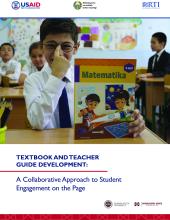
TEXTBOOK AND TEACHER GUIDE DEVELOPMENT - A Collaborative Approach to Student Engagement on the Page

Submitted by admin on
Description/Abstract
The Uzbekistan Ministry of Preschool and School Education (MoPSE) spearheaded an initiative to reform its curricula based on international best practices. The USAID-funded Uzbekistan Education for Excellence Program brought together a diverse cohort of international and local experts to help revitalize the country’s public school curricula under the leadership of RTI International. Together with MoPSE staff, the Program addressed the challenges of increasing student engagement and critical thinking by developing standards-based textbooks and teacher guides for Uzbek Language Arts (ULA) and mathematics.
Assoc. Photo (Port.)
Pages from 13_Brief_Process_TLM_Development_Final_ENG.jpg
Resource (File)
Country
Resource Type
Featured projects
Month and Year

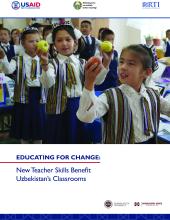
EDUCATING FOR CHANGE - New Teacher Skills Benefit Uzbekistan’s Classrooms

Submitted by admin on
Description/Abstract
Educators are the critical link between learning materials and students. Their approach to instruction influences learning and classroom dynamics every day. While the Government of Uzbekistan has made significant investments in regular professional development opportunities for teachers, the trainings reinforced a teachercentered instruction style. In the classroom, teachers struggled to practically address diverse student needs. While some students excelled in this environment, many fell behind.
Assoc. Photo (Port.)
Pages from 12_Brief_IMPACT_TPD_Final_ENG.jpg
Resource (File)
Country
Resource Type
Featured projects
Month and Year

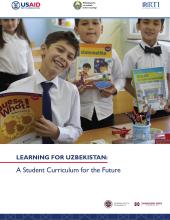
LEARNING FOR UZBEKISTAN - A Student Curriculum for the Future

Submitted by admin on
Description/Abstract
A national curriculum and its learning materials are the backbone of an education system. At their best, they reflect student needs, a country’s aspirations for its youth, and a realistic path to gaining the knowledge that will bridge them. The Government of Uzbekistan Ministry of Preschool and School Education (MoPSE) is investing in a strong education system for the long-term success of students and the nation. Uzbekistan boasts an impressive adult literacy rate of over 99 percent and the country’s support for education is evidenced in the policies and executive decrees of recent years. Yet, challenges persisted in the national curriculum and educational materials,which were not well integrated and did not consistently reflect current evidence on how children learn nor the unique context of Uzbek youth.
Assoc. Photo (Port.)
Pages from 11_Brief_IMPACT_TLM_Final_ENG.jpg
Resource (File)
Country
Resource Type
Featured projects
Month and Year

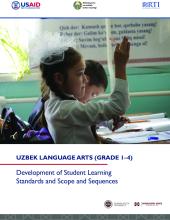
UZBEK LANGUAGE ARTS - Development of Student Learning Standards and Scope and Sequences

Submitted by admin on
Author
Description/Abstract
Central to the Ministry of Preschool and School Education (MoPSE) reform agenda is the shift to a modern standards-based education approach that aligns instruction and outcomes to specific competencies or standards. Such an approach includes student learning standards — the knowledge, concepts, and skills that students need to acquire — and materials, assessments, instructional practices, and teacher professional development that align to the student standards. In 2019, the Republican Education Center defined learning objectives for each subject in the benchmark years and stated that improvement was needed to develop well-defined, wellarticulated, and grade-level appropriate standards for language arts skill areas of listening, speaking, reading, and writing for each grade. A move to a standards-based approach required that instructional materials aligned to standards and that teachers were equipped with the resources they need to bring standards-based instruction to life in their classroom.
Assoc. Photo (Port.)
Pages from 09_Brief_ULA_Stn_SnS_Final_ENG.jpg
Resource (File)
Country
Resource Type
Featured projects
Month and Year

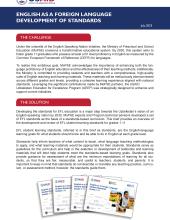
ENGLISH AS A FOREIGN LANGUAGE - DEVELOPMENT OF STANDARDS

Submitted by admin on
Author
Description/Abstract
Developing the standards for EFL education is a major step towards the Uzbekistan’s vision of an English-speaking nation by 2030. MoPSE experts and Program technical advisors developed a set of EFL standards as the basis of a standards-based curriculum. This brief provides an overview of the development and review of EFL student learning standards for grades 1-11
Assoc. Photo (Port.)
Pages from 04_Brief_EFL_Stn_Final_ENG.jpg
Resource (File)
Country
Resource Type
Featured projects
Month and Year

ENGLISH AS A FOREIGN LANGUAGE - DEVELOPMENT OF SCOPE AND SEQUENCE

Submitted by admin on
Author
Description/Abstract
Uzbekistan’s education reform envisions a competency-based curriculum consisting of standards, a scope and sequence (S&S), textbooks, and teacher guides that align with an assessment system. The scope is the vocabulary, grammar, and skills that are taught over the course of a school year, and the sequence is the order in which those skills and content are presented. The S&S is an important element of a national curriculum and serves two primary purposes. First, it elucidates the curriculum, detailing the constituent elements of the standards or competencies, thus breathing life into the national curriculum framework. Second, it provides a blueprint for national textbooks, detailing content and its order. As a blueprint for the textbook, the S&S becomes the assessment framework as it identifies the skills, grammar, and vocabulary taught at any point in the academic year.
Assoc. Photo (Port.)
Pages from 03_Brief_EFL_SnS_ENG.jpg
Resource (File)
03_Brief_EFL_SnS_ENG.pdf
Country
Resource Type
Resource Language
Month and Year

Jordan Early Grade Assessment Framework The Early Grade Reading and Math Initiative (RAMP)

Submitted by admin on
Author
Description/Abstract
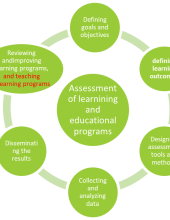
In 2021, Jordan’s Ministry of Education (MOE) is committed to modernizing education assessment and enhancing learning outcomes. The Early Grades Reading and Mathematics Initiative (RAMP) played a crucial role in conceptualizing the early grade assessment framework. The MOE recognized the need for a more effective and cohesive assessment system. it highlights the issues of misalignment and lack of coordination between national and international assessments, resulting in an inability to accurately measure student performance across different grades. It emphasizes the need for a comprehensive assessment system and policies to ensure consistency and monitor the quality of education in MOE's schools. As part of the RAMP sustainability plan, a comprehensive framework for early-grade assessment was developed to incorporate the latest trends in student learning assessment and enhance educational outcomes. The Directorate of Tests, in collaboration with RAMP experts, conducted an analysis of the current early-grade assessment system, identifying areas requiring improvement. A joint Ministry and RAMP team, in consultation with international evaluation experts from the RTI organization, created the framework and provided recommendations to address existing gaps. Subsequently, this framework was shared with MOE's technical departments and the National Curriculum Development Center for final approval. The Early Grades Assessment Framework has significantly benefited the MOE at both the central and field levels, including schools and field districts, by: 1. Defining and communicating clear learning expectations at all levels, including learning standards and indicators. 2. Preventing excessive evaluation practices. 3. Offering capacity-building programs for supervisors and teachers related to formative and summative assessments. 4. Utilizing assessment data to enhance student learning and promote inclusive teaching and learning for all children. 5. Formulating regulations and procedural guidelines for national assessments in early grades, thereby ensuring their sustainability and securing financial resources for implementation. The MOE introduced a structured assessment process, incorporating the Early Grade Reading Assessment (EGRA/EGMA) and the Lot Quality Assurance Sampling (LQAS) methodology to gauge students' foundational knowledge and skills. This approach helped identify areas where students needed additional support. Extending foundational learning assessment to the classroom level allowed for tailored support to students in need, fostering inclusivity. The revamped assessment approach brought about positive changes. LQAS results informed support strategies for districts, individual schools, and teachers. Classroom-level assessments allowed differentiated support to students. The Ministry of Education's (MOE) commitment to aligning the assessment framework with expected learning outcomes has yielded positive results and has paved the way for further improvements in Jordan's education system. As evidence of this commitment, the results of the EGRA/EGMA end-line survey conducted in May 2023 demonstrate significant improvements in the reading and mathematics skills of Grade 2 (G2) and Grade 3 (G3) students compared to 2019 and 2021. For example, G2 students in traditional MoE schools have shown remarkable progress, with their reading proficiency increasing from 10.7% in 2021 to 42.4%, while G3 students improved from 39.4% to 60.3%. The MOE's unwavering commitment to aligning assessment with learning outcomes has yielded tangible, positive results. As Jordan continues its journey towards educational excellence, the comprehensive assessment framework for early grades stands as a testament to the dedication and innovation of the MOE and its partners. By placing learning outcomes at the forefront, Jordan is not just shaping a brighter future for its students but also setting a remarkable example for education systems worldwide. Stay tuned for more updates as Jordan's education transformation unfolds. The future looks promising, indeed.
Assoc. Photo (Port.)
Picture1.png
Resource (File)
Country
Featured projects
Resource Language
Month and Year
Publisher Or Client
USAID and UKaid
Nigeria Hausa Teacher Guide, Grade 2

Submitted by admin on
Description/Abstract
This early grade reading material is made possible through the United States Agency for International Development (USAID) under the Nigeria Reading and Access Research Activity (EdData Task Order Number 26, EHC-E-00-04-00004-00) implemented by RTI International. It was tested in a controlled experiment that demonstrated effectiveness of the approach on improving reading skills.There is a corresponding pupil book and a collection of read alouds with related activities.
Assoc. Photo (Port.)
Screenshot 2023-07-31 at 14.53.44.png
Resource (File)
Country
Resource Language
Month and Year
Publisher Or Client
USAID

Education Reform Support Today

Submitted by admin on
Description/Abstract
Traditional projects in education introduce innovations at the school level, sometimes improving learning in a defined number of schools. The hope is that somehow piloted successes can be replicated or taken to scale. But too often they are not. Dissatisfied with this, donors may choose policy-level interventions that promote resource reallocations, specific policy reforms, and investments in administrative and management capacity to effect system-wide change. But the record of policy reforms having impact on learning at the school level is disappointing. If we fund school-level projects, the challenge lies in how to create policy and institutional reforms that support replicable school-level success. If we support policy-level interventions, the challenge lies in how to ensure that national reforms lead to changes in the day-to-day practice of schools. Both approaches require effective programs of what we call reform support. Why is reform support needed? Ten years ago USAID published the Education Reform Support (ERS) series to answer just this question. ERS recognizes that the existing arrangements in the education sector—urban-rural inequities, management environments skewed by bureaucratic concerns, teaching improvements constrained by union prerogatives—are not accidental. Powerful political forces benefit from, shape, and defend the current situation. Changes within the system cannot realistically be implemented without first dealing with the preexisting institutional environment. Altering that environment means recognizing who stands to win or lose from pro-posed reforms, and what incentives signal them to either work for change or defend the status quo. The literature supporting such an understanding of education reform is rich. ERS draws on that literature and goes one step further to outline the tools and techniques for sup-porting and strategically managing the reform process.
Assoc. Photo (Port.)
Screenshot 2023-06-01 093329.png
Resource (File)
Country
Resource Type
Month and Year
Publisher Or Client
USAID

Education system strengthening across Asia: a systematic review of USAID activities and critical discussion [CIES 2023 Panel Presentation]

Submitted by admin on
Description/Abstract
The purpose of this formal group panel presentation is to hold an in-depth discussion on USAID’s investments into system strengthening across Asia over the past decade and how these efforts are situated within the broader global move to focus more intentionally and coherently on education system strengthening. The panel will discuss a 2022 empirical research study (the USAID System Strengthening Review, hereafter “the Review”) conducted by two international research organizations for the USAID Asia Bureau which reviews USAID system strengthening work in 11 Asian countries. This Review offers a qualitative evidence-based analysis relevant to the field of comparative and international education (CIE) and analyzes new data collected from a desk review of relevant project documents, reports, and evaluations, key informant interviews, multi-stakeholder survey, and three deep-dive case studies in Nepal, Cambodia, and the Philippines. The group panel will include three presentations on different aspects of the Review and include discussant commentary and critique to elicit group and audience discussion. The first panel presentation discusses a theoretical framework drawn from the RISE Programme (Pritchett 2015 and Spivak 2021) and recent analysis from the Brookings Institution’s Center for Universal Education. The Review’s central research questions are guided by these broader global trends, as well as its own analysis framework developed specifically for this study, discussed in Presentation 3. Conclusions are drawn based on this framework, and the overall discussion in Presentations 2 and 3 considers the context of USAID programming in Asia and how new knowledge provides new insights.
Assoc. Photo (Port.)
Resource (File)
Resource Type
Featured projects
Month and Year
Publisher Or Client
USAID