Reform Support

Measurement and Use of Education Data across the Asia Region

Submitted by admin on
Description/Abstract
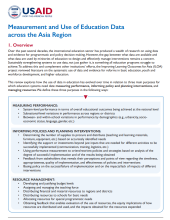
The Improving Learning Outcomes for Asia (ILOA) regional project works closely with USAID’s Asia Bureau and Missions across the region to identify key questions and challenges Mission staff face in their day-to-day work. An advisory group of USAID Mission colleagues raised an important question: how best to wade through the array of education data available? What are the types, how are they used, when are different data useful, etc.? Indeed, the use of different data to effectively partner with governments to make evidence-based decisions is a top priority. As a result, ILOA produced a brief summarizing the different sources and uses of data for basic education, youth and workforce development, and higher education. The brief recognizes how data sources and uses have evolved over time, enabling ministries, their partners, and stakeholders to measure performance, inform policy and plan interventions, and manage limited resources. The brief is designed to succinctly assist USAID staff and their partners in navigating the world of education data.
Assoc. Photo (Port.)
Iloa 1 port.png
Resource (File)
Country
Resource Type
Featured projects
Month and Year

Lot Quality Assurance Sampling (LQAS) Guide

Submitted by admin on
Description/Abstract
The LQAS methodology has a number of objectives in the education sector, including: Holding schools greater accountability; Increasing implementation fidelity and credibility; Identifying schools or regions (field directorates) that needs extra support to assist them; Identifying areas for improvement to conduct reforms contributing to increase the effectiveness of the initiative; Providing an assessment methodology that enables the ministry to assess the students’ outcomes with high credibility and is used at all administrative levels in the ministry; and Providing relevant, reliable, and timely data.
Assoc. Photo (Port.)
Capture.PNG
Resource (File)
LQAS SOP 2022.pdf
Country
Resource Type
Featured projects
Resource Language
Month and Year

Uncovering Risks During Compounded Crises [CIES 2024]

Submitted by admin on
Description/Abstract
The presentation summarizes findings from the Rapid Education Risk Analysis for Lebanon
Assoc. Photo (Port.)
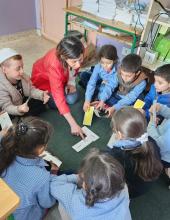
Teacher using Arabic Portfolio ressources with the students.jpg
Resource (File)
CIES PPT_March 11.pdf
Country
Resource Type
Resource Language
Month and Year
Publisher Or Client
USAID

The Ant and the Grasshopper: Lessons for Collaborative Planning in a Changing World [CIES 2024 Presentation]

Submitted by admin on
Description/Abstract
As economies in the global-South mature and calls for decolonizing international assistance become louder, it becomes increasingly important to reimagine the design, planning and implementation of international assistance. This paper will explore the evolution of the relationship between an international funding agency and partner Ministry over a decade of program implementation. USAID has implemented three consecutive education projects in Tanzania since 2011 that focus on improving the quality of teaching to enhance learning outcomes, starting with the USAID Tanzania 21st Century activity. Over time, these programs have shifted the nature of implementation and engagement with Government with the goal of institutionalizing program activities within the administrative structure of the Tanzanian education system. This paper discusses the strategies used under the two most recent activities (Tusome Pamoja and Jifunze Uelewe) and the associated outcomes, providing options for future collaborative engagement. Education service delivery for basic education in Tanzania is a shared responsibility on the mainland, with Ministry of Education and Sports (MoEST) providing policy direction and quality assurance and the President’s Office – Regional Administration and Local Governance (PO-RALG) managing curriculum delivery through the schools. USAID has supported the provision of teaching and learning materials, teacher professional development, sub-national management and community engagement. In this paper we discuss the evolution of four strategies for collaboration: (i) alignment with Government policies; (ii) collaborative work planning; (iii) exploiting opportunities; (iv) consistent communication strategies. Projects, by nature, are perceived as short-term interventions independent of broader system administration. They are frequently perceived as an additional administrative burden but bringing the advantage of substitutive financing. This presentation discusses how Tusome Pamoja addressed these perceptions and expectations, by recognizing the need to demonstrate the alignment between Government initiatives and activity support. We further discuss how consistent and flexible communication led to significant achievement of Government approval of new national guidelines for school quality assurance, parent engagement, and teacher continuous professional development. We will highlight how the most recent activity (Jifunze Uelewe) made significant adjustments to its annual work planning process to address the mismatch between the work planning and budget cycles of the governments of US and Tanzania. We also discuss how clarity and coherence of communication internally between project management and USAID ensured a unified and consistent messaging strategy, with USAID communicating at the political level while project staff engaging at the technical level. This ensured that when important shifts in service delivery implementation were elevated from technical to political approval, the context and concept was already well understood. The presentation will conclude by highlighting that the path to successful collaboration rests upon several critical factors. These include a deep understanding of the political context, the relative power of personalities and positions with the extant institutional structures, consistent communication and an understanding of vested interests. Flexibility and coordination between funder and implementer is key to success.
Assoc. Photo (Port.)
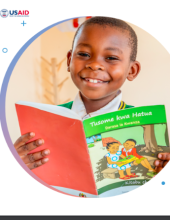
ju port.PNG
Resource (File)
Resource Type
Month and Year
Publisher Or Client
USAID Jifunze Uelewe
ULA and Mathematics Teaching and Learning Materials Uptake Study (Phase 2)

Submitted by admin on
Author
Description/Abstract
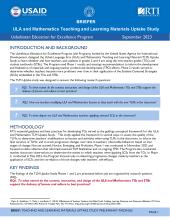
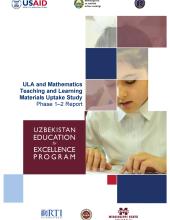
The Uzbekistan Education for Excellence Program (the Program), funded by the United States Agency for International Development, designed the Uzbek Language Arts (ULA) and Mathematics Teaching and Learning Material (TLM) Uptake Study to learn whether and how teachers and students in grades 2 and 4 are using the new teacher guides (TGs) and student textbooks (STBs). The Program used Phase 1 results and ensuing recommendations to inform the development and finalization of materials and ongoing teacher professional development (TPD) efforts. Phase 2 results served to determine whether teachers became more proficient over time in their application of the Student-Centered Strategies (SCSs) embedded in the TGs and STBs.
Assoc. Photo (Port.)
TLM Phase 2 Briefer.jpg
Resource (File)
TLM Phase 2 Briefer.pdf
Country
Resource Type
Month and Year

Uzbek Language Arts and Mathematics Teaching and Learning Materials Uptake Study Phase 1–2 Report

Submitted by admin on
Author
Description/Abstract
The goal of this study was to learn whether and how teachers in grades 2 and 4 were using the new ULA and Mathematics TG and STBs and applying the SCSs therein. The study consisted of two phases. The Program used Phase 1 results and ensuing recommendations to inform the development and finalization of materials and ongoing TPD efforts. Phase 2 results served to determine whether teachers became more proficient over time in their application of the SCSs embedded in the TGs.
Assoc. Photo (Port.)
Pages from ULA and Mathematics.jpg
Country
Resource Type
Featured projects
Month and Year

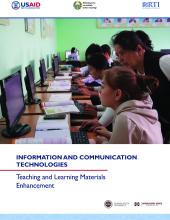
ICT - Teaching and Learning Materials Enhancement

Submitted by admin on
Author
Description/Abstract
In November 2018, the Republic of Uzbekistan Ministry of Preschool and School Education (MoPSE) announced its Information Technology Nation initiative, which is aimed at producing graduates with the ability to work in cyber security, software development and testing, network administration, graphic design, animation, and game design. To achieve these outcomes, the public education system began addressing a series of critical constraints, including access to information and communication technology (ICT) hardware and broadband access at the school level, time allocated to ICT classes, and outdated standards and curriculum for ICT education, which should better reflect assessments of ICT skills and current labor market and university demands.
Assoc. Photo (Port.)
Pages from 06_Brief_ICT_TLM_Final_ENG.jpg
Resource (File)
Country
Resource Type
Month and Year

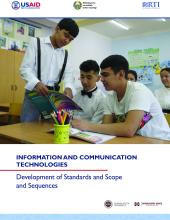
ICT - Development of Standards and Scope and Sequences

Submitted by admin on
Author
Description/Abstract
The U.S. Agency for International Development’s Uzbekistan Education for Excellence Program supported the Ministry to review the standards and curriculum, a supportive teacher professional approach, and piloting to enhance ICT instruction. The Program mobilized local experts from the Republican Education Center and international experts from Mississippi State University’s International Institute and Center for Cyber Education to begin the process by developing standards for grades 1–11 for ICT education. ICT standards development is a major step toward Uzbekistan’s vision of producing graduates with critical thinking, problem-solving, and practical skills that will enable them to succeed. This brief provides an overview of the development and review of ICT student learning standards and scopes and sequences.
Assoc. Photo (Port.)
Pages from 05_Brief_ICT_Stn_SnS_Final_ENG.jpg
Resource (File)
Country
Resource Type
Featured projects
Month and Year

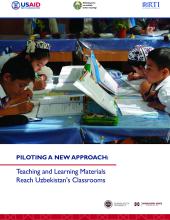
PILOTING A NEW APPROACH - Teaching and Learning Materials Reach Uzbekistan's Classrooms

Submitted by admin on
Description/Abstract
With a modern, robust new curriculum carefully prepared by local and international experts to meet the needs of Uzbekistan’s students, how would the Ministry of Preschool and School Education (MoPSE) ensure the effectiveness of textbooks and teacher guides in the classroom? The new teaching and learning materials (TLMs) created and customized by the USAID-funded Uzbekistan Education for Excellence Program in partnership with the MoPSE were developed through a multi-step, participatory process. Input from international experts and Uzbekistan primary teachers and academics grounded the modern methods and practices in the local context. To evaluate the use and value of these TLMs for students and educators, the Program led an extensive pilot initiative.
Assoc. Photo (Port.)
Pages from 15_Brief_Process_Piloting_Final_ENG.jpg
Resource (File)
Country
Resource Type
Featured projects
Month and Year

EDUCATION RESEARCH - New Knowledge for Improved Outcomes

Submitted by admin on
Description/Abstract
The Uzbekistan Education for Excellence Program led the development of a groundbreaking curriculum based on international best practices and contributions from local experts. The approach was rooted in a theory of change that identified long-term goals (outcomes) and the interconnecting outputs and conditions to achieve them. In collaboration with the Uzbekistan Ministry of Preschool and School Education (MoPSE), the Program developed education standards, scope and sequences, new textbooks and teacher guides, and continuous professional development training for educators in pilot schools among other activities and products. Throughout this process, the Program sought to test the theory of change, fill critical gaps in knowledge about the Uzbek educational system, and determine what kind of research would be most responsive to this breadth of interventions and the complex nature of classroom dynamics.
Assoc. Photo (Port.)
Pages from 14_Brief_Process_Research_Final_ENG.jpg
Resource (File)
Country
Resource Type
Featured projects
Month and Year