Early Mathematics Development

Mathematics from the Beginning: Evaluating the Tayari Preprimary Program’s Impact on Early Mathematics Skills

Submitted by admin on
Description/Abstract
Given the dearth of research on early numeracy interventions in low- and middle-income countries, this paper presents the instructional methodology and impact results of the Tayari program. Tayari is a preprimary intervention in Kenya (2014–2019) that prepares children aged four and five for entry into primary school by providing materials for students, training for teachers, and continuous in-classroom support. The Tayari methodology was built on the Kenyan government’s preprimary syllabus to produce instruction that was developmentally sequenced, linked to out-of-school experiences, and supportive of children’s number sense. Tayari was evaluated using a randomized controlled trial (RCT) and collection of longitudinal data from 2,957 children in treatment and control schools at three time points. Pupil assessment items were drawn from a growing body of research on preprimary numeracy in developing contexts, plus instruments and techniques from the Measuring Early Learning and Quality Outcomes (MELQO) program (UNESCO, UNICEF, Brookings Institution, & World Bank Group, 2017). The impact evaluation of the longitudinal RCT results showed statistically significant effects in the numeracy tasks of producing sets, identifying numbers, and naming shapes, while revealing no initial effects in the areas of oral and mental addition. We present recommendations for Tayari’s improvement in terms of mathematics instruction, as well as preprimary policy implications for Kenya and similar contexts.
Assoc. Photo (Port.)
Screen Shot 2019-01-04 at 11.31.14 AM.png
Country
Resource Type
Resource Language
Month and Year
Publisher Or Client
Global Education Review

Capturing Children’s Mathematical Knowledge: An Assessment Framework.

Submitted by admin on
Description/Abstract
This paper explores an innovative assessment framework for measuring children’s formal and informal mathematical knowledge. Many existing standardized measures, such as the Early Grade Mathematics Assessment, measure children’s performance in early primary grade skills that have been identified by researchers and policy makers as foundational and predictive of later academic achievement (Platas, Ketterlin-Geller, & Sitabkhan, 2016; RTI International, 2014). However, these standardized assessments only provide information on children’s mathematical ability as it pertains to skills and concepts that are a focus of school instruction, referred to as formal mathematics. While valuable, they leave unmeasured the mathematics that children use and develop as part of their everyday life, such as the strategies they use to solve simple arithmetical problems that arise as they move through their day (Khan, 1999; Saxe, 1991; Taylor, 2009). In this article, we draw from mixed methods studies which focus on capturing the informal mathematical skills that children develop outside of school in various contexts (Guberman, 1996; Nasir, 2000; Sitabkhan, 2009; Sitabkhan, 2015). We describe how the use of observations of children’s mathematical activities in natural settings and in subsequent cognitive interviews using mathematical tasks derived from those observations, can illuminate mathematical knowledge and skills that may otherwise remain hidden. We found that an assessment framework that focuses on both standardized measures of formal mathematical learning and contextualized measures of children’s everyday mathematics can provide a more complete and nuanced picture of children’s knowledge, and taken together can inform the development of curricular materials and teacher training focused on early learning.
Assoc. Photo (Port.)
Screen Shot 2019-01-04 at 11.26.35 AM.png
Country
Resource Type
Resource Language
Month and Year
Publisher Or Client
Global Education Review

Tayari At A Glance

Submitted by admin on
Author
Description/Abstract
This "At A Glance" guide presents an overview of the Kenya Tayari program in Kenya. This four year program has supported the Kenyan Ministry of Education and County Governments to improve quality of early childhood development and education (ECDE) for over 240,000 young children.
Assoc. Photo (Port.)
ECD Umoja (125).JPG
Resource (File)
Country
Resource Type
Resource Language
Month and Year

Early Mathematics Counts: Promising Instructional Strategies for Low- and Middle- Income Countries

Submitted by admin on
Description/Abstract
There is a large body of evidence substantiating the importance of mathematical literacy and the key role of foundational mathematics in early years of education on later academic outcomes (Duncan et al., 2007; Duncan & Magnuson, 2011; Hanushek & Woessmann, 2008; Siegler et al., 2012). Despite this, we have little evidence from low- and middle-income countries on how to better ensure that students are learning the foundational skills in pre-primary through lower primary grades. Given that quality of instruction is key, we examined the evidence for the types of instructional strategies used in low- and middleincome contexts. We cannot link the effective instructional strategies to learning outcomes, given the limited information provided in reports we reviewed. However, understanding which strategies are used, and how they manifest in different contexts, is an important first step to understanding which strategies are effective for learning. This brief summarizes our review paper (Sitabkhan & Platas, 2018).
Assoc. Photo (Port.)
EarlyMathBrief_071818.jpg
Resource (File)
EarlyMathBrief_071818.pdf
Country
Resource Type
Resource Language
Month and Year
Publisher Or Client
RTI

Early Mathematics Counts: Promising Instructional Strategies for Low- and Middle- Income Countries

Submitted by admin on
Description/Abstract
This paper examines common instructional strategies in early grade mathematics interventions through a review of studies in classrooms in low- and middle-income countries. Twenty-four studies met the criteria for inclusion, and analyses reveal four sets of instructional strategies for which there is evidence from multiple contexts. Of the 24 studies, 16 involved the use of multiple representations, 10 involved the use of developmental progressions, 6 included supporting student use of explanation and justification, and 5 included integration of informal mathematics. Based on the review, we provide conclusions and recommendations for future research and policy.
Assoc. Photo (Port.)
Picture1.png
Resource (File)
Sitabkhan_Platas_2018.pdf
Country
Resource Type
Resource Language
Month and Year
Publisher Or Client
RTI Press

Stumbling at the First Step: Efficiency implications of poor performance in the foundational first five years

Submitted by admin on
Description/Abstract
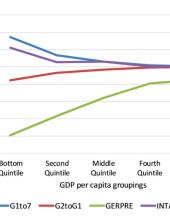
This paper highlights patterns in school enrollment indicators that affect the efficiency and effectiveness of education systems in a set of low-income countries: those that have expanded access quickly in the last decade or two, but have not yet absorbed that expansion efficiently. Although the patterns in these indicators are observable in the first few years of schooling, they could constitute a cause of low learning outcomes at the end of primary school. The data show strong empirical relationships between an early primary enrollment bulge, low levels of pre-primary participation, and poor performance on early grade cognitive skills. This work does not attribute causal precedence to these patterns but instead argues that the indicators are reflections of each other, constituting a ‘‘knot’’ of issues undermining the foundations of the affected education systems. The article presents some of the cost implications and suggests that many countries are already paying for pre-primary education without realizing it.
Assoc. Photo (Port.)
stumbling graph.jpg
Country
Resource Type
Resource Language
Month and Year
Publisher Or Client
Prospects

Understanding pre-primary quality in Tanzania: Data from the MELQO study- CIES 2018 Presentation

Submitted by admin on
Description/Abstract
CIES 2018 Presentation, given by Tara Weatherholt. A current challenge in the equitable access to quality pre-primary education for young children is the current lack of relevant and reliable data on pre-primary education to inform improvement of the education sector in developing country contexts. In 2015, the global Measuring Early Learning and Quality Outcomes (MELQO) initiative was formed by UNICEF, UNESCO, the World Bank, and the Brookings Institution to focus on facilitating feasible, accurate, and useful measurement of young pupils’ development at the start of primary school as well as the quality of pre-primary learning environments, particularly in low- and middle-income countries. The first nationally representative school readiness study utilizing the MELQO suite of instruments was recently completed in Tanzania. This presentation will report on the quality of pre-primary education environments in both Mainland Tanzania and Zanzibar, as found through the national MELQO study conducted in early 2017, and how this may inform sector improvement.
Assoc. Photo (Port.)
Pages from Weatherholt, Tara_CIES2018_Tanzania pre-primary quality.jpg
Resource Type
Month and Year

Instructional models in early mathematics: Can the "I do, we do, you do" model support the development of mathematical thinking? CIES 2018 Presentation

Submitted by admin on
Author
Description/Abstract
CIES 2018 Presentation, given by Yasmin Sitabkhan. The purpose of this presentation is to explore the applicability of the direct instruction (DI) model (also known as the “I do, We do, You do” model) for early grades mathematics instruction in low-income contexts through data gathered on two projects, the Tayari Early Childhood Project in Kenya and the Liberia Teacher Training Project (LTTP2). The results from the two studies point to the effectiveness of the gradual release of responsibility model for early mathematics instruction. The model as it is, with an explicit I do, we do, and you do” section for each concept, does not align with best practices in early mathematics instruction. However, the workshop model, which essentially is a “we do, you do” model, may foster more productive instruction that encourages critical thinking and problem-solving behavior.
Assoc. Photo (Port.)
Pages from Sitabkhan, Yasmin_CIES2018_MathInstructionModel.jpg
Country
Resource Type
Month and Year

Linking literacy and numeracy in Tayari- CIES 2018 Presentation

Submitted by admin on
Author
Description/Abstract
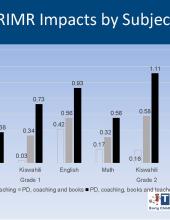
CIES 2018 Presentation, given by Ben Piper. To improve the quality of preprimary education in Kenya, the Ministry of implemented the Tayari program in collaboration with four county governments. The program works with government officers to train teachers and support them in the classroom on a daily basis. Teachers rely on Teachers’ Guides developed to guide them in their lessons and are encouraged to expand children’s learning through two core strategies: the use of materials and extended learning. This presentation details one way in which reading and mathematics can be intertwined on a project through consistent instructional messages in trainings, materials for teachers, and support visits.
Assoc. Photo (Port.)
Pages from Piper, Ben_CIES2018_Literacy and Numeracy in Tayari.jpg
Country
Resource Type
Month and Year

Kindergarten in Jordan: data for decision-making- CIES 2018 Presentation

Submitted by admin on
Author
Description/Abstract
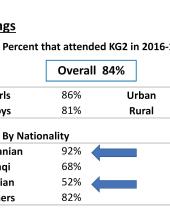
CIES 2018 Presentation, given by Katherine Merseth and Manar Shukri. The Minister of Education has requested that USAID Early Grades Reading and mathematics Project (RAMP) assist the Ministry of Education (MoE) to assess the overall KG situation in Jordan and to develop recommendations for how the Government of Jordan can expand quality kindergarten (specifically, the second year of kindergarten, or KG2) to serve all 5year old children by 2025. In response to the need, RAMP is conducting a study of KG2 with the objective of enabling the MoE to equitably expand and improve KG2.
Assoc. Photo (Port.)
Pages from Merseth, Katherine_CIES2018_Data-driven decision making in Jordan.jpg
Country
Resource Type
Month and Year