Early Mathematics Development

A Research Framework for Capturing Teachers' Decision-Making [CIES 2021 Presentation]

Submitted by admin on
Description/Abstract
The purpose of this session is to articulate a research framework that centers teachers’ voices when trying to understand how teachers use curriculum materials in the classroom. Operating in the context of highly structured lesson plans, the approach identifies ways in which teachers exercise their professional discretion to modify the lesson and frames conversations to elaborate the motivations driving the teachers’ choices. The approach has been iteratively refined across three studies; taken together, the studies provide evidence for the value of listening to teachers and being responsive to their voices during implementation. The research framework uses the lens of modifications, or changes to the intended lesson plan implemented within one class period. Modifications can be large or small, additive or subtractive. For example, in a lesson with a section for independent student practice, a large modification might be skipping the practice section entirely. Or, during a lesson focused on blending of initial sounds using 3 example words, a small modification might be extending the exercise by adding extra words. Researchers observe the lesson, noting any modifications; after the lesson, the researchers select some of the modifications and ask the teachers why they made the choices they did. Analyses of teachers’ explanations highlight the importance of understanding why teachers make the choices they do. For example, a teacher who skipped the independent practice section because they don’t think their students are ready to do the skill on their own suggests that the teacher is exercising agency and using her knowledge of her students to inform her decision-making. Insights such as this one can guide decisions on projects. It may be that while the intention of the teacher was guided by knowledge of students, the end result is not desirable from the project’s point of view. Understanding why the teacher made this choice provides implementers with better and targeted ways to address choices that impact the overall goals of the project. In this presentation, we draw on data from an exploratory case study to understand use of new mathematics materials in Liberia, a more in-depth case conducted in Malawi on teacher use of reading materials, and finally, a systematic study examining how reading teachers use materials across four Sub-Saharan African countries. We use each case to highlight both an aspect of the research framework and instances of modifications to project implementation driven by teachers’ voices. By focusing on teacher voices, we disrupt the deficit notion that teachers are “resistant” to change, or do not “understand” new pedagogies. Instead, we aim to value teacher voices and integrate their insight into implementation programs. By doing this, we not only raise the likelihood of successful use of new materials and pedagogies, but we also develop more responsive pedagogy that better matches existing classroom cultures.
Assoc. Photo (Port.)
framework port.jpeg
Resource (File)
Resource Type
Resource Language
Month and Year

Mobile Learning and Numeracy: Filling gaps and expanding opportunities for early grade learning [Arabic]

Submitted by admin on
Description/Abstract
The present study on Mobile Learning and Numeracy examines how mobile learning (m-learning) could influence and improve numeracy education at early grade levels (ages 4-10) especially in low-income countries. Key questions to guide the research include: 1) What are the benefits and challenges of integrating mobile learning into early grade numeracy education? 2) What is the role of a teacher with regard to mobile learning and numeracy education? 3) How can the community and the parents actively contribute to/participate in the child’s numeracy education with the use of mobile devices? and 4) How can mobile technology be used effectively in measuring/assessing numeracy gains? The conclusions and recommendations of this study have been informed by an international working group that met over two days during the first International Numeracy Conference in Berlin in December 2012. We would like to acknowledge the following participants of this working group for their thoughtful contributions: Michaela Brinkhaus (BMZ); Dorothea Coppard (GIZ); Melanie Stilz (Konnektiv Büro für Bildung und Entwicklung); Jens von Roda-Pulkowski (KfW); Abigail Bucuvalas (Sesame Workshop); Mr. Kann Puthy (Primary Education Department, MoEYS Cambodia); Edward Barnett (DFID).
Assoc. Photo (Port.)
Screen Shot 2020-06-24 at 5.41.40 PM.png
Country
Resource Type
Resource Language
Month and Year
Publisher Or Client
GTZ

Instructional Strategies for Mathematics in the Early Grades

Submitted by admin on
Author
Description/Abstract
This document is intended for program and curriculum experts interested in implementing evidence-based early grade mathematics programs. It was developed by the authors of this document, who are mathematics teaching and learning experts with extensive experience adapting evidence-based practices in low and middle-income contexts. Our collective field and research experience, combined with the existing evidence base, led us to focus on four instructional strategies that are key to effective mathematics instruction: 1. Respecting developmental progressions 2. Using mathematical models to represent abstract notions 3. Encouraging children to explain and justify their thinking 4. Making explicit connections for children between formal and informal math While these four instructional strategies are very important, they are not the only instructional strategies that can result in improved learning outcomes. Effective early grade mathematics teachers draw from an extensive repertoire of evidence-based instructional strategies and strive to create a learning environment the supports that development of positive mathematical identities.
Assoc. Photo (Port.)
Screen Shot 2019-11-12 at 9.51.44 AM.png
Resource (File)
Country
Resource Type
Resource Language
Month and Year
Publisher Or Client
Mathematics Working Group

EGMA Toolkit en Español

Submitted by admin on
Description/Abstract
La Evaluación de Matemáticas en los Primeros Grados (EGMA) Toolkit
Assoc. Photo (Port.)
EGMA spanish.jpeg
Resource (File)
Country
Resource Type
Resource Language
Month and Year
Publisher Or Client
RTI International

Tayari Parent Engagement Pilot Intervention Summary Report

Submitted by admin on
Description/Abstract
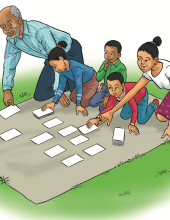
Children’s development is significantly attributed to their experiences at home, from birth through the early years of schooling, and responsive caregiving from early on has a significant impact on later learning outcomes. Interventions aimed at increasing parental engagement in children’s early learning can be expensive, however, and there is limited evidence as to what works best for parenting programs in low- and middle-income countries. This report presents the findings from a parent engagement pilot intervention conducted by the Tayari program in three counties in Kenya that tested two methods of providing parents with home-based responsive play activities to promote children’s holistic development.
Assoc. Photo (Port.)
Parent Engagement Photo.png
Country
Resource Type
Resource Language
Month and Year
Publisher Or Client
Children’s Investment Fund Foundation

Gender patterns in mathematics achievement in the early years: Results from Tayari Kenya [CIES 2019 Presentation]

Submitted by admin on
Description/Abstract
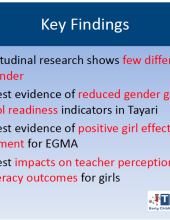
Dr. Benjamin Piper and Dr. Yasmin Sitabkhan presented findings at CIES 2019 on gender and math in the preschool years from the Kenya Tayari program.

Assoc. Photo (Port.)
Screen Shot 2019-05-02 at 11.13.13 AM.png
Country
Resource Type
Resource Language
Month and Year

Core Early Grades Mathematics Assessment (EGMA) Instrument

Submitted by admin on
Description/Abstract
Core EGMA instrument in English
Assoc. Photo (Port.)
Mobile Money.PNG
Resource (File)
Core EGMA_March 2014.pdf
COREEGMA_Stimuli.pdf
Country
Resource Language
Month and Year
Publisher Or Client
RTI

2018 Early Grade Reading and Mathematics Initiative (RAMP) Lot Quality Assurance Sampling Assessment

Submitted by admin on
Author
Description/Abstract
This report summarizes the findings of the 2018 Early Grade Reading and Mathematics Initiative (RAMP) Lot Quality Assurance Sampling Assessment, measuring impact between 2017 and 2018. The United States Agency for International Development (USAID) and UK Aid have funded RAMP as a national effort designed to improve the reading and mathematics skills and performance of students in Jordan from kindergarten 2 through grade 3 (K2–G3). This five-year program began on January 1, 2015, and is scheduled to end on December 31, 2019. Her Majesty Queen Rania Al-Abdullah formally launched RAMP as part of the broader Ministry of Education (MoE) initiative to improve education. The Research Triangle Institute (RTI) International leads implementation with its partners: Queen Rania Teacher’s Academy, ChangeAgent for Arab Development and Education Reform, We Love Reading, The Kaizen Company, Mercy Corps, Dajani Consulting, and Prodigy Consulting. The RAMP team and the MOE conducted a Lot Quality Assurance Sampling (LQAS) assessment in November 2018. Approximately 200 assessors (most of whom were MOE supervisors) were trained to collect reading and mathematics performance data across all 42 field directorates in the kingdom. For this activity, an approach was used at the school level, which led to a final sample of more than 39,000 Grade 2 and Grade 3 students in 2,076 schools. Performance comparisons made on three key indicators (reading comprehension, oral reading fluency, and mathematics) provides illustrative evidence of the gains made by RAMP schools over one school year. Large gains were seen on reading comprehension with the percent of students reaching the comprehension benchmark, increasing from 43% in 2017 to 55% in 2018. Gains in terms of oral reading fluency increased from 13% in 2017 to 19% in 2018. The smallest gains were in terms of mathematics (where the percent of students reaching the benchmark improved only slightly from 28% in 2017 to 30% in 2018).
Assoc. Photo (Port.)
LQAS cover.JPG
Resource (File)
Country
Resource Type
Resource Language
Month and Year
Publisher Or Client
USAID/Jordan and UK Aid