Early Mathematics Development

Numeracy At Scale: TAFITA Program, Lessons From Madagascar

Submitted by admin on
Description/Abstract
Children need a strong foundation in learning to succeed in their education and life. Yet, by the age of 10 years, nearly 9 out of 10 children in SSA cannot do basic mathematics. There is an urgent need to learn from success stories like the TAFITA program in Madagascar to accelerate results in numeracy to ensure that every child is ready to succeed at school. This short brief highlights some of the key successes from the program to provide policy makers and development practitioners with evidence-based strategies for improving instruction and learning in numeracy.
Assoc. Photo (Port.)
EPP Mangave CDR.jpg
Resource (File)
TAFITA Two-pager.pdf
Country
Resource Type
Resource Language
Month and Year
Publisher Or Client
Center for Global Development / Bill and Melinda Gates Foundation

Mathematics - Development of Student Learning Standards and Scope and Sequences

Submitted by admin on
Author
Description/Abstract
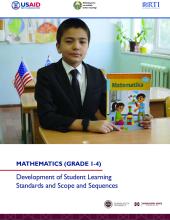
Leveraging the significant contributions made by MoPSE partners, the US Agency for International Development’s (USAID) Uzbekistan Education for Excellence Program was strategically designed to enhance and support mathematics quality enhancement initiatives. Specifically, the Program crafted high-quality, research-based standards. Student learning standards are the foundation or core of an educational system, and every component of each subject is based on these standards. Once complete, student standards inform the development of scope and sequences, textbooks, and assessments
Assoc. Photo (Port.)
Pages from 07_Brief_Math_Stn_SnS_Final_ENG.jpg
Resource (File)
Country
Resource Type
Featured projects
Month and Year

Jordan reflective approach builds a more resilient education system [CIES 2023 Presentation]

Submitted by admin on
Author
Description/Abstract
The USAID-FCDO Jordan Early Grades Reading & Mathematics Initiative (RAMP) started in 2015 with the goal to improve Kg-Gr.3 students reading and mathematics skills through improving curriculum system coherency, teacher professional development and coaching, increasing parental involvement, and improving standards, evaluation, monitoring, and accountability systems. The presentation is about how RAMP built a resilient MOE early grades system that could mitigate the learning loss caused after the school closure as a measure of the spread of COVID-19. It was notable the early grades school system was more resilient than the upper levels, administrators and teachers were more ready to cope with a new context where children reading and mathematics skills were varying widely: the MOE was able to rapidly implement a national survey (EGRA/EGMA) to measure learning losses and design a remedial program; teachers were able to use diagnostic assessment tools and identified individual students actual learning needs; teachers were familiar with differentiated instruction and remedial strategies for vulnerable children; and a system was already in place to regularly coach teachers in under-served schools/areas.
Assoc. Photo (Port.)
Jordan port.JPG
Country
Resource Type
Featured projects
Resource Language
Month and Year

Developing school-level instruments for better understanding effective numeracy instruction at scale [CIES 2023 Presentation]

Submitted by admin on
Description/Abstract
While there has been substantial investment in early-grade reading in low- and middle-income country contexts (LMICs) in the last 15 years, and a concomitant increase in evidence around what works to improve reading outcomes, there has been much more limited investment in early-grades mathematics. As a result, the body of evidence on what works to improve mathematics teaching and learning in LMICs is more limited. This study has identified six government- and program-led interventions in LMICs that have evidence of impact on students’ numeracy outcomes and are working at scale, to understand how and why they are effective and consolidate that evidence for the international education community. In order to examine the target programs, the study team has developed a suite of instruments designed to examine the programs and to identify common elements that these successful numeracy may have in common. The goal in designing these instruments was to be able to examine a range of potential factors, based on the evidence that we have on mathematics teaching and learning from research in high-income country contexts, as well as the limited research evidence we have from LMICs. This suite of instruments includes: (1) a quantitative classroom observation instrument, based on multiple frameworks for high-quality math instruction, including work by The Danielson Group (2019), The University of Michigan’s High Leverage Teaching practices, and a cross-institutional working group of math education experts working in LMICs (co-author, 2019); (2) a student cognitive interview instrument intended to provide insight into students’ development of higher order, conceptual understanding of basic mathematics concepts; (3) a qualitative classroom observation instrument and accompanying lesson-based teacher interview; (4) a survey of teachers’ Mathematical Knowledge for Teaching, based on work by Deborah Ball (2011). Focusing primarily on the quantitative classroom observation and student cognitive interview instruments, this paper will present the theoretical foundations of the instrument and the processes for developing, piloting, and adapting the instruments for different country and program contexts. Preliminary findings and lessons learned from utilizing the tools for data collection across country contexts will also be shared. Given the need to expand the body of evidence around what works to improve math teaching and learning, these instruments represent potentially valuable resources for research in this area – and the authors look forward to discussing the potential for use and further development/adaptation.
Assoc. Photo (Port.)
numeracy portrait.JPG
Resource (File)
Country
Resource Type
Month and Year

Using the GPF to create mathematics student standards in Uzbekistan [CIES 2023 Presentation]

Submitted by admin on
Description/Abstract
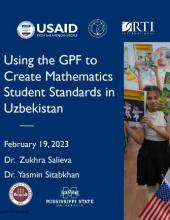
To support the Ministry of Public Education (MoPE) in achieving its reform agenda, USAID initiated the Uzbekistan Education for Excellence Program (UEEP) to improve the quality of education and enable all students to be proficient in 21st century skills such as problem solving and critical thinking. UEEP is implemented by a Consortium of partners including RTI International, Florida State University, and Mississippi State University. The Program aims to achieve three overarching results: improved Uzbek language (UL) reading and mathematics outcomes in grades 1–4; enhanced information and communication technology (ICT) instruction for grades 1–11, and improved English as a foreign language (EFL) instruction in grades 1–11. In this presentation, we will describe the process of revising the student standards for Grades 1-4 in mathematics, led by Florida State University and UEEP math experts, with ongoing review and feedback from MoPE representatives. The revision of student standards was the first step of the country’s curricular reform, followed by the creation of TLMs and a corresponding teacher professional development package. This process consisted of several stages, beginning with comparing current MoPE standards with the GPF, student math standards from South Korea and the TIMSS framework for assessment. These three resources were chosen for specific purposes. The TIMSS framework reflected the Government of Uzbekistan’s priority to prepare children in Grade 4 to take TIMSS assessment and perform well. This framework only reflected Grade 4 learning, so it was used primarily to backwards map other standards in Grades 1-3 to ensure that all content on the TIMSS framework was adequately covered by the end of Grade 4. The GPF was the most detailed reference, and was used to map the current standards and identify gaps in the progression. However, there was concern from the Government of Uzbekistan that the GPF might be targeting skills that are too easy for children in Uzbekistan. Because of this, we also brought in the South Korea standards, which provided us with a reference from a country that is seen as a model in Uzbekistan, and we were able to use the South Korea standards to make decisions about certain skills. This process allowed us to ensure that the standards development process met national priorities (i.e. Presidential Decree on Improving Math Education, 2020), reflected best international practices in mathematics, created standards that were age appropriate and measurable, and was logically organized. We will discuss how we used a quantitative comparative analysis of Uzbekistan's existing standards for different grade levels with the GPF and South Korea standards to identify revisions needed to facilitate more alignment. The rigor of that exercise allowed us to revise and to create a set of standards that could be approved by MoPE. The rigorous student standards development process described in this presentation allowed us to create a set of standards that were approved by MoPE. These standards were the cornerstone of further reforms including creating a scope and sequence and Teacher/Learning Materials (TLMs) for Grades 1-4, currently being piloted with 10,000 teachers across Uzbekistan.
Assoc. Photo (Port.)
GPFportrait.JPG
Resource (File)
GPF_CIES_2023_FINAL.pdf
Country
Resource Type
Month and Year

The mathematical knowledge for teaching survey [CIES 2023 Presentation]

Submitted by admin on
Description/Abstract
The Mathematics Knowledge for Teaching (MKT) is a short survey (23 items) that measures primary grade teacher knowledge by a) math domains and b) pedagogical and content knowledge. Math domain included Number Sense, Operations, Geometry, and Measurement. Pedagogical knowledge was measured by problems that measured teacher understanding of Developmental Progression, Scaffolding, and Content knowledge. In this presentation, we will discuss the process of developing the MKT survey, highlight exemplary results from the Kyrgyz Republic, and then discuss the various uses of this survey. The MKT survey build from previous work in measurement of teachers’ MKT in the United States and other countries (Ball et.al., 2008; Cole, 2012). Our goal was to create an instrument that focused on the early primary grade and was easily adaptable to multiple contexts. To do this, we created an initial instrument, conducted cognitive interviews with math and learning experts form several countries, and then conducted a pilot in the Kyrgyz Republic and Nepal. In Kyrgyz Republic, the MKT test was administered to 323 primary grade teachers in 30 pilot schools as a pre-post training survey as part of the USAID Okuu Keremet! The survey was administered online in two languages. Analysis of pre-post test showed that the survey was effective in detecting changes in teacher knowledge across all math domains and pedagogical and content knowledge areas. In Nepal, we conducted cognitive interviews with teachers, providing additional insights into how teachers were thinking about early math knowledge. Finally, we conclude with the different potential uses for this survey, such as diagnosing and measuring changes in teacher knowledge over time and using it as professional development tool to develop teacher knowledge. We will discuss implications for the use of this tool for the wider development audience.
Assoc. Photo (Port.)
math portrait.JPG
Resource (File)
IE_CIES_MKT_FINAL.pdf
Country
Resource Type
Month and Year

Using teaching and learning materials in Uzbekistan: Lessons from observations and interviews [CIES 2023 Presentation]

Submitted by admin on
Description/Abstract
The purpose of this panel presentation is to present the results of two uptake studies to understand how mathematics, Uzbek language arts, ICT, and EFL teachers in Uzbekistan are using and applying newly developed teaching and learning materials in the classroom.
Assoc. Photo (Port.)
uzbek portrait.JPG
Resource (File)
TLM Uptake Panel.pdf
Country
Resource Type
Resource Language
Month and Year
Publisher Or Client
USAID

Mathematics Teacher Guide

Submitted by admin on
Description/Abstract
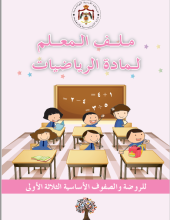
A teacher's guide for mathematics instruction in the context of Jordan, developed by the Jordanian Ministry of Education.
Assoc. Photo (Port.)
Capture.PNG
Resource (File)
غلاف خارجي.pdf
Country
Resource Type
Featured projects
Resource Language
Month and Year

Report of Self-Administered EGRA/EGMA Pilot (Ghana, English)

Submitted by admin on
Description/Abstract
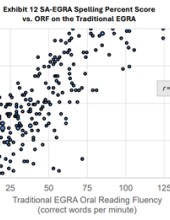
This report summarizes the findings of an effort to develop and validate tablet-based, self-administered assessments of English-language foundational literacy and numeracy in the early grades. The tools described in the report were developed at the request of Imagine Worldwide with the support of the Jacobs Foundation. RTI carried out field testing and a pilot study to assess the tools' internal consistency, test-retest reliability, and concurrent validity with respect to "traditional" EGRA and EGMA. RTI International developed the two assessments, known respectively as the Self-Administered Early Grade Reading Assessment (SA-EGRA) and the Self-Administered Early Grade Mathematics Assessment (SA-EGMA), with the support and at the direction of Imagine Worldwide. The assessments are deemed “self-administered,” because children complete the assessments independently in response to instructions and stimuli imbedded in the tablet-based software. However, adults typically supervise the organization and conduct of the assessment as well as the collection of individual data from the tablets for analysis. The tools have been developed under an open-source license. The code can be viewed and downloaded for reuse or modification at https://github.com/ICTatRTI/SE-tools/blob/main/README.md. Users of RTI's Tangerine software may request that the SA-EGRA and SA-EGMA tools be added to their Tangerine groups via https://www.tangerinecentral.org/contact
Assoc. Photo (Port.)
SA EGRA.png
Resource (File)
Country
Resource Type
Resource Language
Month and Year
Publisher Or Client
RTI International

Online Training on Formative Assessment for Early Language, Literacy, and Numeracy (ELLN) in the Philippines

Submitted by admin on
Description/Abstract
This report describes findings and lessons learned from an online teacher training course in the Philippines. "Becoming a Learning Detective" is a 5-day online course that focuses on the design and use of formative assessment to improve literacy and numeracy outcomes in Kindergarten to Grade 3 (K–3) classrooms. The emphasis is on classroom-based assessment strategies that are embedded within daily teaching and learning experiences, involving an active partnership between teacher and students. The course brings together asynchronous and synchronous elements, as well as whole group, small group, and individual learning experiences. The course was implemented for the first time among a small cohort of participants across 17 regions in the Philippines. Findings and recommendations of this initial training are being applied toward strengthening the course prior to offering it at a larger scale in the Philippines.
Assoc. Photo (Port.)
ACER 1.jpeg
Country
Resource Type
Featured projects
Month and Year
Publisher Or Client
USAID