Early Mathematics Development

Guía Pedagógica para tutores educativos de cuarto a sexto primaria y primero básico

Submitted by admin on
Description/Abstract
Esta Guía Pedagógica para tutores educativos de cuarto a sexto primaria y primero básico fue elaborada por la Asociación de Cooperación para el Desarrollo Rural de Occidente (CDRO) en Guatemala, como parte del programa de subvenciones ¡Éxito! de Educación Básica de Calidad para la Transición (Basic Education Quality and Transitions -BEQT). El propósito de esta Guía pedagógica es ser un instrumento orientador a las y los tutores educativos, para reforzar los aprendizajes en las áreas de lectoescritura y matemáticas de niños y niñas de cuarto a sexto primaria y de primero básico, con el propósito de ir mejorando y nivelando las competencias de aprendizaje para que tengan éxito en el proceso de transición al ciclo básico.
Assoc. Photo (Port.)
Guía Pedagógica para Tutores_CDRO.PNG
Country
Resource Type
Featured projects
Resource Language
Month and Year
Publisher Or Client
USAID

Libro de Trabajo para Maestros: Fondos del Conocimiento (Funds of Knowledge Workbook for Teachers)

Submitted by admin on
Description/Abstract
Este es un libreto de trabajo (workbook) para maestros sobre Fondos del Conocimiento (Funds of Knowledge) aplicado en el aula. Este libreto de trabajo fue elaborado por el equipo técnico del Centro de Investigaciones Educativas de la Universidad del Valle de Guatemala, socio implementador de Educación Básica de Calidad para la Transición (Basic Education Quality and Transitions - BEQT, por sus siglas en inglés).
Assoc. Photo (Port.)
Fondos de conocimiento worksheet.PNG
Resource (File)
Country
Resource Type
Featured projects
Resource Language
Month and Year
Publisher Or Client
USAID

Libro de Trabajo para Maestros: Diseño Universal para el Aprendizaje (DUA Workbook for Teachers)

Submitted by admin on
Description/Abstract
Este es un libreto de trabajo (workbook) para maestros sobre el Diseño Universal para el Aprendizaje (DUA) aplicado en el aula. Este libreto de trabajo fue elaborado por el equipo técnico del Centro de Investigaciones Educativas de la Universidad del Valle de Guatemala, socio implementador de Educación Básica de Calidad para la Transición (Basic Education Quality and Transitions - BEQT, por sus siglas en inglés).
Assoc. Photo (Port.)
DUA Worksheet.PNG
Country
Resource Type
Featured projects
Resource Language
Month and Year
Publisher Or Client
USAID

Guía sobre el Marco Universal de Competencias (Global Proficiency Framework Teacher Guide)

Submitted by admin on
Description/Abstract
Esta es una guía informativa para maestros sobre el Marco Universal de Competencias (Global Proficiency Framework - GPF, por sus siglas en inglés). La guía informa sobre este parámetro de evaluación integral que indica lo que los estudiantes deben saber y ser capaces de hacer en lectura y matemáticas. El marco también define los conocimientos y habilidades importantes relacionados con la lectura y matemáticas que los estudiantes deben desarrollar en la escuela primaria y el primer ciclo de secundaria. También, describe los niveles mínimos de competencia que se espera que los estudiantes demuestren, con respecto a los conocimientos y habilidades definidos en cada grado, desde primero primaria hasta tercero básico. Esta guía fue elaborada por el equipo técnico del Centro de Investigaciones Educativas de la Universidad del Valle de Guatemala, socio implementador de Educación Básica de Calidad para la Transición (Basic Education Quality and Transitions - BEQT, por sus siglas en inglés).
Assoc. Photo (Port.)
Marco Universal de Competencias.PNG
Resource (File)
Country
Resource Type
Featured projects
Resource Language
Month and Year
Publisher Or Client
USAID

Landscape Assessment: Aspectos Relacionados con la Calidad Educativa en Lectura, Escritura, Matemática y Aprendizaje Socioemocional y su influencia en la transición al Ciclo Básico

Submitted by admin on
Description/Abstract
Como parte de las actividades del Proyecto Educación Básica de Calidad para la Transición (BEQT, por sus siglas en inglés), la Universidad del Valle de Guatemala por medio del Centro de Investigaciones Educativas CIE diseñó y desarrolló el estudio Landscape Assessment: Aspectos relacionados con la calidad educativa en Lectura, Escritura, Matemática y Aprendizaje Socioemocional y su influencia en la transición al Ciclo Básico. Este tiene como propósito conocer el estado de la situación y aspectos que inciden en la calidad educativa. El objetivo general es explicar los aspectos estructurales, culturales, educativos y familiares que influyen en la lectura, escritura, matemática y aprendizaje socioemocional en los grados de 4.º a 6.º primaria y la transición a 1º. básico, en los municipios de los departamentos de Baja Verapaz, Quiché, Huehuetenango y San Marcos, donde se implementa el proyecto. Visibilizar los aspectos estructurales, familiares, culturales y educativos que inciden en la calidad educativa y la transición al ciclo básico que se evidencia en los resultados de las pruebas nacionales y en los indicadores educativos, permitirá analizar y adecuar las acciones planificadas en el proyecto. El Centro de Investigaciones Educativas de la Universidad del Valle de Guatemala conformó un equipo de investigación para el diseño y desarrollo del Landscape Assessment: Aspectos relacionados con la calidad educativa en Lectura, Escritura, Matemática y Aprendizaje Socioemocional y su influencia en la transición al Ciclo Básico. El equipo preparó el protocolo del estudio y los instrumentos respectivos, los cuales fueron revisados por USAID y RTI. Asimismo, se hicieron las gestiones correspondientes con el Ministerio de Educación (Mineduc) de Guatemala a nivel central, departamental y local para la aprobación respectiva.
Assoc. Photo (Port.)
Landscape Assessment.PNG
Resource (File)
Country
Resource Type
Featured projects
Resource Language
Month and Year
Publisher Or Client
USAID

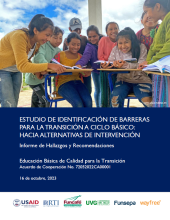
ESTUDIO DE IDENTIFICACIÓN DE BARRERAS PARA LA TRANSICIÓN A CICLO BÁSICO: HACIA ALTERNATIVAS DE INTERVENCIÓN

Submitted by admin on
Description/Abstract
La educación básica en Guatemala enfrenta retos significativos, incluyendo altas tasas de deserción escolar y habilidades básicas insuficientemente desarrolladas. Estos problemas se acentúan en los grupos vulnerables como son los estudiantes de áreas rurales, niñas y personas con discapacidad. La pandemia de COVID-19 ha exacerbado aún más estos desafíos al exponer las carencias en recursos y acceso tecnológico. Mediante un acuerdo con USAID, RTI International colabora con diversas instituciones locales, como Fundación de la Caficultura para el Desarrollo Rural (Funcafé), Universidad del Valle Guatemala (UVG), Fundación Sergio Paiz Andrade (Funsepa) y Wayfree implementando el proyecto Educación Básica de Calidad para la Transición (Basic Education Quality and Transitions -BEQT) para mejorar la adquisición de destrezas básicas de lectoescritura, matemáticas y habilidades socioemocionales, y promover la transición de estudiantes de primaria al ciclo básico. Educación Básica de Calidad para la Transición se enfoca en estudiantes de cuarto a sexto de primaria y primero básico en doce municipios priorizados de los departamentos de: Huehuetenango, San Marcos, Quiché, y Baja Verapaz. Para identificar las barreras de transición educativa desde los actores clave locales, RTI y Funcafé llevaron a cabo un estudio cualitativo en seis de los doce municipios de intervención del proyecto, enfocándose en aquellos con altos índices de inasistencia escolar, migrantes retornados y población indígena. Se realizaron 46 entrevistas y 25 grupos focales con diversos actores clave, desde jóvenes y padres hasta directores de escuelas e institutos.

Assoc. Photo (Port.)
Estudio de Barreras Report.PNG
Resource (File)
Country
Resource Type
Featured projects
Resource Language
Month and Year
Publisher Or Client
USAID

Aligning Learning Inputs to Global Norms (ALIGN) for Minimum Proficiency: Case Studies from Djibouti, Uzbekistan, Nigeria

Submitted by admin on
Description/Abstract
he Sustainable Development Goals (SDGs) include a commitment to ensure that by 2030, all girls and boys complete free, equitable, and quality primary and secondary education leading to relevant and effective learning outcomes (SDG 4.1). Performance on this goal is reported as the proportion of learners: “(a) in grades 2/3; (b) at the end of primary; and (c) at the end of lower secondary achieving at least a minimum proficiency level in (i) reading and (ii) mathematics, by sex” (M. Gustafsson, 2019, p. 6). These SDG indicators are based on global research that highlights the critical contribution of foundational skills in reading and mathematics to learners’ overall academic performance (Juel, 1988; Wharton-McDonald et al., 1988; Duncan et al., 2007; Duncan & Magnuson, 2011; Watts et al., 2014; Claessens & Engel, 2013). They also apply research from health and development sectors indicating that foundational skills are essential to reducing social inequality and improving individuals’ social and economic security and well-being (OECD, 2010; UNESCO, 2016). The recent COVID-19 pandemic further underscored the importance of focusing on foundational skills. Studies show the pandemic has resulted in a 17 percent global increase in the number of ten-year-olds lacking basic skills to 70 million learners in 2021 alone (ONE Campaign, 2021). There is an urgent need to reverse this trend so every learner develops the foundational skills required to participate fully in their community’s social and economic life. That means using evidence-based approaches to identify where resources are most needed, both across countries and within a country, to address learning inequities and ensure that learners are able to demonstrate minimum proficiency levels. This panel presentation will show how the Align Learning Inputs to Global Norms (ALIGN) for Minimum Proficiency process can help address these needs. The ALIGN process is an evidence-based gap analysis that uses the Global Proficiency Framework (GPF) as a reference to determine if a country’s education system will enable learners to meet global norms in reading and mathematics. An ALIGN process focuses on four components: curriculum and standards, teaching and learning materials, teacher training, and assessment. The ALIGN process identifies potential gaps or misalignments in each of these four components and actions to address them. The ALIGN process was successfully piloted in four countries, Djibouti, Nigeria, and Uzbekistan.
Assoc. Photo (Port.)
Resource (File)
Country
Resource Type
Featured projects
Month and Year

Success Story #12: Early Grade Math Teaching Improves in Uzbekistan (UEEP)

Submitted by admin on
Author
Description/Abstract
This video success story documents the experience of a math teacher participating in a pilot of new math materials and teacher training and his inspiring observations on students' learning.
Assoc. Photo (Port.)
SS12 Image.jpg
Country
Featured projects
Resource Language
Month and Year

UEEP Success Story #6: Early Grade Teacher Co-Authors New Uzbek Language Arts Textbooks (UEEP)

Submitted by admin on
Author
Description/Abstract
This success story highlight the experience of one Uzbek Language Arts teacher in supporting the development of new reading materials for grades 1-4 learners. When she started working on the student textbooks and teacher guides, she found transforming Uzbekistan's approach to reading in local language challenging and rewarding, especially with the tremendous support of the international and local experts, who helped the writers to ensure international best practices guided the content and teaching methods. The result of their hard work, lead to the creation of books that inspire children to learn and develop a love of the Uzbek language.
Assoc. Photo (Port.)
SS 6 Image.png
Country
Featured projects
Resource Language
Month and Year

Learning from Successful Early-Grade Math Programs: Lessons from the Numeracy at Scale study [CIES 2024 Presentation]

Submitted by admin on
Description/Abstract
The Numeracy at Scale study was designed to identify and examine aspects of successful numeracy programs, to provide policy makers and development practitioners with evidence-based strategies for improving numeracy instruction and learning outcomes across contexts. To this end, the study team identified and analyzed six programs across five countries that had rigorous evidence of impact on numeracy learning outcomes and which were operating at scale or which showed the potential for scale in an entire region or country. In each country, the study teams carried out a mixed-methods study including quantitative observations and interviews conducted in 80 to 130 schools per country; as well as qualitative observations and interviews in ten schools per country. The Numeracy at Scale study investigated two research questions addressed in this presentation: 1) What classroom ingredients (such as teaching practices and classroom environment) lead to learning in programs that are effective at scale? 2) What methods of training and support lead to teachers adopting effective classroom practices? The programs involved in this study are based in India, Jordan, El Salvador, Madagascar and South Africa. Two of the programs are government-led. The six Numeracy at Scale programs represent a variety of designs, from providing instruction to at-risk girls via interactive software to a national-scale numeracy initiative integrated into all public primary schools. Despite their differences, these programs share a large number of common elements. This presentation will provide an overview of the common pedagogical strategies found across these successful numeracy programs, such as use of multiple representations, discussion about mathematical concepts, and targeted support for students, as well as the approaches these programs used to support the development of these practices among teachers. Drawing from qualitative data, the paper will then discuss details of how these common elements were executed differently under different program models. Both the common, key elements and “differences in the details” that are found across these programs can generate helpful guidelines and ideas for how practitioners and governments can strengthen their own numeracy professional development approaches, across different operating contexts and program designs.
Assoc. Photo (Port.)
numeracy port.PNG
Resource (File)
Resource Type
Resource Language
Month and Year