Evaluation

ICT Endline Assessment

Submitted by admin on
Author
Description/Abstract
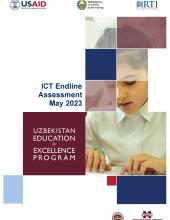
This information and communication technology (ICT) assessment measured the competency of 1,244 grade 9, 10, and 11 students from the beginning to the end of the 2022–2023 school year in two regions. This longitudinal study measured the impact of student learning outcomes over the course of a year. The U.S. Agency for International Development (USAID) Uzbekistan Education for Excellence Program conducted a baseline assessment at the beginning of the school year in September 2022 and an endline assessment at the end of the school year in May 2023. These assessments included a knowledge examination of the content of newly introduced ICT standards and textbooks. The examination was based on standards and proficiency was defined as 78%, 79%, and 77% correct responses in the assessment for grades 9, 10, and 11 respectively by the subject matter specialists in ICT. Additionally, to better measure the progress during the early years of implementation of the new curriculum, the Program also set intermediate proficiency levels at 50%, 40%, and 40% for grades 9, 10, and 11 respectively.
Assoc. Photo (Port.)
Pages from ICT Endline Assessment.jpg
Resource (File)
ICT Endline Assessment.pdf
Country
Resource Type
Featured projects
Month and Year
Publisher Or Client
USAID

EDUCATION RESEARCH - New Knowledge for Improved Outcomes

Submitted by admin on
Description/Abstract
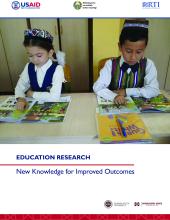
The Uzbekistan Education for Excellence Program led the development of a groundbreaking curriculum based on international best practices and contributions from local experts. The approach was rooted in a theory of change that identified long-term goals (outcomes) and the interconnecting outputs and conditions to achieve them. In collaboration with the Uzbekistan Ministry of Preschool and School Education (MoPSE), the Program developed education standards, scope and sequences, new textbooks and teacher guides, and continuous professional development training for educators in pilot schools among other activities and products. Throughout this process, the Program sought to test the theory of change, fill critical gaps in knowledge about the Uzbek educational system, and determine what kind of research would be most responsive to this breadth of interventions and the complex nature of classroom dynamics.
Assoc. Photo (Port.)
Pages from 14_Brief_Process_Research_Final_ENG.jpg
Resource (File)
Country
Resource Type
Featured projects
Month and Year

ENGLISH AS A FOREIGN LANGUAGE - TEXTBOOK APPRAISAL

Submitted by admin on
Author
Description/Abstract
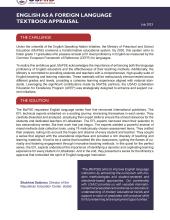
The Ministry of Preschool and School Education of the Republic of Uzbekistan requested English language series from five renowned international publishers. The EFL technical experts embarked on a exciting journey, immersing themselves in each series. They carefully dissected and analyzed, employing their expert skills to ensure the utmost relevance for the students and dedicated teachers of Uzbekistan. The EFL experts narrowed down their selection to two extraordinary series. But their work had just begun.
Assoc. Photo (Port.)
EFL_Textbook Appraisal_Final_ENG.jpg
Resource (File)
Country
Resource Type
Resource Language
Month and Year

Strengthening sector capacity for Student Learning Assessment in the context of bilingualism in Senegal [CIES 2023 Presentation]

Submitted by admin on
Description/Abstract
This presentation on development of an assessment system under Senegal's new bilingual policy includes an explanation of the bilingual policy in Senegal and plans for development of a national assessment system including use of the ANLAS methodology (Analysis of National Learning Assessment Systems)
Assoc. Photo (Port.)
INEADE portrait.JPG
Resource (File)
Country
Resource Type
Month and Year
Publisher Or Client
RTI International

Using teaching and learning materials in Uzbekistan: Lessons from observations and interviews [CIES 2023 Presentation]

Submitted by admin on
Description/Abstract
The purpose of this panel presentation is to present the results of two uptake studies to understand how mathematics, Uzbek language arts, ICT, and EFL teachers in Uzbekistan are using and applying newly developed teaching and learning materials in the classroom.
Assoc. Photo (Port.)
uzbek portrait.JPG
Resource (File)
TLM Uptake Panel.pdf
Country
Resource Type
Resource Language
Month and Year
Publisher Or Client
USAID

Report of Self-Administered EGRA/EGMA Pilot (Ghana, English)

Submitted by admin on
Description/Abstract
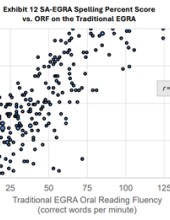
This report summarizes the findings of an effort to develop and validate tablet-based, self-administered assessments of English-language foundational literacy and numeracy in the early grades. The tools described in the report were developed at the request of Imagine Worldwide with the support of the Jacobs Foundation. RTI carried out field testing and a pilot study to assess the tools' internal consistency, test-retest reliability, and concurrent validity with respect to "traditional" EGRA and EGMA. RTI International developed the two assessments, known respectively as the Self-Administered Early Grade Reading Assessment (SA-EGRA) and the Self-Administered Early Grade Mathematics Assessment (SA-EGMA), with the support and at the direction of Imagine Worldwide. The assessments are deemed “self-administered,” because children complete the assessments independently in response to instructions and stimuli imbedded in the tablet-based software. However, adults typically supervise the organization and conduct of the assessment as well as the collection of individual data from the tablets for analysis. The tools have been developed under an open-source license. The code can be viewed and downloaded for reuse or modification at https://github.com/ICTatRTI/SE-tools/blob/main/README.md. Users of RTI's Tangerine software may request that the SA-EGRA and SA-EGMA tools be added to their Tangerine groups via https://www.tangerinecentral.org/contact
Assoc. Photo (Port.)
SA EGRA.png
Resource (File)
Country
Resource Type
Resource Language
Month and Year
Publisher Or Client
RTI International

Improving children's reading in Liberia: results from the NORC impact evaluation of the Read Liberia Activity

Submitted by admin on
Description/Abstract
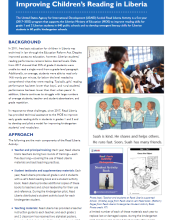
This brief highlights data from Read Liberia's external impact evaluation conducted by NORC
Assoc. Photo (Port.)
improving reading.png
Resource (File)
Country
Resource Type
Featured projects
Resource Language
Month and Year

What Works to Improve Learning at Scale? Key Findings from Learning at Scale and the Kenya Tusome Early Grade Reading Activity

Submitted by admin on
Author
Description/Abstract
This brief presents findings on what worked to improve learning outcomes at scale under 8 successful early grade literacy programs, with a focus on findings from the Tusome program in Kenya.1 These findings were generated as part of the Learning at Scale study, conducted by RTI International with the Center for Global Development and funded by the Bill and Melinda Gates Foundation.
Assoc. Photo (Port.)
_AGK8749.jpeg
Resource (File)
Kenya_Findings_FINAL.pdf
Country
Sub-topic
Resource Type
Month and Year
Publisher Or Client
RTI International, Center for Global Development, Bill and Melinda Gates Foundation

Measuring the impact of play on social and emotional learning across countries [CIES Presentation]

Submitted by admin on
Author
Description/Abstract
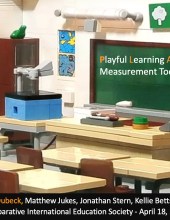
This presentation was part of a CIES 2022 panel on measuring learning through play and child SEL outcomes across humanitarian and LMIC contexts. The presentation focuses primarily on the development of a new SEL tool that is being used as part of impact evaluations for five learning through play implementation programs across five countries.
Assoc. Photo (Port.)
the-benefits-of-learning-through-play-1200x900_0.jpeg
Resource (File)
Resource Type
Resource Language
Month and Year

PLAY overview CIES (Dubeck et al., 2022)

Submitted by admin on
Description/Abstract
Play has the potential to transform the global learning crisis. In infancy and early childhood, play builds a strong foundation for later learning by improving brain development and growth (Goldstein, 2012). In education systems that lack capacity to support children effectively, play brings its own powerful engine to drive learning—the joyful, engaged intrinsic motivation of children themselves (Zosh et al., 2017). In this way, play contributes to the holistic development of children, helping to prepare them for the challenges of the current and future world. Accordingly, there is an urgent need to improve measurement of playful learning, to be able to add to the evidence base on what the benefits of play are, how playful learning takes place, and how it can be promoted at home and at school across the lifespan. This presentation focuses on a renewed conceptualization of playful learning and describes an innovative approach to measuring how settings contribute to playful learning for children ages 0 to 12, supported by the Lego Foundation. The settings we examine include homes, classrooms and ECD centers. Following Tseng and Seideman (2007), we view settings as consisting of social interactions (i.e. between teachers or caregivers and children) and the organization of resources (e.g. learning materials, games). First, we will present our conceptual framework which identifies six constructs to guide our measurement strategy. The constructs, such as ‘support for exploration’, represent the ways in which a setting supports playful learning. Next, we will present our contextualization framework which guides how we are adapting and modifying the measurement tools to different contexts. The tool consists of a protocol to observe adult-child interactions and survey measures conducted with teachers, caregivers and primary school pupils. As part of the development process for these measurement tools, observation and survey measures will go through a three-phase development process in Kenya, Ghana, Colombia, and Jordan. The Build phase involved collecting qualitative data from teachers, caregivers and students to understand their perception of playful learning and how it is supported at home and at school. Next, an Adapt phase took place where the initial versions of the measurement tools underwent cognitive interviewing, field adaptation, and a small pilot to adjust and extend the items in the tool. The third Test phase is a full pilot of the instruments, and the data will undergo rigorous psychometric analyses to review the validity and reliability of the tools in the four country contexts. We will use the results to adjust the instruments and to finalize the conceptual framework and contextualization strategies. The final toolkit will be publicly available towards the end of 2022 with supporting materials for contextualization, piloting, training and analysis. The toolkit will be available on a public platform designed to promote sharing of data collected using the tool and to collaborate to continually improve approaches to measuring support for playful learning.
Assoc. Photo (Port.)
Screen Shot 2022-04-28 at 1.16.28 PM.png
Resource (File)
Resource Type
Month and Year
Publisher Or Client
The Lego Foundation