Evaluation

Instructional Practices for Effective Large-Scale Reading Interventions (Learning at Scale)

Submitted by admin on
Description/Abstract
The Learning at Scale study aimed to investigate factors contributing to successful improvements in learning outcomes at scale in eight of the most effective large-scale education programs in LMICs (see the map of programs on the last page of this brief). These programs were selected based on their demonstrated gains in reading outcomes at-scale, from either midline or endline impact evaluations. The study addressed three overarching research questions, focused on understanding the components of instructional practices (Brief 1), instructional supports (Brief 2), and system supports (Brief 3) that lead to effective instruction. This brief focuses specifically on instructional practices. It addresses the following research question: What classroom ingredients (e.g., teaching practices, classroom environment) lead to learning in programs that are effective at scale?
Assoc. Photo (Port.)
Brief1.png
Resource (File)
Resource Type
Resource Language
Month and Year
Publisher Or Client
Center for Global Development, Bill and Melinda Gates Foundation

Learning to Thrive: Education, opportunity and foundational skills in El Salvador [CIES 2021]

Submitted by admin on
Author
Description/Abstract
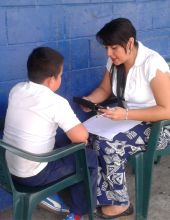
The El Salvador Early Grade Reading Assessment (EGRA) was conducted in 2018 in late June and early July 2018 (toward the end of the El Salvador school year, which runs from January to October). The objective was to provide the Government of El Salvador with information on the reading performance of public school students in second and third grades. The sample was designed to represent government schools at the national level with a minimum enrollment of six students in each of the second and third grades and all of the second and third grade students in these grades. EGRA is an individually administered oral assessment of foundational reading skills; in Spanish, the skills tested include letter sound identification, familiar word reading, and oral reading fluency, among others. Closing early learning deficits in contexts like El Salvador is critical to improving economic development. According to a World Bank review of the causes of dropout in Central America, skills gaps that are not corrected through additional support and remediation compound over time. Students with weak foundational skills are more likely to struggle and become disinterested as content becomes more complex. As students age, they also face rising direct and opportunity costs and increased risk of teenage pregnancy and violence. Together these factors are associated with higher levels of grade repetition and school dropout. Analyzing El Salvador household survey data, the same report indicated that 40% of youth who had left school cited lack of interest while 25% reported economic causes as the main reasons for dropping out of school. Among girls, personal reasons, including pregnancy and caring for younger siblings, are the highest reported cause at 32%. The EGRA results indicate that 49% of second graders and 40% of third graders are reading at or below a rate of one correct word per second. Students performing at this level for oral reading fluency are identified as “At Risk” for developing later reading difficulties, and potentially school failure. This means that additional remediation steps, such as intensive instruction and frequent progress monitoring, are needed to increase the chances that these students catch up with their peers. Early skills gaps are associated with higher levels of grade repetition and in contexts like El Salvador, where primary completion is not universal, school dropout. On nearly every component of the assessment, boys, students in rural schools, students from lower-income groups, and students with some form of self-reported disability all scored lower than their more advantaged peers. Income disparities were especially noteworthy: Students in the lowest income group were more than three times as likely to score zero on the oral reading fluency passage relative to students in the highest income group (20% versus 6%).
Assoc. Photo (Port.)
ESEGRA.png
Resource (File)
Country
Resource Type
Resource Language
Month and Year

Qualitative Research in International Education

Submitted by admin on
Description/Abstract
This brief describes the use of qualitative analysis in international education research.
Assoc. Photo (Port.)
QA brief.PNG
Resource (File)
Country
Resource Type
Resource Language
Month and Year
Publisher Or Client
RTI International

Jordan Early Grade Reading and Mathematics Initiative (RAMP) Endline Survey Report

Submitted by admin on
Description/Abstract
This report presents the findings of the Jordan Early Grade Reading and Mathematics Initiative (RAMP) endline survey conducted at the end of the 2018–2019 school year (in May 2019).
Assoc. Photo (Port.)
Capture_Jordan RAMP.PNG
Resource (File)
Country
Resource Type
Featured projects
Resource Language
Month and Year

Is It Possible to Improve Learning at Scale? Reflections on the Process of Identifying Large-Scale Successful Education Interventions

Submitted by admin on
Description/Abstract
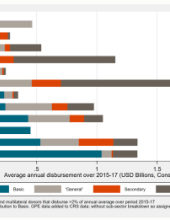
Improving learning outcomes at scale is hard. That may seem obvious, but only recently have policymakers and donors become aware of just how dire—and broad—the learning crisis is. Most of their efforts to improve learning have been pilot programs, and although in some cases it has been possible to improve outcomes at this small scale, it is an entirely different challenge at scale, which can involve thousands of schools—the level at which change must happen to fix the crisis.
Assoc. Photo (Port.)
scale.png
Country
Month and Year

Bahan Rujukan bagi LPTK III: Praktik yang Baik dalam Pembelajaran di SD/MI - MBS

Submitted by admin on
Description/Abstract
Unit 1 Gambaran Umum Monitoring Program USAID PRIORITAS Unit 2 Kaji Ulang Kemajuan Sekolah (Dampak Pelatihan Modul Kedua) Unit 3 Pengelolaan Program Budaya Baca Unit 4 Mendengar Aktif Unit 5 Supervisi MBWA (Peran Kepala Sekolah/Pengawas) Unit 6 Penilaian dan Pengembangan Profesi Guru Unit 7 Peran Komite Sekolah dalam Upaya Mendukung Peningkatan Mutu Pembelajaran di Sekolah Unit 8 Sikap dan Tindakan Pemangku Kewajiban Terhadap Peningkatan Mutu Sekolah Unit 9 Rencana Tindak Lanjut | | | | | Unit 1 Overview of USAID PRIORITAS Program Monitoring Unit 2 Review School Progress (Second Module Training Impact) Unit 3 Management of the Reading Culture Program Unit 4 Active Listening Unit 5 Supervision of MBWA (Role of School Principals / Supervisors) Unit 6 Teacher Professional Assessment and Development Unit 7 The Role of School Committees in Efforts to Support Quality Improvement of Learning in Schools Unit 8: Attitudes and Actions of Stakeholders towards School Quality Improvement Unit 9 Follow-up Plan
Assoc. Photo (Port.)
Bahan_Rujukan_Bagi_LPTK-Praktik_yang_Baik_dalam_Pembelajaran-SD-MI_3-MBS.jpg
Resource (File)
Adaptasi_Modul_MBS.pdf
Country
Featured projects
Resource Language
Month and Year
Publisher Or Client
USAID

Getting to ownership and use of information: the case of Uganda in Ministry-led Early Grade Reading Assessment and Action Research [CIES 2019 Presentation]

Submitted by admin on
Description/Abstract
The USAID/Uganda School Health and Reading Program (SHRP) works through existing Ministry systems to provide reading instruction in 12 local languages and English to over 3,000 primary schools. A major focus of the program has been on increasing the use of evidence to inform programs and improve performance. This CIES 2019 presentation highlights examples of program support to the Ministry to take the lead in information generation to increase “buy in” of results and, ultimately, action.
Assoc. Photo (Port.)
Screen Shot 2019-05-02 at 4.57.29 PM.png
Country
Resource Type
Month and Year