Jordan

Country Code
JOR

Early Grade Reading and Mathematics Initiative (RAMP) Time-on-Task Study Report

Submitted by admin on
Author
Description/Abstract
The Time on Task study was completed as part of the USAID Jordan Reading and Mathematics Project (RAMP), RAMP was a 7-year project aimed at improving foundational learning skills. The time on task study aims to understand how time is allocated throughout the school day, how that time is used to teach various subjects, and the effectiveness of instructional approaches used to teach Arabic. The study examined grades 1-3 classrooms in schools that were selected as high-growth and low-growth schools based on the results of the 2019 RAMP endline survey. In high-growth schools, students demonstrated growth in reading skills based on reading comprehension and zero scores. Conversely, in low-growth schools where there was a decline in reading comprehension and/or an increase in zero scores. The sample included a total of 34 schools: 16 high-growth schools and 18 low-growth schools. The study utilized classroom observations, teacher and principal interviews, and innovative instructional methods to identify teaching strategies associated with higher student engagement and better learning outcomes. The time on task study took place between October 2022 and March 2023. The results show that while there are existing good practices in terms of effective Arabic instructional pedagogies in early-grade classrooms, there remains a need for adjustments to diversify and expand teachers’ pedagogical skills, along with increasing opportunities for students to engage in reading and writing. Teachers need to provide effective reading instruction that aligns with students' developmental progression of skills incorporating diverse materials and extending Arabic lesson time. Additionally, teachers should design high-quality tasks that foster better understanding and learning. The study was undertaken to inform Arabic literacy instruction and decisions that can be made by Jordan's Ministry of Education (MoE) decision-makers.
Assoc. Photo (Port.)
ramp TOT port.PNG
Resource (File)
Time-on-Task Study.pdf
Country
Resource Type
Featured projects
Resource Language
Month and Year
Publisher Or Client
USAID

Early Grade Reading and Mathematics Initiative (RAMP) The Decodable Levelled Reading Books Study Report

Submitted by admin on
Author
Description/Abstract
Introducing the groundbreaking Reading and Mathematics Program (RAMP), a USAID-funded initiative with a mission to transform early-grade education in Jordan's government primary schools. It addresses the need for enhanced foundational abilities in reading and math among early-grade students, particularly those facing challenges. The program emerged from a 2019 survey indicating that while national scores improved, struggling students, especially those in refugee camps, did not progress as desired. The survey underscored the need for tailored reading materials to master phonics, crucial for fluency and comprehension. Consequently, RAMP analyzed Arabic reading textbooks and identified gaps, primarily in grade 2, prompting the introduction of decodable leveled reading books. The study's central objective is to gauge the effectiveness of these books in classrooms. Designed to bolster phonics skills, they aim to bridge proficiency gaps among different-performing students. The literature review discusses decodable and leveled reading books, highlighting their benefits. The study employs a mixed-methods approach, using pre-tests, post-tests, and questionnaires to measure changes in reading fluency, comprehension, and perceptions. The results showed a significant improvement in first-grade emergent readers using decodable books, while struggling third-grade readers exhibited enhanced oral reading proficiency. Second-grade results were less clear. Students reported increased interest and faced challenges, underscoring the need for tailored resources. Teachers largely endorsed the books and recommended wider implementation. In conclusion, the study seeks to advance the "all children reading" goal by enhancing foundational skills for struggling students.
Assoc. Photo (Port.)
leveld port.PNG
Country
Resource Type
Month and Year
Publisher Or Client
USAID

Early Grade Reading and Mathematics Initiative (RAMP) The Decodable Levelled Reading Books Study Report

Submitted by admin on
Author
Description/Abstract
The Decodable Levelled Reading Books Study Report- Jordan/RAMP Discover the Power of Decodable Books: Bridging the Reading Gap in Jordan's Education System Introducing the groundbreaking Reading and Mathematics Program (RAMP), a USAID-funded initiative with a mission to transform early-grade education in Jordan's government primary schools. It addresses the need for enhanced foundational abilities in reading and math among early-grade students, particularly those facing challenges. The program emerged from a 2019 survey indicating that while national scores improved, struggling students, especially those in refugee camps, did not progress as desired. The survey underscored the need for tailored reading materials to master phonics, crucial for fluency and comprehension. Consequently, RAMP analyzed Arabic reading textbooks and identified gaps, primarily in grade 2, prompting the introduction of decodable leveled reading books. The study's central objective is to gauge the effectiveness of these books in classrooms. Designed to bolster phonics skills, they aim to bridge proficiency gaps among different-performing students. The literature review discusses decodable and leveled reading books, highlighting their benefits. The study employs a mixed-methods approach, using pre-tests, post-tests, and questionnaires to measure changes in reading fluency, comprehension, and perceptions. The results showed a significant improvement in first-grade emergent readers using decodable books, while struggling third-grade readers exhibited enhanced oral reading proficiency. Second-grade results were less clear. Students reported increased interest and faced challenges, underscoring the need for tailored resources. Teachers largely endorsed the books and recommended wider implementation. In conclusion, the study seeks to advance the "all children reading" goal by enhancing foundational skills for struggling students.
Assoc. Photo (Port.)
JordanDecPort.PNG
Country
Resource Type
Featured projects
Resource Language
Month and Year
Publisher Or Client
USAID

Jordan reflective approach builds a more resilient education system [CIES 2023 Presentation]

Submitted by admin on
Author
Description/Abstract
The USAID-FCDO Jordan Early Grades Reading & Mathematics Initiative (RAMP) started in 2015 with the goal to improve Kg-Gr.3 students reading and mathematics skills through improving curriculum system coherency, teacher professional development and coaching, increasing parental involvement, and improving standards, evaluation, monitoring, and accountability systems. The presentation is about how RAMP built a resilient MOE early grades system that could mitigate the learning loss caused after the school closure as a measure of the spread of COVID-19. It was notable the early grades school system was more resilient than the upper levels, administrators and teachers were more ready to cope with a new context where children reading and mathematics skills were varying widely: the MOE was able to rapidly implement a national survey (EGRA/EGMA) to measure learning losses and design a remedial program; teachers were able to use diagnostic assessment tools and identified individual students actual learning needs; teachers were familiar with differentiated instruction and remedial strategies for vulnerable children; and a system was already in place to regularly coach teachers in under-served schools/areas.
Assoc. Photo (Port.)
Jordan port.JPG
Country
Resource Type
Featured projects
Resource Language
Month and Year

Navigating Aid Alternatives: Government-to-Government funding partnerships in Jordan, Senegal, Nepal [CIES 2023 Panel Presentations]

Submitted by admin on
Description/Abstract
Since 2010, USAID has increased funding to partner country institutions by 50% [1], and the current administration’s localization agenda suggests that the government-to-government (G2G) modality may be increasingly frequent. Implementing partners operating in countries with a G2G arrangement, must pay careful attention to the meaning of technical assistance and system strengthening for scale and sustainability. This topic was covered by three presentations in a panel session, including: (1) Driving government ownership of a new language policy through a Government-to-Government partnership: The case of Senegal; (2) Government-to-Government programs to improve student learning: The case of Nepal; and (3) The case of Jordan
Assoc. Photo (Port.)
G2G portrait.JPG
Country
Resource Type
Month and Year

Mathematics Teacher Guide

Submitted by admin on
Description/Abstract
A teacher's guide for mathematics instruction in the context of Jordan, developed by the Jordanian Ministry of Education.
Assoc. Photo (Port.)
Capture.PNG
Resource (File)
غلاف خارجي.pdf
Country
Resource Type
Featured projects
Resource Language
Month and Year

Early Grade Reading and Mathematics Initiative: KG Data for Decision-Making: Phase II National Survey of Families

Submitted by admin on
Description/Abstract
The Kingdom of Jordan’s Human Resource Development (HRD) Strategy mandates the universal provision of kindergarten (KG2) by 2025. The HRD Strategy emphasizes using partnerships between the Ministry of Education (MoE) and other governmental and nongovernmental actors to assure expanded provision of kindergarten services. The strategy further emphasizes the need to improve the quality of kindergarten services, while reaching every child. To fully understand how the MoE can increase access, improve quality, and assure equitable provision of KG1 services, more accurate information is needed, especially about other, as yet unrecognized service providers who may be offering KG or KG-similar services to five-year-old children. The MoE needs a more complete picture of the current provision of KG2 to determine the best strategy to achieve the HRD goal that every child in Jordan receives a high-quality kindergarten experience.
Assoc. Photo (Port.)
Capture.PNG
Country
Featured projects
Resource Language
Month and Year
Publisher Or Client
RTI International

Measuring support for children’s engagement in learning: psychometric properties of the PLAY toolkit [CIES 2023 Presentation]

Submitted by admin on
Description/Abstract
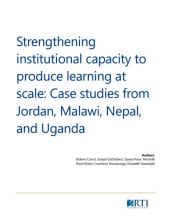
Despite the growing interest in supporting learning through play across many low and middle-income countries, measures of how contexts can support learning through play are lacking. As part of the Playful Learning Across the Years (PLAY) project, the concept of “self-sustaining engagement” was identified as central to learning through play. That is, learning through play is effective because children are deeply engaged in their learning and are self-motivated to learn. The PLAY toolkit was designed to measure how settings – particularly adult-child interactions in those settings – support children’s self-sustaining engagement in learning. The toolkit was developed for use in multiple age-groups across different settings. For the 0-2 age-group, the toolkit assessed support for children’s engagement in the home, largely through interactions between the caregiver and child. These interactions were assessed through observations and through an interview with the caregiver. In the 3-5 age-group, tools were developed to measure support for engagement in the home and the classroom. Tools for the 6-12 age-group were focused only on the classroom. The classroom-based tools had several components. Teacher-child interactions were assessed through observations, a teacher survey and – for the 6-12 age-group only – a student survey. There was also a classroom inventory to assess physical aspects of the classroom – such as materials on the walls – which might support self-sustaining engagement in learning. The toolkit was developed in three phases – the Build phase used qualitative data to understand local concepts of self-sustaining engagement. The Adapt phase used cognitive interviewing and small-scale (approx. 25 schools, centers or homes) quantitative data to refine the tools. In the Test Phase we used large-scale (approx. 150 schools, centres or homes) quantitative data to assess the psychometric properties of the tool. This presentation focuses on these psychometric analyses. Data were collected for the 6-12 age group from Kenya, Ghana and Colombia; for the 3-5 age group from Colombia, Jordan and Ghana; and from Colombia only for the 0-2 age group. Results indicate how the concept of “support for self-sustaining engagement” can be divided into constituent sub-scales and how the different methods of assessment – observation, teacher report and student report – relate to one another. We will discuss plans to develop a final toolkit, based on these analyses, which can help strengthen the evidence base on learning through play.
Assoc. Photo (Port.)
LegoPort.JPG
Resource (File)
Resource Type
Month and Year

Strengthening institutional capacity to produce learning at scale: Case studies from Jordan, Malawi, Nepal, and Uganda

Submitted by admin on
Description/Abstract
Case studies of RTI's work on strengthening institutional capacity in Nepal, Jordan, Malawi, and Uganda focusing on three core functions: (1) setting and communicating expectations; (2) monitoring against expectations; (3) providing targeted support to struggling schools.
Assoc. Photo (Port.)
bidemi cap assessment_port.jpg
Resource Type
Month and Year

PLAY overview CIES (Dubeck et al., 2022)

Submitted by admin on
Description/Abstract
Play has the potential to transform the global learning crisis. In infancy and early childhood, play builds a strong foundation for later learning by improving brain development and growth (Goldstein, 2012). In education systems that lack capacity to support children effectively, play brings its own powerful engine to drive learning—the joyful, engaged intrinsic motivation of children themselves (Zosh et al., 2017). In this way, play contributes to the holistic development of children, helping to prepare them for the challenges of the current and future world. Accordingly, there is an urgent need to improve measurement of playful learning, to be able to add to the evidence base on what the benefits of play are, how playful learning takes place, and how it can be promoted at home and at school across the lifespan. This presentation focuses on a renewed conceptualization of playful learning and describes an innovative approach to measuring how settings contribute to playful learning for children ages 0 to 12, supported by the Lego Foundation. The settings we examine include homes, classrooms and ECD centers. Following Tseng and Seideman (2007), we view settings as consisting of social interactions (i.e. between teachers or caregivers and children) and the organization of resources (e.g. learning materials, games). First, we will present our conceptual framework which identifies six constructs to guide our measurement strategy. The constructs, such as ‘support for exploration’, represent the ways in which a setting supports playful learning. Next, we will present our contextualization framework which guides how we are adapting and modifying the measurement tools to different contexts. The tool consists of a protocol to observe adult-child interactions and survey measures conducted with teachers, caregivers and primary school pupils. As part of the development process for these measurement tools, observation and survey measures will go through a three-phase development process in Kenya, Ghana, Colombia, and Jordan. The Build phase involved collecting qualitative data from teachers, caregivers and students to understand their perception of playful learning and how it is supported at home and at school. Next, an Adapt phase took place where the initial versions of the measurement tools underwent cognitive interviewing, field adaptation, and a small pilot to adjust and extend the items in the tool. The third Test phase is a full pilot of the instruments, and the data will undergo rigorous psychometric analyses to review the validity and reliability of the tools in the four country contexts. We will use the results to adjust the instruments and to finalize the conceptual framework and contextualization strategies. The final toolkit will be publicly available towards the end of 2022 with supporting materials for contextualization, piloting, training and analysis. The toolkit will be available on a public platform designed to promote sharing of data collected using the tool and to collaborate to continually improve approaches to measuring support for playful learning.
Assoc. Photo (Port.)
Screen Shot 2022-04-28 at 1.16.28 PM.png
Resource (File)
Resource Type
Month and Year
Publisher Or Client
The Lego Foundation