Capacity Building

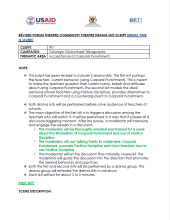
"Break Time is Over!" - Forum/Community Theatre Drama Skit Script

Submitted by admin on
Description/Abstract
Forum Theatre / Community Theatre Drama Skit Script titled "Break Time is Over!" created by USAID/Uganda's Literacy Achievement and Retention Activity (LARA) as part of their Social and Behavior Change Communication (SBCC) materials to reduce primary teachers' use of corporal punishment in school.
Assoc. Photo (Port.)
BreakTime.PNG
Country
Resource Type
Resource Language
Month and Year

Using the EGR Barometer to support benchmark and target setting for reading outcomes (CIES 2019 Presentation)

Submitted by admin on
Author
Description/Abstract
The Barometer offers a dynamic tool for interactive use of data on early grade reading outcomes. The ability to look at how the data are impacted by different parameters, like the level at which a reading benchmark is set, allows users to consider what benchmark and target for students achieving that benchmark in the near term may or may not be realistic. Furthermore, when such data are available, the Barometer also allows users to review the impact of interventions that have contributed to improving reading outcomes, and then factor in whether they can expect those kinds of improvements in the future, given the different investments and initiatives underway in their countries. The presentation is a short demonstration of these two features of the Barometer – target setting and considering the impact of previous or current interventions. Presented at CIES 2019.

Assoc. Photo (Port.)
Capture.PNG
Country
Resource Type
Featured projects
Resource Language
Month and Year

Scaling up Early Grade Reading in Uganda [CIES 2019 Presentations]

Submitted by admin on
Description/Abstract
This panel shared presentations from Uganda government officials and development partners which are collaboratively engaged in the efforts to improve and assess EGR in Uganda’s primary schools. Panel participants will discuss the process of gradually scaling up program activities to reach the majority of the nation’s schools by working with and through government structures. The Uganda MoES which has led the process from the begin will discuss how it has worked with donors and other development partners to mobilize resources and technical assistance by incorporating EGR in the ministry’s overall strategic plans. The Uganda National Examinations Board and the Uwezo Uganda initiative will discuss how they have been able to scale up assessment of Ugandan children’s reading skills through government ownership and civil society engagement in conducting early grade reading assessments. The GPE, SHRP, and LARA projects will share how they have worked through government structures at both the national and district levels to develop instructional materials in 12 local languages plus English and improve EGR instruction and learning in schools in a sustainable way. The panel will illustrate that attaining measurable improvements in reading scores at scale takes considerably more time and effort than smaller scale and pilot programs because interventions at scale require working through government structures and personnel, requiring systems strengthening and capacity building while also implementing program activities. This requires enormous effort and constant collaboration among government and development partners with sustainability as the ultimate objective.
Assoc. Photo (Port.)
Country
Resource Type
Resource Language
Month and Year

Journey to Self-Reliance: Case Study of Early Grade Reading Assessments in the Philippines

Submitted by admin on
Author
Description/Abstract
Over the course of four years (ending in 2016), the Department of Education (DepEd) in the Philippines grew increasingly self-sufficient at managing all aspects of early grade reading assessments (EGRAs). As DepEd’s capacity developed over time, the role of the technical assistance provided through the Education Data for Decision Making project (EdData II) shifted, diminished, and then disappeared altogether. International development professionals sometimes cite the cliché, “If we were truly successful, we would be working ourselves out of a job.” That sentiment now informs USAID’s goal to help each country on a journey to self-reliance. The EdData II project’s work in the Philippines provides some examples of what such a journey might include.
Assoc. Photo (Port.)
PHil JSR.jpeg
Resource (File)
Country
Resource Type
Featured projects
Month and Year

Journey to Self-Reliance: Case Study of Capacity Development in Cambodia

Submitted by admin on
Author
Description/Abstract
What conditions make it possible to accomplish significant capacity development without running any workshops, without requiring any explicit project deliverables, and with only three short-term technical assistance trips over the course of 19 months? The All Children Reading–Cambodia Activity has been supporting the Education Quality Assurance Department (EQAD) of the education ministry in Cambodia since February 2017. An EQAD staffer, asked about the assistance, said, “The value of the support …is more than I can express… Through collaboration with [the project], EQAD has developed remarkably.” This case study examines how a different approach to providing technical assistance helped EQAD make those “remarkable” strides toward self-reliance.
Assoc. Photo (Port.)
Cambodia JSR.jpeg
Country
Resource Type
Featured projects
Month and Year

USAID Early Grade Reading (EGR) EGR Final Report

Submitted by admin on
Author
Description/Abstract
Improving early grade reading and writing outcomes has implications more far-reaching than simply raising scores on national and international assessments. Reading is a fundamental tool for thinking and learning, which has an integrated and cumulative effect on comprehension in all subject areas. Providing students with a strong foundation in reading increases the likelihood of future academic and workforce success. By providing Palestinian teachers with additional strategies and resources to build essential primary students’ reading and writing skills, the US Agency for International Development (USAID) Early Grade Reading (EGR) Project supported the goal of the USAID mission in the West Bank/Gaza of “providing a new generation of Palestinians with quality education and competencies that would enable them to thrive in the global economy and empower them to participate actively in a well-governed society.” Specifically, EGR addressed USAID’s strategic Sub-objective 3.1.5 to improve “service delivery in the education sector through increased access to quality education, especially in marginalized areas of the West Bank; a higher quality of teaching, learning and education management practices; and improved quality and relevancy of the education system at all levels.” EGR also directly supports USAID’s global goal to improve early grade reading skills. In support of the overarching goals, EGR’s project goal was to facilitate change in classroom delivery of early grade reading and writing instruction through three inter-connected component areas including evidence-based standards and curriculum revisions, instructional improvements, and parental engagement activities designed to improve student reading and writing competencies in Kindergarten (KG)–Grade 2 in the West Bank. EGR offered a scalable model of early grade reading instruction in 104 West Bank public schools among 351 teachers who taught 9,679 students. EGR collected data through reviews of curricular and standards’ documents, studies in schools, and assessments of students’ reading competencies. The project developed book leveling criteria to ensure the age- and grade-level appropriateness of reading materials, which facilitated the development or procurement of over 100,000 books for schools. EGR provided the Ministry of Education and Higher Education (MOEHE) with training modules in early grade reading and writing skills, a reading remediation manual, and a school-based professional development model. The project created innovative materials for parents to use to enhance their children’s reading skills. Despite its abbreviated timeframe, the project provided the MOEHE with a wealth of educational data, materials, and resources, including many interventions offered for the first time in the Palestinian educational system.
Assoc. Photo (Port.)
Final Report photo.JPG
Resource Type
Resource Language
Month and Year
Publisher Or Client
USAID/West Bank and Gaza

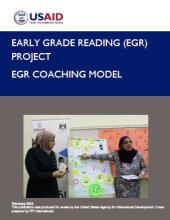
Early Grade Reading (EGR) Project EGR Coaching Model

Submitted by admin on
Author
Description/Abstract
RTI International and its partner AMIDEAST supported the Ministry of Education and Higher Education (MOEHE) in the implementation of the United States Agency for International Development (USAID)/West Bank Early Grade Reading (EGR) project. The EGR program goal was to facilitate change in classroom delivery of early grade reading and writing instruction through an integrated process of instruction and assessment designed to improve student reading and writing competencies in Kindergarten (KG)–Grade 2 in the West Bank. EGR worked to equip the coaches, teachers, and principals with the tools and strategies that would enable them to provide effective reading and writing instruction that results in changing classroom delivery of early grade reading and writing instruction. The EGR coaching model outlined the support provided to teachers to implement new instructional strategies that were introduced in EGR training sessions to strengthen students’ reading and writing skills. A good coach helps teachers grow professionally and develop their skills. EGR views coaching as an interactive process that supports teachers to set goals, strengthen classroom practices, and provide encouragement to overcome challenges and celebrate successes. As an interactive process, coaching goes beyond training teachers; it involves continuously checking in with the teachers to ensure they have the support and guidance needed to be successful in the classroom. EGR’s coaching model includes classroom observations followed by delivery of descriptive feedback, teacher-to-teacher collaboration through participation in teacher learning circles, and access to a variety of online resources.
Assoc. Photo (Port.)
Coaching report photo 2.JPG
Resource Type
Resource Language
Month and Year
Publisher Or Client
USAID/West Bank and Gaza

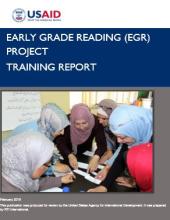
Early Grade Reading (EGR) Project EGR Training Report

Submitted by admin on
Description/Abstract
In cooperation with the MOEHE Training Technical Working Group (TWG), EGR developed training modules in the five basic reading skills: phonemic awareness, phonics, fluency, vocabulary, and reading comprehension as well as a comprehensive module in writing skills. The project initially planned to introduce one module at each training session conducted throughout the academic year. However, when EGR learned that the project would close prematurely due to legislative restrictions and funding issues, project staff compressed the trainings on the five basic skills into four over a period of four months. The shortened timeframe did not allow EGR to offer training in the four basic writing skills, but the project developed one comprehensive writing module, which was provided to the coaches in January 2019. EGR supplemented the training modules with additional instructional resources. Project specialists developed three instructional videos to reinforce the strategies introduced in the training modules. Additional activities to support the five basic reading skills were compiled in one resource book. EGR provided four interactive posters for teachers to use in their classrooms and a variety of complementary reading materials. The project’s goal was to equip coaches and teachers with the tools needed to implement a quality early grade reading program.
Assoc. Photo (Port.)
Tranng report photo.JPG
Resource Type
Resource Language
Month and Year
Publisher Or Client
USAID/West Bank and Gaza

Nigeria Reading Access and Research Activity (RARA): Development of Teaching and Learning Materials for Early Grade Reading Instruction

Submitted by admin on
Description/Abstract
This document focuses on the instructional materials for early reading in Hausa developed under Nigeria RARA. It documents the process through which the materials were conceptualized. The intention is to provide guidance to similar projects implemented by donors, ministries of education, non-government organizations (NGOs), and private publishers. The lessons documented are most applicable in contexts in which existing materials do not adequately support early reading instruction or are very scarce. While Nigeria RARA materials are exemplars of a research-based approach to materials development, they are pilot versions. Similar initiatives are encouraged to build upon this model and make improvements of their own.
Assoc. Photo (Port.)
Nigeria RARA Materials Development Process_Final.jpg
Country
Resource Type
Resource Language
Month and Year
Publisher Or Client
RTI International