Capacity Building

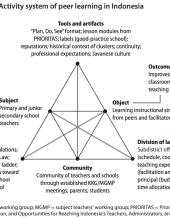
Using Activity Theory to Understand Teacher Peer Learning in Indonesia

Submitted by admin on
Description/Abstract
Chapter 7 of Edited Volume: Pouezevara, S. R. (Ed.) (2018). Cultivating dynamic educators: Case studies in teacher behavior change in Africa and Asia. (RTI Press Publication No. BK-0022-1809). Research Triangle Park, NC: RTI Press. DOI: 10.3768/rtipress.2018.bk.0022.1809 This case study explores the methods and implementation considerations of peer-learning approaches to changing teaching practice in the Indonesian context, where cluster-based training is deeply embedded in the education system. These clusters were leveraged by USAID/PRIORITAS to disseminate professional development through a structured lesson-study approach. To understand more about how teachers were learning to improve their practice through peer mentoring, data were collected through interviews and school visits in August 2016. The main purpose of the case study was to understand the scope and implementation considerations of school-based and peer-to-peer approaches to teacher behavior change, with particular focus on improving reading instruction. We particularly have tried to uncover the implementation factors that influenced the possibility of success of peer mentoring in Indonesia under USAID/PRIORITAS, including issues of intrinsic and extrinsic motivation, readiness for self-directed learning, and the relative importance of the foundation laid by the preexisting school- cluster structure described in the Methodology section.
Assoc. Photo (Port.)
activity theory.jpg
Country
Resource Type
Resource Language
Month and Year
Publisher Or Client
RTI Press

System sustainability for quality early childhood development and education in Kenya- CIES 2018 Presentation

Submitted by admin on
Author
Description/Abstract
CIES 2018 Presentation, given by Sam Ngaruiya. This study explores the role of the Tayari program in promoting a viable and quality ECDE system that county governments in Kenya can sustainably deliver. Tayari is a three year pilot implemented by the national Ministry of Education and four county governments. The program is designed to help the government develop a cost effective and scalable ECDE model. The pilot program is implemented in public schools and ECDE centers in low resource settings. Utilizing data from a qualitative study conducted in 4 pilot and 3 non-pilot counties’ decision-making, the presentation outlines three key aspects of sustainability: the extent to which collaborative implementation has improved ownership and resource allocation and how the Tayari instructional approach has impacted on process quality and teacher retention in the program. The findings and discussion are critical in helping county governments prioritize investment in a quality and sustainable ECDE model for improved school readiness.
Assoc. Photo (Port.)
Pages from Ngaruiya, Sam_CIES2018_System sustainability for quality ECDE in Kenya.jpg
Country
Resource Type
Month and Year

USAID PRIORITAS Final Project Report, Volume I: Main Report

Submitted by admin on
Description/Abstract
The USAID PRIORITAS project began in May 2012 with the aim of achieving expanded access to improved quality basic education (IR1). The intermediate results (IRs) that the project aimed to achieve are as follows: * strengthened instruction in schools in targeted districts (IR1-1) * improved education management and governance in targeted schools (IR1-2) * strengthened coordination between all levels of the Government of Indonesia (GOI) and education institutions (IR1-3). This report covers the duration of the project, from May 2012 to September 2017.
Assoc. Photo (Port.)
PRIORITAS final report cover.jpg
Country
Resource Type
Resource Language
Month and Year

The opportunities and challenges of collaborating with government and other partners on the Ethiopia READ program

Submitted by admin on
Author
Description/Abstract
Presentation delivered at CIES 2017 (Atlanta). As the READ TA project’s main focus is on providing technical assistance to and building the capacity of the Ethiopian Ministry of Education and its Regional Education Bureaus to develop and conduct the foundational components of a reading program (i.e., curriculum development, in-service and pre-service teacher training, and teacher support), the project has had to work through government systems to accomplish its objectives. This has provided great opportunities along with challenges. While there are some activities in which the project has direct involvement in the inputs and outcomes (curriculum development workshops, training of trainers, incorporating technology), there are others which are largely outside of the control of the project (printing of textbooks, training of teachers, government approvals). But all activities are necessary for the reading program to be successful. This requires establishing strong collaborative relationships with government counterparts and having the flexibility to adjust to the ever-changing situation.
Assoc. Photo (Port.)
USAID presentation.jpg
Resource (File)
Country
Resource Type
Resource Language
Month and Year

Community Forum Sustainability Review

Submitted by admin on
Description/Abstract
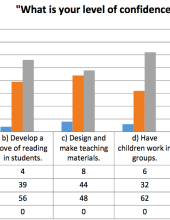
This reports summarizes a process to improve performance management and accountability that emphasized participatory data collection and use in Northern Nigeria. Private sector actors at State, LG and school and community level were encouraged to collect data and use it for purposes of advocacy, capacity building, and accountability. At the local government level, community participation was encouraged through a series of forums in which representatives from school staff, parents, business and religious leaders collectively reviewed data on the performance of their primary school education system, established areas for support, and assigned responsibilities. Although successful with support from project funds, it was unclear if the process would survive after the project. This report summarizes a survey of forum participants and is divided into three sections: (i) a short discussion of the data collection process; (ii) a summary review of survey results; and (iii) recommendation for three key areas of sustainability – roles and responsibilities; financing and formalization of the process.

Assoc. Photo (Port.)
Nigeria community forum initiative.png
Country
Resource Type
Resource Language
Month and Year
Publisher Or Client
USAID

Zambia 2016 Grade 2 National Assessment Survey Implementation Plan

Submitted by admin on
Description/Abstract
This implementation report was designed to assist the Examination Council of Zambia (ECZ) by providing detailed instructions for carrying out the 2016 National Assessment Survey for Grade 2.
Assoc. Photo (Port.)
Country
Resource Type
Resource Language
Month and Year
Publisher Or Client
USAID

Zambia 2016 Grade 2 NAS Implementation Plan

Submitted by admin on
Description/Abstract
This implementation report was designed to assist the Examination Council of Zambia (ECZ) by providing detailed instructions for carrying out the 2016 National Assessment Survey for Grade 2.
Assoc. Photo (Port.)
Country
Resource Type
Month and Year
Publisher Or Client
USAID

Research on Reading in Morocco: Analysis of Teachers’ Perceptions and Practices

Submitted by admin on
Description/Abstract
This report is one of three undertaken in the context of a situation analysis of reading in Morocco. The present report analyzes in detail teachers’ attitudes and practices. As a starting point, it addresses the following questions: What are the perceptions that have the most influence on the teaching of reading in the early grades? How do these perceptions impact the professional development of teachers? How do teachers respond to questions about the language of teaching? Are they receptive to the learning of reading in local languages? This third research component studies the perceptions of language use in general and the behavior of teachers specifically. It analyses teachers’ perceptions of the teaching of reading in Arabic and how these perceptions influence their practice.
Assoc. Photo (Port.)
morocco attitudes.png
Resource (File)
Country
Resource Type
Resource Language
Month and Year
Publisher Or Client
USAID

Tech’n Teachers: Assembling the jigsaw puzzle - but do we even know the picture?

Submitted by admin on
Author
Description/Abstract
This presentation was given at the 2015 Game Change Summit of the United Methodist Church in Nashville, TN. The presentation takes the audience along a journey of 2 different technology initiatives that involve teachers in Samoa and Kenya and share with you some of the pieces we have found, and where we think some are still missing. While there are many more, the presentation focused on each initiative’s main puzzle pieces – the key design elements of education objective, content, technology, training, cost and scale, as well as monitoring and evaluation.
Assoc. Photo (Port.)
technteachers.jpg
Resource (File)
Country
Resource Type
Resource Language
Month and Year
Publisher Or Client
RTI International