Zambia

Country Code
ZMB

Early Grade Reading Barometer

Submitted by admin on
Description/Abstract
The Early Grade Reading Barometer is an interactive dashboard that lets you: - SEE an overview of how well students are reading, the percentage of struggling readers, and how comprehension is associated with reading fluency. - VIEW information about student performance on EGRA subtasks. See how outcomes vary by key student and school characteristics. - EXPLORE how different EGRA subtasks are related to one another. View graphic displays of these relationships. - CHOOSE a target oral reading fluency benchmark, and see information on how many students are meeting the targeted benchmark now and how the percentage of students meeting the benchmark value could change over time. - SEE how countries compare with each other with respect to student outcomes on EGRA assessments and progress towards meeting UN SDG Goal 4. - REVIEW the impact of interventions aimed at improving the fundamental reading skills of students. - COMPARE how the distributions for selected EGRA subtasks have changed or remained the same over time.
Assoc. Photo (Port.)
Generic_icon_shared.rti_.org_.png
Resource Type
Resource Language
Month and Year
Publisher Or Client
USAID

Cultivating Dynamic Educators [CIES 2019 Presentation]

Submitted by admin on
Description/Abstract
This presentation introduces the panel of authors who presented at CIES 2019 about their chapter of the book.
Assoc. Photo (Port.)
Sarah CIES 2019 Panel Presentation.jpg
Resource (File)
Resource Type
Resource Language
Month and Year
Publisher Or Client
RTI International

Cultivating Dynamic Educators: Case studies in teacher behavior change in Africa and Asia

Submitted by admin on
Description/Abstract
Cultivating Dynamic Educators: Case Studies in Teacher Behavior Change in Africa and Asia responds to growing recognition by international education professionals, policy makers, and funding partners of the need for qualified teachers and interest in the subject of teacher professional development (also referred to as “teacher behavior change”). The book responds to important questions that are fundamental to improving teaching quality by influencing teaching practice. These questions include: How do we provide high-quality training at scale? How do we ensure that training transfers to change in practice? What methods are most cost-effective? How do we know what works? The book includes case studies from seven countries--Ethiopia, India, Indonesia, Malawi, Nigeria, Philippines and Zambia--describing different approaches to teacher behavior change and illustrates how specific implementation choices were made for each context. Individual chapters document lessons learned as well as methodologies used for discerning lessons. The key conclusion is that no single effort is enough on its own; teacher behavior change requires a system-wide view and concerted, coordinated inputs from a range of stakeholders.
Assoc. Photo (Port.)
TBC book front coer.jpg
Resource Type
Resource Language
Month and Year
Publisher Or Client
RTI Press

Effective Teaching and Education Policy in Sub-Saharan Africa: A Conceptual Study of Effective Teaching and Review of Educational Policies in 11 Sub-Saharan African Countries

Submitted by admin on
Description/Abstract
This report explores teacher issues and policies in sub-Saharan African countries via three interrelated questions and methods, each of which is discussed in turn. First, the paper presents the state of issues related to teaching and learning in sub-Saharan African countries. Recent data and evidence, obtained from international, regional, and national databases for numerous sub-Saharan African countries are presented that speak to the state of teacher issues and conditions of service for teachers. Second, the paper outlines national policies and educational plans germane to teaching and learning in 11 sub-Saharan African countries. A third section of the paper highlights reasons why educational policies and plans may not be sufficiently salient to substantially influence the classroom practice of teachers.

Assoc. Photo (Port.)
DERP1.png
Resource Type
Month and Year

Proposing Benchmarks and Targets for Early Grade Reading and Mathematics in Zambia

Submitted by admin on
Description/Abstract
A National Policy Dialogue Workshop was held on July 1, 2015, followed immediately by a Benchmark Setting Workshop July 2–3, to address the question: "What is an acceptable level of reading and mathematics achievement for Zambian pupils in the early grades of primary school?”

Assoc. Photo (Port.)
zambia3.png
Country
Resource Type
Month and Year

National Assessment Survey of Learning for Grade 2: Preliminary Results for Early Grade Mathematics in Zambia

Submitted by admin on
Description/Abstract
The 2014 Standard 2 National Assessment Survey (NAS) was intended to provide a national measure of pupil reading (local languages and English) and mathematics skills. The final report for the entire survey will consist of three main sections reporting pupil reading performance: • Early Grade Reading Assessment (EGRA) by local language • Early Grade Reading Assessment in English • Early Grade Mathematics Assessment (EGMA) This preliminary report focuses on presenting only the results for the EGMA.
Assoc. Photo (Port.)
Resource (File)
Country
Resource Type
Month and Year
Publisher Or Client
DFID

USAID/Zambia Education Project Baseline Report: Nonreading Indicators

Submitted by admin on
Description/Abstract
RTI International was asked to develop 10 nonreading indicators (NRI) related to improved early grade reading (EGR) in Zambia—or more generally, to improved learning outcomes. Accordingly, the desk study that was required as background research for this effort focused on the international literature related to high performing education systems and schools, or “effective schools”; and our own research and experience in the realm of systems reform and reform support for improved learning outcomes. While some of the findings of this desk study may not be immediately applicable to the Zambian context, they nevertheless helped to create an overall understanding of what is needed by a system to improve learning outcomes, and so inform our effort to develop 10 nonreading indicators. The general findings of this desk study are as follows.
Assoc. Photo (Port.)
zambia 2.png
Country
Resource Type
Month and Year

National Assessment Survey of Learning Achievement at Grade 2: Results for Early Grade Reading in Zambia

Submitted by admin on
Description/Abstract
This analysis report for the reading portion of the Grade 2 NAS presents the results for pupil performance on the EGRA in seven local languages, each of which also had a small set of subtasks in English. Additional information about schools, teachers, head teachers, and pupils’ socioeconomic background that was collected alongside the EGRA provides context for many of the results. For grade 2, a nationally representative sample of pupils was selected to take locally developed versions of the EGRA and the Early Grade Mathematics Assessment (EGMA), which together comprised the Grade 2 National Assessment Survey (NAS). Outcomes on the EGMA portion of the survey, sponsored by the British Department for International Development (DFID), are documented in a separate findings report.
Assoc. Photo (Port.)
zambia 1.png
Resource (File)
Country
Resource Type
Month and Year

Assessing the impact of language on pupil learning

Submitted by admin on
Description/Abstract
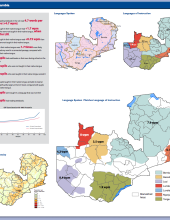
This poster presented at the 2016 Comparative International Education Society (CIES) Conference in Vancouver, British Columbia, explores the relationship between Language of Instruction on pupil EGRA outcomes in Zambia and Ghana and uses GIS data to map information on languages spoken in a given area (from SIL Ethnologue data) with information on school language of instruction.
Assoc. Photo (Port.)
ghana poster.png
Country
Resource Type
Resource Language
Month and Year
Publisher Or Client
USAID

Survey of Children's Reading Materials in 11 African Countries: Suvey Instruments

Submitted by admin on
Description/Abstract
The attached survey instruments were used to analyze various learning materials as part of the Survey of Children's Reading Materials in African Languages in Eleven Countries (part of the DERP program).
Assoc. Photo (Port.)
Month and Year
Publisher Or Client
USAID