
Capacity Building

Data-driven decentralized school support: the use of student learning data to direct management support in Tanzania [CIES 2024 Presentation]

Submitted by admin on
Description/Abstract
On mainland Tanzania, most resource allocation decisions are centralized. The President’s Office - Regional Administration and Local Government (PO-RALG) recruits and assigns teachers, supplies teaching and learning materials and funds capital construction projects. Local Governments are provided limited funds for training support or redeployment of teachers among schools. Their main resource, therefore, is to provide management attention and support to schools. With an average of 140 schools in a District and a staff of 5 individuals, only a few schools can be supported. In 2016, The Ministry of Education and Sports developed a School Quality Assurance Framework to guide local administrators on key areas of focus and guidance for school support. The framework focuses on six areas: school inputs, teacher practice, student learning outcomes, school environment, school leadership and community engagement. To facilitate the monitoring of these areas, USAID Tusome Pamoja project piloted a data collection tool that allowed measurement of progress through indicators. Of particular interest was the use of a group administered learning assessment that established benchmarks for success for grade 2 learners across six sub-tasks for reading, writing and mathematics. Due to limited resources, this assessment was only applied to a sample of schools in each district. Districts could assess their overall performance against these indicators and as a result developed somewhat generic district level support plans.. This presentation will explore how initial challenges of vague district plans were overcome through the critical data collection process leading to the establishment of benchmarks for success. o Under a subsequent activity, USAID Jifunze Uelewe, software was developed that allowed districts to capture group administered learning data for every grade 2 student and to aggregate this information at the school level. Districts were then able to rank order all schools in the district by scores on learning sub-tasks and then select the lowest performing schools for additional management attention. At the same time, districts were able to pair high-performing and low performing schools. The result of the access to school specific data was to allow districts to direct their attention to the development of plans at the school level to address low learning performance, and the ability to track progress of these schools over time. Schools enter data on Government provided tablets and the data can be synched when headteachers have access to Government provided wifi. Decentralized administrators have long been seen as critical for translating national policy into local action. However, they are frequently hampered by a combination of distracted management attention and unclear targets or benchmarks for key inputs, which encourages a laissez-faire status quo. In Tanzania, local governments in four regions have been able to contextualize data to meet their needs and use simple technology to prioritize their attention and decision-making. Our presentation showcases the significance of data driven decision making and continuous improvement of the system. We further highlight the important of simple and meaningful change and fostering proactive decision making at the local level.

Assoc. Photo (Port.)
ju port.PNG
Resource Type
Month and Year
Publisher Or Client
USAID Jifunze Uelewe

Improving Learning Outcomes for the Philippines - Strengthening performance management: Case studies and key insights

Submitted by admin on
Description/Abstract
Taken together, the case studies in this Report highlight the core components of an effective performance and accountability framework – a comprehensive system to optimize individual and system-wide performance through establishing outcome goals, tracking, and incentivizing progress against them The case studies show that effectiveness is not determined by implementing a set of individual policies, tools, and structures, but rather how they are collectively used to drive a culture that empowers its people to achieve a system’s ambitious agenda. The components of a performance and accountability framework that are featured in these case studies include: • System leadership that prioritizes a culture of high-performance around targets. • Outcome focused targets and supporting indicators that are well understood and communicated throughout the system, to define and quantify a system’s aspiration. • Quantitative data which is available and regularly shared across a system to gauge system performance, and to identify areas for additional focus or support. • Targeted and tailored support for system actors to help them improve performance, including a focus on specialized support for underperformers, driven by an understanding of data and evidence. • Performance routines and reporting with key system actors focused on reviewing progress, problem solving, and decision making to unlock barriers to improvement. • System engagement and site-visits/fieldwork that surfaces key challenges and opportunities to drive improvement. • Public engagement that keeps the public up to date on progress. Some of these components may require adaptation to different parts of the system. For example, targets may feature in performance agreements for senior leadership roles, but not for frontline staff who may be engaged in a more indirect way around targets (for example, communication of the reform with a focus on enhancing practice and improved outcomes). Similarly, formal performance routines that focus on a broader strategic reform are effective at driving a performance culture at senior levels, but not so for frontline staff who are rightly focused on teaching practice in their classroom. To be effective, embedding a performance and accountability culture across a system requires a nuanced and tailored application of these components to frontline staff, middle management, and senior levels.
Assoc. Photo (Port.)
FY24PerformanceManagement_CoverSheet_Portrait.png
Country
Resource Type
Featured projects
Resource Language
Month and Year

Что необходимо знать Руководителям системы образования?

Submitted by admin on
Author
Description/Abstract
Повышение уровня базовой грамотности и навыков счета требует изменений в повседневной практике преподавания. Структурированные педагогические программы эффективны в тех случаях, когда учителя имеют возможность ежедневно применять необходимые учебно- методические материалы, последовательно использовать время занятий более продуктивно, а также систематически внедрять усовершенствованные методы обучения. Каковы наиболее важные аспекты системы образования, способствующие достижению этих целей?
Assoc. Photo (Port.)
SP_8_MOE Systems_Russian.jpg
Resource (File)
SP_8_MOE Systems_Russian.pdf
Country
Resource Type
Resource Language
Month and Year

Практическое руководство и обзор литературы

Submitted by admin on
Description/Abstract
*** This is the Russian translation of the Science of Teaching Structured Pedagogy Guide Literature Review *** Результаты обучения в странах с низким и средним уровнем дохода являются катастрофически низкими. Задача улучшения результатов в области базовой грамотности и счета (FLN) зависит от повышения качества преподавания и поддержки принятия методических решений отдельными учителями - их десятки тысяч во многих странах. Программы структурированной педагогики показали их способность оказывать поддержку учителям в принятии таких индивидуальных педагогических решений в широком масштабе, и, что такие изменения могут оказать значительное влияние на результаты обучения.
Assoc. Photo (Port.)
10. Практическое руководство и обзор литературы.jpg
Country
Sub-topic
Resource Type
Resource Language
Month and Year

Рекомендации для руководителей сферы образования

Submitted by admin on
Description/Abstract
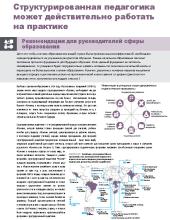
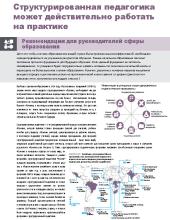
Для того чтобы система образования в вашей стране была признана высокоэффективной, необходимо сконцентрироваться на улучшении результатов обучения. Раннее начальное образование означает заложение прочного фундамента для будущего обучения. Если данный фундамент не заложить своевременно, то учащимся будет затруднительно сдавать экзамены по окончании начальной школы и переходить на более высокие ступени образования. Конечно, развитие у человека навыков мышления высшего порядка и достижение успеха на протяжении всей жизни зависит от уровня грамотности и навыков счета, полученных в младших классах.
Assoc. Photo (Port.)
09. Рекомендации для руководителей сферы.jpg
Country
Sub-topic
Resource Type
Resource Language
Month and Year

Что необходимо знать Руководителям системы образования?

Submitted by admin on
Author
Description/Abstract
Повышение уровня базовой грамотности и навыков счета требует изменений в повседневной практике преподавания. Структурированные педагогические программы эффективны в тех случаях, когда учителя имеют возможность ежедневно применять необходимые учебно- методические материалы, последовательно использовать время занятий более продуктивно, а также систематически внедрять усовершенствованные методы обучения. Каковы наиболее важные аспекты системы образования, способствующие достижению этих целей?
Assoc. Photo (Port.)
09. Рекомендации для руководителей сферы.jpg
Country
Sub-topic
Resource Type
Resource Language
Month and Year

2022 Higher Education in Asia: Strategic Review: Improving Learning Outcomes for Asia (ILOA) Mechanism

Submitted by admin on
Description/Abstract
The United States Agency for International Development's (USAID's) Bureau for Asia conducted a strategic review to examine the depth and breadth of USAID higher education (HE) programming in Asia over the five-year period from 2016 through 2021. The review highlights ways in which USAID's HE programming has been a vehicle for all sectors, not only education, to achieve USAID development objectives. The review's findings and recommendations should inform continued USAID HE investment in Asia. USAID investments in HE support the 2022 lndo-Pacific Strategy (IPS). Within USAID and the interagency, there is a growing interest in HE programming opportunities. This recognition of the role of HE in driving economic development is reflected in its inclusion in the lndo-Pacific Strategy of the United States (White House, 2022), which highlights education as key to regional economic prosperity and security, as well as regional resilience to transnational threats. Unlike in previous strategies, HE is now explicitly noted in the 2022 version of the strategy as a vehicle to advance the United States Government's (USG's) vision for a "free and open lndo-Pacific" (p. 6). This review details examples of how USAID HE investments could support the IPS by countering malign influence, strengthening democratic systems, conducting cutting-edge research to fight the COVID-19 pandemic, and building diverse and equitable partnerships between U.S. and Asian partners. USAID is forging lasting transpacific partnerships through HE investments. In 2021, this engagement included partnerships among 270 higher education institutions (HEls) from across the region and with more than 20 HEls from across the U.S. Programs are aligned with USAID's Education Policy and achieving outcomes in all USAID sectors by "advancing knowledge and research; providing quality and relevant education and workforce training; and engaging and strengthening networks and communities" (Dockser et al., 2020, p. 5) in food security and agriculture; democracy, governance, and human rights; peace and security; economic growth and workforce development; and global health. These investments are advancing locally led development, producing the next generation of leaders, laying the groundwork for more resilient economies and future trade partners, and sustainably advancing American values in a region wary of malign influence.
Assoc. Photo (Port.)
HEactivities_GIS.png
Resource Type
Featured projects
Month and Year

Summary report of the Regional Institutional Capacity Assessment Process and Results (Diourbel, Fatick, Kaffrine Kaolack, Kedougou, Louga, Matam, Saint Louis, Tambacounda)

Submitted by admin on
Description/Abstract
In French, with an English Executive Summary. Senegal is embarking on an ambitious reform program with the objective of improving learning outcomes for all students by more systematically using regional mother tongues as bridges to proficient literacy in French. The Renforcement de la Lecture Initiale pour Tous (RELIT) activity made possible by the American people through USAID is supporting the National Education Ministry (MEN) in the development of the materials, pedagogy, assessments, and teacher training needed to implement the MOHEBS. The institutional capacity development elements of RELIT are by design meant to complement these other interventions. RELIT is approaching institutional capacity in terms of the knowledge and skills of actors in key positions at each level of the system, but more importantly also in terms of how those levels relate to each other and the institutional environments within which all the concerned actors operate. This relates to how their jobs are defined, how their responsibilities are assigned and resourced, and what explicit or tacit incentives or disincentives they encounter in the day-to-day fulfillment of those responsibilities. Additionally, RELIT recognized from the beginning that investments to improve institutional capacity are dependent on the engagement and willingness of the actors involved to identify their needs and, on the basis of those needs, jointly plan with RELIT the actions that will best address them. Therefore, RELIT has taken the participatory approach described below to assessing and addressing institutional capacity development needs in the education system in Senegal. This report describes the result of institutional capacity self-assessment activities in the regions involved in RELIT.
Assoc. Photo (Port.)
RELIT portrait.PNG
Country
Resource Type
Featured projects
Resource Language
Month and Year
Publisher Or Client
USAID

ICT Baseline Assessment

Submitted by admin on
Author
Description/Abstract
The information and communication technology (ICT) baseline assessment measured current competency of grades 9, 10, and 11 students on the Program-developed materials that include standards, teacher guides, and use of the ICT student textbooks (STB). The Program customized the STB for Uzbekistan from an internationally sourced series of ICT materials originating from Cambridge University Press. The assessment was conducted with students across these three grades in two distinct regions (Namangan and Sirdaryo) of Uzbekistan.
Assoc. Photo (Port.)
ICT Baseline Assessment.jpg
Resource (File)
ICT Baseline Assessment.pdf
Country
Resource Type
Month and Year

EDUCATION RESEARCH - New Knowledge for Improved Outcomes

Submitted by admin on
Description/Abstract
The Uzbekistan Education for Excellence Program led the development of a groundbreaking curriculum based on international best practices and contributions from local experts. The approach was rooted in a theory of change that identified long-term goals (outcomes) and the interconnecting outputs and conditions to achieve them. In collaboration with the Uzbekistan Ministry of Preschool and School Education (MoPSE), the Program developed education standards, scope and sequences, new textbooks and teacher guides, and continuous professional development training for educators in pilot schools among other activities and products. Throughout this process, the Program sought to test the theory of change, fill critical gaps in knowledge about the Uzbek educational system, and determine what kind of research would be most responsive to this breadth of interventions and the complex nature of classroom dynamics.
Assoc. Photo (Port.)
Pages from 14_Brief_Process_Research_Final_ENG.jpg
Resource (File)
Country
Resource Type
Featured projects
Month and Year