Capacity Building

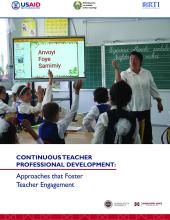
CONTINUOUS TEACHER PROFESSIONAL DEVELOPMENT - Approaches that Foster Teacher Engagement

Submitted by admin on
Author
Description/Abstract
To improve the quality of instruction and learning, a challenge that many ministries must confront, is the need to provide teacher professional development at scale. Uzbekistan has approximately 10,104 schools, 502,687 teachers, and 6,336, 933 students.2 In 2022, when MoPSE rolled out the new EFL teacher and student books, it struggled to reach and train all teachers.

Assoc. Photo (Port.)
Pages from 08_Brief_TPD_Final_ENG.jpg
Resource (File)
Country
Resource Type
Featured projects
Resource Language
Month and Year

Can the Middle Tier Drive Foundational Learning at Scale?

Submitted by admin on
Author
Description/Abstract
An integral part of a decentralized education system hierarchy is the “middle tier” comprising subnational actors in charge of education delivery at the regional, provincial, state, district, municipality, city, or circuit and cluster levels. The general roles and responsibilities of the middle tier are described in research on district leadership in OECD countries. Their responsibilities range from planning, monitoring, and implementing reforms at the subnational and school levels, to ensuring school-based accountability through data and evidence, to innovating, supporting, and monitoring improvements in teaching and learning in schools through instructional leadership and fostering professional learning communities at the district and school levels. While rigorous academic evidence may be lacking on the ability of middle managers to bring about improvements in foundational literacy and learning outcomes at scale in LMICs, we have theoretical and programmatic evidence on (1) their role in instructional leadership, (2) the importance of building their capacity to drive teaching and learning, and (3) the importance of trust and support within the education system that fosters learning at scale. Thumbnail Credit: Pakistan Reading Program/IRC

Assoc. Photo (Port.)
Picture4_0.jpg
Resource (File)
Resource Type
Resource Language
Month and Year
Publisher Or Client
Center for Global Development / Bill and Melinda Gates Foundation

Education system strengthening across Asia: a systematic review of USAID activities and critical discussion [CIES 2023 Panel Presentation]

Submitted by admin on
Description/Abstract
The purpose of this formal group panel presentation is to hold an in-depth discussion on USAID’s investments into system strengthening across Asia over the past decade and how these efforts are situated within the broader global move to focus more intentionally and coherently on education system strengthening. The panel will discuss a 2022 empirical research study (the USAID System Strengthening Review, hereafter “the Review”) conducted by two international research organizations for the USAID Asia Bureau which reviews USAID system strengthening work in 11 Asian countries. This Review offers a qualitative evidence-based analysis relevant to the field of comparative and international education (CIE) and analyzes new data collected from a desk review of relevant project documents, reports, and evaluations, key informant interviews, multi-stakeholder survey, and three deep-dive case studies in Nepal, Cambodia, and the Philippines. The group panel will include three presentations on different aspects of the Review and include discussant commentary and critique to elicit group and audience discussion. The first panel presentation discusses a theoretical framework drawn from the RISE Programme (Pritchett 2015 and Spivak 2021) and recent analysis from the Brookings Institution’s Center for Universal Education. The Review’s central research questions are guided by these broader global trends, as well as its own analysis framework developed specifically for this study, discussed in Presentation 3. Conclusions are drawn based on this framework, and the overall discussion in Presentations 2 and 3 considers the context of USAID programming in Asia and how new knowledge provides new insights.
Assoc. Photo (Port.)
Resource (File)
Resource Type
Featured projects
Month and Year
Publisher Or Client
USAID

Navigating Aid Alternatives: Government-to-Government funding partnerships in Jordan, Senegal, Nepal [CIES 2023 Panel Presentations]

Submitted by admin on
Description/Abstract
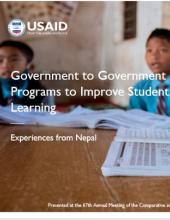
Since 2010, USAID has increased funding to partner country institutions by 50% [1], and the current administration’s localization agenda suggests that the government-to-government (G2G) modality may be increasingly frequent. Implementing partners operating in countries with a G2G arrangement, must pay careful attention to the meaning of technical assistance and system strengthening for scale and sustainability. This topic was covered by three presentations in a panel session, including: (1) Driving government ownership of a new language policy through a Government-to-Government partnership: The case of Senegal; (2) Government-to-Government programs to improve student learning: The case of Nepal; and (3) The case of Jordan
Assoc. Photo (Port.)
G2G portrait.JPG
Country
Resource Type
Month and Year

Analyzing Alignment in Early Grade Reading Curricula, Instruction, and Assessment in Nepal: The Surveys of Enacted Curriculum Approach [CIES 2023 Presentation]

Submitted by admin on
Author
Description/Abstract
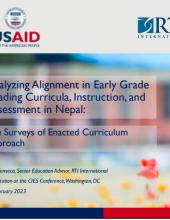
This presentation was given at the Comparative and International Education Society (CIES) annual conference in Washington, DC on February 21, 2023. The presentation describes a systematic research method used in USAID's Early Grade Reading Program II (EGRP II) in Nepal to analyze the alignment between the early grade reading curriculum, teacher instruction, and student assessment. The file includes both the presentation slides and the explanatory notes.
Assoc. Photo (Port.)
Jodie Portrait.JPG
Country
Resource Type
Month and Year

Read Liberia: Institutionalization of the DEMA-GALA

Submitted by admin on
Description/Abstract
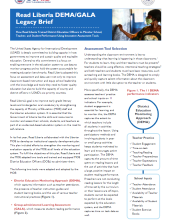
It is essential that the Government of Liberia has the skills and resources to monitor and assess their schools, students, and teachers as part of an evidenced-based education system on the road to self-reliance. Read Liberia maintained a focus on assessment and data use—not only to improve classroom-based instruction and equip school leadership with the knowledge and tools they need to foster quality education, but also to build the capacity of county and district officers in USAID’s six priority counties.
Assoc. Photo (Port.)
DEMA_GALA.png
Resource (File)
Country
Resource Type
Featured projects
Resource Language
Month and Year

Online Training on Formative Assessment for Early Language, Literacy, and Numeracy (ELLN) in the Philippines

Submitted by admin on
Description/Abstract
This report describes findings and lessons learned from an online teacher training course in the Philippines. "Becoming a Learning Detective" is a 5-day online course that focuses on the design and use of formative assessment to improve literacy and numeracy outcomes in Kindergarten to Grade 3 (K–3) classrooms. The emphasis is on classroom-based assessment strategies that are embedded within daily teaching and learning experiences, involving an active partnership between teacher and students. The course brings together asynchronous and synchronous elements, as well as whole group, small group, and individual learning experiences. The course was implemented for the first time among a small cohort of participants across 17 regions in the Philippines. Findings and recommendations of this initial training are being applied toward strengthening the course prior to offering it at a larger scale in the Philippines.
Assoc. Photo (Port.)
ACER 1.jpeg
Country
Resource Type
Featured projects
Month and Year
Publisher Or Client
USAID

ABE-ACR Tanzania National Early Grade Reading Assessment (EGRA) Final Report

Submitted by admin on
Description/Abstract
This final report describes the progress made from October 1, 2015 - December 31, 2018 under the Tanzania National Early Grade Reading Assessment activity. USAID/Tanzania contracted RTI International to conduct two rounds of student assessments in early grade reading.
Assoc. Photo (Port.)
TZ EGRA.PNG
Resource (File)
Resource Type
Resource Language
Month and Year

Uganda/LARA: EGR Action Research Tools

Submitted by admin on
Description/Abstract
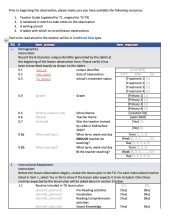
LARA developed action research tools to measure the level of fidelity of implementation of the EGR methods and generate lessons learned to inform adaptations in EGR programming. The action research tools gather both historical and real-time data at the school. They include the EGR core methodologies action research tool; the remedial instruction action research tool and the intensive coaching action research tool (subdivided into two tools i.e. head teacher coaching event log and school based community of practice event log). The EGR core methodologies action research tool assesses the teacher’s perception of the Teacher Guide usability, level of macro pacing, implementation of lesson plan elements, implementation of core EGR methodologies and tracking of instructional adaptations by the teacher. The remedial instruction research tool tracks the teacher’s perception to remedial instruction, the implementation of group-based instruction as well as in-class assessment. The intensive coaching action research tool tracks teacher’s perception of intensive coaching and keeps a log of head teacher instructional coaching events in addition to school-based community of practice activities. The action research tools are designed to be deployed electronically in order to seamlessly incorporate extra data quality standards and innovations like the Stalling’s classroom observation snapshot (Stallings and Kaskowitz, 1974 ). The project also developed the action research process flow guidelines to guide data collection activities.
Assoc. Photo (Port.)
Screen Shot 2020-12-18 at 7.59.05 AM.png
Country
Month and Year
Publisher Or Client
USAID/Uganda Literacy Achievement & Retention Activity

Uganda/LARA EGR Monitoring and Support Supervision Tools

Submitted by admin on
Description/Abstract
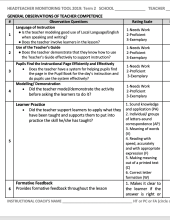
There are two sets of monitoring and support supervision (MSS) tools that the project has been using throughout the implementation period. These are; (i) the Lesson Observation Tools; and (ii) the Head teacher/CCT Coaching Tool. The lesson observation tools are used by the support supervision actors (e.g., school inspectors, CCTs, head teachers and project staff) during support supervision visits to schools. Specifically, the tools gather monitoring data on the uptake of EGR instructional methods by teachers to understand what teachers are doing well and areas where they need support. LARA developed a lesson observation tool for every grade (P1 – P4). Each tool has a section to assess the teacher’s preparedness for the lesson they are going to teach; a check list to assess the teacher’s instructional practices during the lesson; and the post observation section where the support supervision actor summarizes what the teacher did well and areas that the teacher needs to improve. The lesson observation tool for each grade is accompanied by a learner check which is administered to a sample of 4-6 learners per grade. The purpose of a learner check is to quickly show the classroom teacher and or head teacher the reading abilities of the learners present in the observed EGR lesson. The learner checks are designed from the content of the previous weeks and the teacher is able to gauge and determine the areas to prioritize when carrying out revision or remedial sessions. The Head teacher/CCT Coaching Tool is used by the zonal head teachers and CCTs to support head teachers so that they can in turn effectively support teachers in their schools. The zonal head teachers and CCTs observe and support head teachers to provide effective instructional support to teachers. The tool has a pre-observation section which assesses how the head teacher is prepared to support the teacher in class; a lesson observation section used by the zonal head teachers and CCTs to evaluate the actions of the head teacher while in the class observing the lesson; and post observation section to appraise how the head teacher conducts the post observation discussion with the teacher.
Assoc. Photo (Port.)
Screen Shot 2020-12-18 at 7.54.47 AM.png
Country
Month and Year
Publisher Or Client
USAID/Uganda Literacy Achievement & Retention Activity