Mobile Learning

Senegal RELIT project Success Stories: 2022 (ENG)

Submitted by admin on
Description/Abstract
These Success Stories were prepared by the project team for the USAID Renforcement de la Lecture Initiale pour Tous program in Senegal in Calendar year 2022. SS001 : "Fifty resource persons from the MEN and the implementing partner put in place, together, the mechanisms for implementing RELIT." Describes the collaborative and locally-led co-launch of the program in 2022. SS002: "At Boly Diaw elementary school in Saint Louis, the RELIT program mobilizes a community of parents around reading and bilingual education." Describes a school that created a community-wide celebration for the launch of the RELIT program in 2022. SS003: "Innovations in the teaching of early grade reading: RELIT designs early learning materials for three new national languages" Describes the process and outputs of the first Grade 1 materials in 5 national languages that were developed in time for the new school year in Senegal. SS04: "A participatory approach to assessing the institutional capacity of Senegal’s education system" describes the approach to capacity assessment using the "Core Components" model of System Strengthening.
Assoc. Photo (Port.)
relit ss1 port.png
Country
Featured projects
Resource Language
Month and Year
Publisher Or Client
USAID

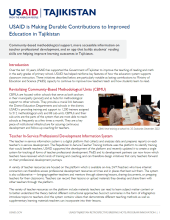
USAID is Making Durable Contributions to Improved Education in Tajikistan

Submitted by admin on
Description/Abstract
Community-based methodological support, more accessible information on teacher professional development, and an app that builds students’ reading skills are helping improve learning outcomes in Tajikistan. Over the last 10 years, USAID has supported the Government of Tajikistan to improve the teaching of reading and math in the early grades of primary school. USAID has helped reinforce key features of how the education system supports classroom instruction. Three initiatives described below are particularly notable as lasting contributions to Ministry of Education and Science (MoES) capacity to continue to improve how teachers teach and how students learn to read.
Assoc. Photo (Port.)
USAID is Making Durable Contributions to Improved Education in Tajikistan.png
Country
Resource Type
Featured projects
Month and Year
Publisher Or Client
USAID

Harnessing AI Speech Recognition Technology for Educational Reading Assessments amid the COVID-19 Pandemic in the Philippines [CIES 2024 Presentation]

Submitted by admin on
Description/Abstract
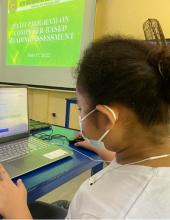
The challenges of conducting educational assessments in low- and middle-income environments during the pandemic can be eased by AI-powered speech recognition technology that offers a promising solution to enhance assessments. By utilizing advanced algorithms and machine learning techniques, this technology accurately transcribes spoken language into written text. Reading fluency and comprehension can be efficiently measured by integrating AI speech recognition into assessments, without the need for physical presence. From the safety of their homes, students can perform the assessments using their smartphones or computers, assisting schools in organizing complex logistics. AI speech recognition technology has a great edge in providing instant feedback, which is one of its main benefits. While students are speaking out loud, the AI system can swiftly assess their intonation, pronunciation, and tempo, rendering quick guidance and identifying areas for refinement. This personalized feedback effortlessly assists students in boosting their reading abilities, even in the absence of in-person teacher interactions. Moreover, AI-backed evaluations can be carried out on a wider scale, enabling educators to collect extensive data on reading patterns and tackle specific issues that are commonly seen among students. The objective of this presentation is to feature the self-administered AI Speech recognition Computer-based reading assessment that RTI developed at the request of the Philippines Department of Education (DepEd), under the USAID All Children Reading (ACR). Throughout the school years of 2020-2022, the COVID-19 pandemic posed significant challenges to conducting face-to-face assessments, particularly in remote learning environments. As a result, teachers faced constraints in terms of time and resources to individually assess learners' reading skills against crucial learning competencies. The proposed automated assessment technology offered a potential solution to alleviate this burden and streamline the evaluation process, allowing educators to efficiently gauge students' reading abilities remotely. In February 2022, ACR-Philippines initiated discussions with USAID and the Philippines Department of Education (DepEd) to produce a ‘proof of concept’ that explores the feasibility of a self-administered computer-based reading assessment (CoBRA) in English and Filipino for students in the Philippines. The concept found resonance with the DepEd leadership as the adoption of a computer-based format for assessments aligns with international practices and provides an excellent opportunity to ascertain students' preparedness to take computer-based tests, such as the Program for International Student Assessment (PISA). The result of this intervention generated a prototype solution piloted and tailored to fit DepED's existing platforms for supporting remote learning and delivery. The pilot provided insights on the feasibility of a computer-based assessment in the context of the Philippines for students in grades 4 -6. The research findings examined the performance, reliability, and results of the AI Speech recognition technology reading assessment, compared to the assessor-administered approach of the assessment. The research generated key design considerations, feedback from end users, recommendations regarding implementing similar approaches, and the future development of similar technology for other languages within and outside the Philippines.
Assoc. Photo (Port.)
cobra 3.jpg
Resource (File)
Country
Resource Type
Featured projects
Resource Language
Month and Year
Publisher Or Client
USAID ASIA

LET’S LIVE IN HARMONY (LLH) - Jordan Early Grade Reading and Math Program (RAMP)

Submitted by admin on
Author
Description/Abstract
Between June 2021, and May 2022, RAMP, in coordination with the Ministry of Education (MOE) and in collaboration with INTEGRATED, implemented the Let’s Live in Harmony (LLH) pilot program based on the LLH initiative funded by UNICEF in 2018-2019. This initiative aimed to establish a positive learning environment for students across 96 Double Shifting Schools (DSSs) in Jordan. The study addressed educational challenges faced by underprivileged students in Jordan, particularly those in double-shift public schools with a mix of Jordanian and Syrian students. At the beginning of the school semester in 2021, 1310 tablets were updated with the Ministry of Education (MoE)-approved LLH content material application. These tablets were strategically distributed among the 96 DSSs for students in Grades 1 to 3, with the allocation based on the number of students in each class to ensure equitable access to resources. The study employed tablets with multimedia content to facilitate interactive learning. Achievements encompassed teacher training, updated materials, curriculum alignment, and enhanced program delivery. These initiatives addressed challenges posed by refugees and the pandemic, leading to improvements in reading fluency, comprehension, and literacy. The study underscored the significance of adaptable educational solutions. The LLH activities were introduced to supervisors through a WhatsApp group to facilitate interactive communication. Integrated into the curriculum, the activities aimed to enhance Arabic literacy for grades 1-3. MOE supervisors ensured fidelity through observations and feedback. Additionally, the study focused on institutionalizing LLH within the MOE, involving various departments and the School and Directorate Development Program (SDDP). Lessons learned included role clarification, formal adoption, capacity building, and effective communication strategies for integration. Findings highlighted LLH's potential impact on reading skills and emphasized the need for ongoing support. Recommendations encompassed further capacity-building, recognition, incentives, and improved communication strategies between schools and the MOE.
Assoc. Photo (Port.)
Jordan report cover.png
Resource (File)
Country
Resource Type
Featured projects
Month and Year
Publisher Or Client
USAID and UKaid

A Monitoring, Evaluation, and Learning (MEL) Framework for Technology-Supported Remote Trainings [CIES Presentation]

Submitted by admin on
Description/Abstract
Existing research on the uptake of technologies for adult learning in the global South is often focused on the use of technology to reinforce in-person learning activities and too often involves an oversimplified “with or without” comparison (Gaible and Burns 2005, Slade et al. 2018). This MEL Framework for Technology-Supported Remote Training (MEL-Tech Framework) features a more nuanced perspective by introducing questions and indicators that look at whether the technology-supported training was designed based on a solid theory of learning; whether the technology was piloted; whether there was time allocated to fix bugs and improve functionality and user design; how much time was spent using the technology; and whether in-built features of the technology provided user feedback and metrics for evaluation. The framework presents minimum standards for the evaluation of technology-supported remote training, which, in turn, facilitates the development of an actionable evidence base for replication and scale-up. Rather than “just another theoretical framework” developed from a purely academic angle, or a framework stemming from a one-off training effort, this framework is based on guiding questions and proposed indicators that have been carefully investigated, tested, and used in five RTI monitoring and research efforts across the global South: Kyrgyz Republic, Liberia, Malawi, the Philippines, and Uganda (Pouezevara et al. 2021). Furthermore, the framework has been reviewed for clarity, practicality, and relevance by RTI experts on teacher professional development, policy systems and governance, MEL, and information and communications technology, and by several RTI project teams across Africa and Asia. RTI drew on several conceptual frameworks and theories of adult learning in the design of this framework. First, the underpinning theory of change for teacher learning was informed by the theory of planned behavior (Ajzen 1991), Guskey’s (2002) perspective on teacher change, and Clarke and Hollingsworth’s (2002) interconnected model of professional growth. Second, Kirkpatrick’s (2021) model for training evaluation helped determine many of the categories and domains of evaluation. However, this framework not only has guiding questions and indicators helpful for evaluating one-off training events focusing on participants’ reactions, learning, behavior, and results (as is the focus in Kirkpatrick’s model) but also includes guiding questions and indicators reflective of a “fit for purpose” investigation stage, a user needs assessment and testing stage, and long-term sustainability. Furthermore, this framework’s guiding questions and indicators consider participants’ attitudes and self-efficacy (based on the research underpinning the theory of planned behavior), as well as aspects of participants’ post-training, ongoing application and experimentation, and feedback (Clarke and Hollingsworth; Darling-Hammond et al. 2017; Guskey). Lastly, the framework integrates instructional design considerations regarding content, interaction, and participant feedback that are uniquely afforded by technology.
Assoc. Photo (Port.)
Photo credit- ABC+ Philippines_1.png
Resource (File)
Resource Type
Resource Language
Month and Year
Publisher Or Client
RTI International

Lessons Learned from Technology-Supported Remote Training: A Case Study from Malawi [CIES Presentation]

Submitted by admin on
Author
Description/Abstract
This case study examines a training targeting 18,000 head teachers and subject heads over seven days using IVR accompanied by electronic materials shared via WhatsApp conducted by the USAID-funded and RTI-implemented Malawi Early Grade Reading Improvement Activity (MERIT). While the training was conducted in June of 2020, this case study includes findings from a follow up study one conducted year later, to see what training content and skills participants retained, and the training elements that were most effective in their delivery. The case study applies a process-based and learning-oriented approach, drawing from the MEL-Tech Framework (Paper 1), to understand technology-supported remote teacher training introduced in response to COVID-19.
Assoc. Photo (Port.)
Malawi.png
Country
Resource Type
Resource Language
Month and Year
Publisher Or Client
Infonex Malawi

Digital transformation: An opportunity for long-lasting improvement of quality of education service delivery in Kyrgyz Republic, Tajikistan, and Uzbekistan [CIES Presentation]

Submitted by admin on
Description/Abstract
Digital transformation: an opportunity for long-lasting improvement of quality of education service delivery in Kyrgyz Republic, Tajikistan, and Uzbekistan Over the past decade, Uzbekistan, Tajikistan, and Kyrgyz Republic have been consistently demonstrating their commitment to quality education, evidenced by the amount of GDP allocated to education. These education systems aim to produce world-class graduates capable of success both globally and at home. Various donors have stepped in to support these efforts in a coordinated way via direct funding of initiatives that enhance instructional skills, increase accountability for excellence, and improve formal and non-formal learning environments. In Uzbekistan, critical thinking, problem solving, and practical skills are at the forefront of the Ministry of Public Education (MPE)’s agenda. In the Kyrgyz Republic, performing well on the upcoming PISA survey in 2025 is a focal point for the Ministry of Education and Science (MOES) in recent years. And, in Tajikistan, COVID-19 provided an important opportunity to rethink the delivery of in-service teacher training from in-person to a blended learning format, resulting in impressive early grade learning gains. However, the COVID-19 crisis brought many education systems to a grinding halt, and these three countries were no exception. Nevertheless, the speed and efficiency with which their education systems adapted has been remarkable. It speaks to their resilience, rooted in the fact that these countries enjoy strong institutional, financial, and policy legacies that are strongly rooted and capable of weathering storms. Undoubtedly, the strongest driving force behind this change is the belief shared at all levels of their education systems – especially at the level of parents and teachers – that education is important. It comes as no surprise that when faced with the challenge of school closure due to a pandemic, their various systemic actors collaborated and adapted their approaches to continue delivering teacher professional development (TPD). In the Kyrgyz Republic, after less than a year following the outbreak of the pandemic, the majority of teachers reported accessing online learning resources, and 85% of teachers did so using smartphones. The USAID-funded Okuu Keremet! project had planned to deliver teacher training in person, but swiftly shifted to development of blended learning modules for reading and mathematics. It designed an online training platform that in a short period of time was accessed by 18,000 registered teachers and librarians. The online learning platform integrates Google Analytics that can allow the Ministry of Education and Science (MOES) to not only monitor progress towards certification of individual teachers, but to also detect, in real time, the teachers and schools that are lagging behind . In Uzbekistan, the Ministry of Public Education (MPE) has made significant investment in continuous professional development, and as part of its growth strategy, Avlonyi has created a Learning Management System (LMS) for teacher accreditation based on OECD teacher professional development standards. To aid Avlonyi in this significant undertaking, the USAID-funded Uzbekistan Education for Excellence Program (UEEP) project developed a blended TPD model comprised of synchronous and asynchronous in-person and online assessment-based learning events (with the focus to improve Information and Communication Technology (ICT) and English as a Foreign Language (EFL) instruction for grades 5–11 and 1-11, respectively). In addition to gaining skills through this opportunity, teachers will achieve career advancement through the accreditation of their efforts by Avlonyi. In Tajikistan, the impact evaluation data shows strong performance as a result of the USAID Read with Me project implemented in collaboration with the Ministry of Education. TPD in Tajikistan applies digital development principles, a multi-user coaching and training platform, which provides content and accountability for self-regulated learning, coaching, peer learning and performance monitoring, including uploading assignments and assessments, aligned with the National Teacher Competency Framework. The EGRA end line results clearly showed the benefit of effective teaching techniques correlating to oral reading fluency gains of more than thirteen correct words per minute. This panel brings together researchers and practitioners documenting the transformational change of Teacher Professional Development in the three Central Asian Republics – Kyrgyz Republic, Uzbekistan and Tajikistan. Panelists will discuss details about the effectiveness and utility of online learning platforms vis-à-vis TPD and student learning gains; the skills required to make this shift to digital, self-regulated learning; and lessons learned for getting these new platforms mainstreamed into educational systems.
Assoc. Photo (Port.)
Screenshot 2023-03-20 145843.png
Resource Type
Month and Year

MEL-Tech Case Studies: Lessons Learned from Technology-Supported Remote Trainings in Five Countries During the Pandemic

Submitted by admin on
Description/Abstract
This report presents case studies of five remote training activities conducted by USAID-funded and RTI-implemented programs: the Advancing Basic Education Project (ABC+) in the Philippines, the Malawi Early Grade Reading Improvement Activity (MERIT), Read Liberia, Okuu Keremet! in the Kyrgyz Republic, and the Uganda Literacy Achievement and Retention Activity (LARA). The case studies seek to apply a more process-based and learning-oriented approach, drawing from the MEL-Tech Framework, to understand technology-supported remote teacher training introduced in response to COVID-19.
Assoc. Photo (Port.)
photo credit- Uganda SHRP_4.JPG
Resource (File)
Resource Type
Featured projects
Resource Language
Month and Year
Publisher Or Client
RTI International

MEL Framework for Technology Supported Remote Teacher Training

Submitted by admin on
Description/Abstract
This MEL Framework for Technology-Supported Remote Training seeks to help education program implementers, governments, and program evaluators more effectively design, implement, and learn lessons from remote training activities. It places special consideration on the unique characteristics of technology-supported interventions in the global South. The framework presents minimum standards for the evaluation of technology-supported remote training, which, in turn, facilitates the development of an actionable evidence base for replication and scale-up. Rather than “just another theoretical framework” developed from a purely academic angle, or a framework stemming from a one-off training effort, this framework is based on guiding questions and proposed indicators that have been carefully investigated, tested, and used in five RTI monitoring and research efforts across the global South: Kyrgyz Republic, Liberia, Malawi, the Philippines, and Uganda (Pouezevara et al. 2021). Furthermore, the framework has been reviewed for clarity, practicality, and relevance by several RTI project teams across Africa and Asia.
Assoc. Photo (Port.)
Teacher Learning Journey - graphic_0.png
Resource (File)
MEL_Framework_FINAL.pdf
Resource Type
Resource Language
Month and Year
Publisher Or Client
RTI International

Remote Learning in the Philippines During COVID [Briefs Series]

Submitted by admin on
Description/Abstract
The Remote Learning Study was conducted during the 2020–2021 school year to investigate how mother-tongue-based multilingual education reading instruction proceeded in 20 schools around the country while classrooms were closed. The school head, 2 teachers, and 4 home learning partners from each school in Grades 1 and 3 were interviewed to gain insights on school administration, teaching and learning, and the home environment. Data was collected at three time points—November, March and June—from 20 school heads, 37 teachers of and 79 parents. Not all respondents were available at each time point. No parents were interviewed in November as recruitment was still underway. Children were also asked to fill out a literacy assessment worksheet, but very few parents returned this worksheet at each occasion. These briefs describe essential themes that emerged from this activity. #1 - Strategies for Assisting Home Learning Partners, #2 - Use of Teaching and Learning Materials, #3 - Use of Technology, #4 - Student Engagement Strategies, #5 - Challenges and Solutions to Remote Learning, #6 - School Leadership, #7 - Literacy Instructional Practice.
Assoc. Photo (Port.)
RLS portrait_0.jpeg
Country
Resource Type
Featured projects
Resource Language
Month and Year
Publisher Or Client
USAID