Carmen Strigel

MEL Framework for Technology Supported Remote Teacher Training

Submitted by admin on
Description/Abstract
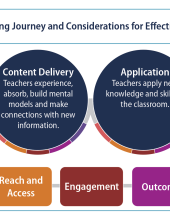
This MEL Framework for Technology-Supported Remote Training seeks to help education program implementers, governments, and program evaluators more effectively design, implement, and learn lessons from remote training activities. It places special consideration on the unique characteristics of technology-supported interventions in the global South. The framework presents minimum standards for the evaluation of technology-supported remote training, which, in turn, facilitates the development of an actionable evidence base for replication and scale-up. Rather than “just another theoretical framework” developed from a purely academic angle, or a framework stemming from a one-off training effort, this framework is based on guiding questions and proposed indicators that have been carefully investigated, tested, and used in five RTI monitoring and research efforts across the global South: Kyrgyz Republic, Liberia, Malawi, the Philippines, and Uganda (Pouezevara et al. 2021). Furthermore, the framework has been reviewed for clarity, practicality, and relevance by several RTI project teams across Africa and Asia.
Assoc. Photo (Port.)
Teacher Learning Journey - graphic_0.png
Resource (File)
MEL_Framework_FINAL.pdf
Resource Type
Resource Language
Month and Year
Publisher Or Client
RTI International

Governments' Organizational Responses to COVID-19 - Igniting Interest and Institutional Capacity in EdTech - Study Report

Submitted by admin on
Description/Abstract
Led by the Basic Education Coalition (BEC), the Governments' Organizational Responses to COVID-19 - Igniting Interest and Institutional Capacity in EdTech study sought to understand what governments, specifically Ministries of Education (MoE), had to do organizationally to implement these programs, such as forging new partnerships, organizing and capacity building of personnel, developing or revising distance learning policies, and so on. The information shared in this report stems from a global survey implemented across 12 countries in Asia, Africa, the Caribbean and South America with 23 responses from key MoE staff, including several department directors. In doing so, the study fills a knowledge gap for the international basic education sector and provides valuable insights to inform future education systems' capacity building programming. Insights and learnings surfaced from this study provide critical data on MoE capacity, technology investment, and other emerging structural shifts and strategies to support large-scale Education Technology (EdTech) programming and digital transformation of key activities.
Assoc. Photo (Port.)
BEC_EdTechSurveyCover.png
Resource (File)
Country
Resource Type
Month and Year
Publisher Or Client
Basic Education Coalition

Basic Education Coalition (BEC) publishes study on governments’ organizational responses to COVID-19

Submitted by admin on

Over the past 18 months, governments have made in rapidly designing and implementing distance, blended, and remote learning opportunities for students and teachers. Countries deployed a diversity of remote learning opportunities, ranging from radio-based instruction, to TV lessons, to mobile or online learning programs. In parallel, researchers have designed and are implementing studies to monitor and evaluate the feasibility and effectiveness of these efforts.

Lessons that “Stick” – How Technology Can Support Refugee Learning

Submitted by admin on

Blogs, commentaries, and reports on education technology (EdTech) topics so often highlight the “rapidly changing” nature of technology. More often than not, this is framed as a challenge or obstacle. There are technologies and EdTech efforts, however, that stand the test of time and continue to be relevant for many years.

The 2015-2017 Project Reconnect is one such effort.

On World Teachers’ Day, Samoa Project Offers Lessons for Improving Learning during COVID-19 Pandemic

Submitted by admin on

October 5, 2020 marks World Teachers’ Day and this year, particularly, we want to recognize the immense contributions teachers make in our lives and to our futures. Teachers are among the many unsung heroes of the coronavirus 2019 (COVID-19) pandemic, as parents got a glimpse into teachers’ day to day realities when suddenly faced with closed schools and their children at home.
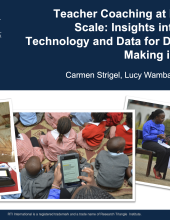
Teacher Coaching at National Scale: Insights into Using Technology and Data for Decision- Making in Kenya

Submitted by admin on
Description/Abstract
This presentation summarizes qualitative data from user observations and semi-structured interviews with teachers and coaches, as well as Kenyan education officials on their use of Tangerine:Coach (previously Tangerine:Tutor) data for decision-making and teacher support. Tangerine:Coach is open-source software developed by RTI International that has been deployed in support of over 25,000 schools nationwide in Kenya since 2015, and is currently being introduced or scaled up also in Cambodia, Jordan, Liberia, Sierra Leone, West Bank, and Uganda. In Kenya, a typical coach visit to a school includes taking stock of classroom conditions, observing teacher practice, appraising student ability, and providing pedagogical support to teachers. Tangerine:Coach is designed with the intent of supporting this process - the software applies logic to combine data from surveys, classroom observations, and student assessments into a feedback report tailored for each coaching conversation. Coaches regularly upload their data to a central server which are then published to an online dashboard and sent by email to education officials. In theory, this data-sharing enables ongoing monitoring of coach activities and student progress and allows for timely targeted support (e.g., through additional school visits or professional development) to schools, teachers, or coaches as needed. Yet, how are these different actors actually using the data and dashboards? What changes are they making in their coaching or resource allocations? What data format is most accessible to actors across the different levels of the education system?   This prevention was developed by Lucy Wambari, Timothy Slade, and Carmen Strigel for the 2018 mEducation Alliance Symposium.
Assoc. Photo (Port.)
mEdAlliancePresentation_IntroSlide_Nov2018.jpg
Resource (File)
Country
Sub-topic
Resource Type
Month and Year

Looking Beyond School Closures: Considering Teacher Well-Being and Support

Submitted by admin on

Whether schools are reopening or continue to be closed with some form of virtual instruction, it is clear that school systems are facing tremendous changes. For this new reality, aside from family and student well-being and student academic growth, we also need need to place emphasis and consideration on our teachers. This includes their well-being, their support, and their training. 

Going Virtual for Project Implementation – Decisions and Considerations

Submitted by admin on

As we all adjust to working from home, we face many challenges, both personal and professional. Yet, we still deliver the work we were contracted to do for our clients and with our partner governments around the world. Therefore, we need to find ways to adapt, shift priorities, and collaborate in new ways in order to effectively implement project activities. A team from RTI International has been working on a series of recommendations, decision-support tools, and step-by-step guides based on their expertise from decades of working with education technologies in low-resource settings.

New frontiers in technology for assessment in low-income contexts

Submitted by admin on

Editor's Note: The following essay comes from "Meaningful education in times of uncertainty," a collection of essays from the Center for Universal Education and top thought leaders in the fields of learning, innovation, and technology.

Authors: Luis Crouch, Chief Technical Officer, International Development Group - RTI International; Carmen Strigel, Director, Technology for Education and Training - RTI International