Briefs

One-page Brief on Electronic Vision and Hearing Screening Applications

Submitted by admin on
Author
Description/Abstract
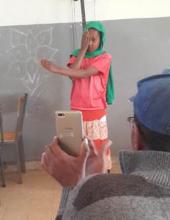
Peek Acuity and hearScreen® are mobile, electronic screening tools that provide data on vision and hearing impairments. The tools were designed to be administered in schools and classrooms so that teachers and schools can better accommodate visually- or hearing-impaired students to increase their opportunities of succeeding in school.
Assoc. Photo (Port.)
Vision_ethiopia.jpg
Country
Resource Type
Month and Year

Moving the needle on reading achievement in Uganda

Submitted by admin on
Author
Description/Abstract
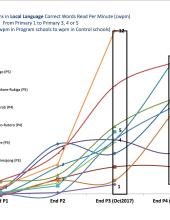
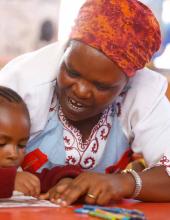
This brief presents Early Grade Reading Assessment (EGRA) data from a randomized control trial conducted in conjunction with the USAID/Uganda School Health and Reading Program (SHRP). SHRP supports reading in 3,700 government schools working through the systems that support these schools and was the catalyst for reform efforts which now cover 80% of Uganda's government primary schools. The assessment collected baseline data at the beginning of Primary 1 for 12 language cohorts and follow up at the end of every school year. These data collected in October, 2017 track progress at the school level (and differences between program and control schools) until the end of Primary 4, Primary 5 or Primary 6 (depending on the year the language was phased into the program). Learning for Uganda and beyond • Registering significant programmatic gains in reading achievement takes time. In the case of Uganda, this is partially attributable to the low baseline levels of reading (94% of learners across the 12 languages could read no words in English at the beginning of P1) and other systemic challenges within Ugandan schools not uncommon in other settings including teacher and learner absenteeism. • When learners learn to read in a local language, the gains realized in the local language are transferred to learning to read in English Major messages - When children learn to read (decode) in their local language, they are able to transfer this skill to decoding English. However, more work needs to be done to improve English comprehension. - Although SHRP has been able to move more learners to higher reading levels and they are on their way to becoming fluent readers, there are still too many learners not acquiring foundation skills. - It takes more time to move children from the foundation threshold than anticipated but when you move them from that level, the gains take off as can be seen from P3 onwards. - Reading gains in large scale interventions working through government structures take time due to systemic and contextual challenges.
Assoc. Photo (Port.)
UG SHRP.jpg
Resource (File)
Country
Resource Type
Resource Language
Month and Year
Publisher Or Client
USAID

Early Mathematics Counts: Promising Instructional Strategies for Low- and Middle- Income Countries

Submitted by admin on
Description/Abstract
There is a large body of evidence substantiating the importance of mathematical literacy and the key role of foundational mathematics in early years of education on later academic outcomes (Duncan et al., 2007; Duncan & Magnuson, 2011; Hanushek & Woessmann, 2008; Siegler et al., 2012). Despite this, we have little evidence from low- and middle-income countries on how to better ensure that students are learning the foundational skills in pre-primary through lower primary grades. Given that quality of instruction is key, we examined the evidence for the types of instructional strategies used in low- and middleincome contexts. We cannot link the effective instructional strategies to learning outcomes, given the limited information provided in reports we reviewed. However, understanding which strategies are used, and how they manifest in different contexts, is an important first step to understanding which strategies are effective for learning. This brief summarizes our review paper (Sitabkhan & Platas, 2018).
Assoc. Photo (Port.)
EarlyMathBrief_071818.jpg
Resource (File)
EarlyMathBrief_071818.pdf
Country
Resource Type
Resource Language
Month and Year
Publisher Or Client
RTI

Uganda Early Years Study Policy Brief: Causes and Implications of Hidden Repetition in Early Primary

Submitted by admin on
Description/Abstract
The Uganda Early Years Study policy brief describes the findings and presents policy recommendations from the associated research study funded by the British Department for International Development. The study investigates the magnitude of repetition in primary 1 in Uganda, examines the financial impact of repetition, and presents a cost-projection model which underscores the importance of investing in pre-primary and early primary education in reducing inefficiency.
Assoc. Photo (Port.)
early years.jpg
Resource (File)
Policy Brief.pdf
Country
Resource Type
Resource Language
Month and Year
Publisher Or Client
East Africa Research Fund, Department for International Development, UK AID

IE Selected Publications (2015 - 2018)

Submitted by admin on
Description/Abstract
This is a list of select peer-reviewed publications by International Education staff between 2015 and 2018. For some of the publications, links to information about the documents and related resources can be found on this websiate. Where possible, the DOI has been included in the attached brief.
Assoc. Photo (Port.)
publications2.jpg
Resource (File)
Country
Resource Type
Resource Language
Month and Year
Publisher Or Client
RTI International

Tangerine: Evaluaciones Móbiles de Manera Sencilla

Submitted by admin on
Description/Abstract
Tangerine overview in Spanish
Assoc. Photo (Port.)
tang spanish.png
Resource (File)
Country
Resource Type
Resource Language
Month and Year
Publisher Or Client
RTI

Cambodia Teacher Professional Development Policy Brief Options

Submitted by admin on
Description/Abstract
Cambodia’s teacher professional development (PD) system is at a crossroads. There is a growing realization that the lower than expected learning outcomes in Cambodia are directly related to lower than desirable classroom teaching. To respond to this reality, Cambodia aims to put in place improved systems for pre-service teacher preparation (moving to a 12+4 system and introducing a new Bachelor of Arts in Education (BA [Ed.]) degree, intensive upgrading of existing teachers, and continuous professional development and mentoring. A working group organized by the Teacher Training Department is bringing together stakeholders to assist in the design and implementation of an improved in-service training (INSET) system. The present document aims to bring together pertinent information and evidence on effective continuous professional development (CPD) to support the work of this group.
Assoc. Photo (Port.)
cambodia.png
Resource (File)
Country
Resource Type
Resource Language
Month and Year

Primary 1 Repetition and Pre-Primary Education in Uganda (Research Brief)

Submitted by admin on
Description/Abstract
As a result of Universal Primary Education (UPE) and reform efforts, primary school enrollment in Uganda doubled from 2.9 million in 1995 to 5.8 million by 1998. By 2016, enrollment had reached 8.3 million. Although enrollment gains have been dramatic, the completion rate has stalled for at least a decade, with only about 60% of learners completing primary school. RTI International conducted research that suggests this is due to problems that begin in the first few grades of primary school (and earlier). Primary 1 (P1) repetition is partially attributed to lack of access to early childhood educational opportunities. This brief summarizes these and other key findings of the research, “Repetition of Primary 1 and Pre-Primary Education in Uganda,” published in 2017.
Assoc. Photo (Port.)
rep research brief.jpg
Country
Resource Type
Resource Language
Month and Year

Weakest Part of Poorly-Performing Educational Systems: An Argument for Focus on “Teaching at the Right Level” and Improved Foundation-Year Performance

Submitted by admin on
Author
Description/Abstract
n roughly thirty-five to forty countries that are expanding education very quickly, experts have noticed that learning problems originating in the earliest grades are showing as a massive over-enrolment. In Grade 1, it is not unheard of for ratios of enrolment to population of appropriate age to be as high as 150 percent. This problem is not typical of upper-middle or high-income countries, where the issue has been resolved. Nor, does it seem to affect the very poorest countries where massive enrolment expansions have not yet taken place, and so “don’t even have the problem yet.” Instead, the typical countries showing over-enrolment tend to be those that have received a great deal of funding and attention from development agencies and have expanded enrolment quickly in the last decade or two. This piece looks at the evidence of the enrolment bulge starting in Grade 1. It shows there is a set of inter-related problems occuring, including the lack of "Teaching at the Right Level," that is leading to high enrolment figures, but low levels of learning. The Insight concludes by stating that given the inefficiency signified by the foundation-years over-enrolment, “Teaching at the Right Level” could be an investment that, if tied to proper accountability measures, could essentially pay for itself, and lead to improved foundations for learning in the later grades, and (meaningful) completion of primary school.
Assoc. Photo (Port.)
RISE Crouch.png
Resource (File)
Country
Resource Type
Resource Language
Month and Year
Publisher Or Client
RISE Programme

USAID/Uganda School Health and Reading Program Early Grade Reading Assessment Results: Cluster 1, End of Primary 4

Submitted by admin on
Description/Abstract
The USAID/Uganda School Health and Reading Program is a large scale, systemic reform effort to increase reading and provide health information in primary schools. This is one of the first Early Grade Reading Studies in Africa to combine rigorous research methods with a large scale reform working through Ministry of Education Systems. This briefer highlights the findings from a Randomized Control Trial/Early Grade Reading Assessment for the first 4 languages (of 12 total program local languages and English) to start the program in Primary 1 in 2013: Ateso, Leblango, Luganda, and Runyunkore-Rukiga. Findings: At the end of Primary 4, learners are between 1.5 and 6 times more likely to be reading 40 or more words per minute in the local language in program schools compared to control schools (all statistically significant differences with effect sizes ranging from 0.39 to 0.75). Program learners were also significantly more likely to be reading 60 or more words per minute in English in 3 of the 4 languages.
Assoc. Photo (Port.)
uganda image.jpg
Resource (File)
Country
Resource Type
Resource Language
Month and Year
Publisher Or Client
United States Agency for International Development