Briefs

Using Mobile Communications Technology to Support School-based, In-service Teacher Training

Submitted by admin on
Description/Abstract
The Asian Development Bank (ADB) funded an investigation of the effective use of information and communication technology (ICT) in rural areas of Nepal, Bangladesh, Mongolia, and Samoa. In these areas, the multidimensional elements of poverty diminish access to and the quality of education for the poorest people. The study assessed the potential for ICT, combined with training, to improve these education factors for people whose educational opportunities are severely limited. In Bangladesh, the focus was on creating an opportunity for school-based in-service teacher training with the support of mobile communications technology. RTI equipped a cluster of 10 schools with mobile telephones that had advanced multimedia and communications features. A standard 2-week face-to-face training was converted to 6-weeks distance mode, and a pair of teachers from each school completed the course using print materials, practical school-level exercises, and communication on a regular basis with trainers and teacher trainees in other schools. The results show that the distance mode can be as effective as face-to-face training, and it is the strongly preferred mode by training participants.

Assoc. Photo (Port.)
bangla brochure.png
Resource (File)
Country
Resource Type
Resource Language
Month and Year
Publisher Or Client
ADB

Proposing Benchmarks and Targets for Early Grade Reading and Mathematics in Zambia

Submitted by admin on
Description/Abstract
A National Policy Dialogue Workshop was held on July 1, 2015, followed immediately by a Benchmark Setting Workshop July 2–3, to address the question: "What is an acceptable level of reading and mathematics achievement for Zambian pupils in the early grades of primary school?”

Assoc. Photo (Port.)
zambia3.png
Country
Resource Type
Month and Year

Proposing Benchmarks for Early Grade Reading Skills in Liberia

Submitted by admin on
Description/Abstract
Ministry of Education officials, district education officers, and a cross section of stakeholders attended this workshop over two days to begin Liberia’s first ever effort to define standards for student performance in key areas of reading skill development in grades 1, 2 and 3.

Assoc. Photo (Port.)
liberia.png
Country
Resource Type
Resource Language
Month and Year

Proposing Benchmarks for Early Grade Reading and Mathematics in Ghana

Submitted by admin on
Description/Abstract
The results of the 2013 national study on early grade reading and early grade mathematics provided the evidence base for developing benchmarks for reading and mathematics that are appropriate for the current Ghanaian context.
Assoc. Photo (Port.)
ghana.png
Resource (File)
Country
Resource Type
Month and Year

Benchmarks for Early Grade Reading Skills in Egypt

Submitted by admin on
Description/Abstract
In spring 2013, USAID supported the MOE to conduct the first national baseline assessment of early grade reading skills. Findings of this national Grade 3 EGRA were presented to the MOE in June 2013 in a policy workshop. The workshop initiated USAID support to establish target benchmarks for improved reading skills in Grade 3 of MOE schools.
Assoc. Photo (Port.)
Egypt.png
Country
Resource Type
Month and Year

Setting and Using Benchmarks for Reading Performance

Submitted by admin on
Description/Abstract
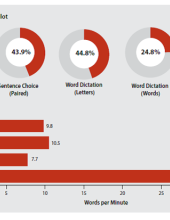
The spread of the Early Grade Reading Assessment (EGRA) has yielded a wealth of country-specific evidence on students’ literacy skills. Those data were then used to help a dozen countries set meaningful benchmarks for student reading performance. This brief summarizes the approach used, shares the results of the benchmarking workshops, and draws some lessons from our experience.
Assoc. Photo (Port.)
Benchmarking Pakistan1_2015-06-11 11.34.24.jpg
Resource (File)
Country
Resource Type
Month and Year

Complements to the Early Grade Reading Assessment: Spelling, Reading Comprehension, and Oral Language Subtasks

Submitted by admin on
Description/Abstract
The EGRA has been a useful tool to understand students’ progress toward fluent reading. However, users are often left wanting additional information about reading comprehension, writing, and language. The subtasks that we piloted in the research activity described in this brief can give researchers and practitioners more detailed information to understand the early literacy abilities of students in low-income contexts.
Assoc. Photo (Port.)
egra 2.0.png
Resource (File)
Country
Resource Type
Month and Year

Results of Social and Behavior Change Communication Pilots in Senegal and Malawi

Submitted by admin on
Description/Abstract
Social and behavior change communication (SBCC) represents the culmination of decades of research and practice in the public health field, where communication has been a critical element of efforts to encourage positive health behaviors. A basic tenet of SBCC is that information is necessary but seldom sufficient to sustainably change behavior (C-Change, 2012). The methodology bridges the gap between awareness and action by influencing the beliefs that can block or enable needed behavior change.
Assoc. Photo (Port.)
senegalSBCC_port2.png
Resource (File)
Country
Resource Type
Month and Year

An Addition to the Toolbox for Measuring Literacy Skills of the Youngest Students: The Group Administered Literacy Assessment (GALA)

Submitted by admin on
Author
Description/Abstract
The GALA was designed to maximize the benefits of a group-administered instrument, while also taking advantage of lessons learned from the individually administered Early Grade Reading Assessment (EGRA). It limits administration time; can be administered with minimal training; has a simplified scoring system; is based on a previously validated tool; assesses a full range of early grade literacy skills; does not rely on passage reading; and can be adapted for new contexts and languages.
Assoc. Photo (Port.)
GALA_2016-08-04 08.56.22.jpg
Resource (File)
Country
Resource Type
Month and Year

Can big data save labor market information systems?

Submitted by admin on
Author
Description/Abstract
Labor markets desperately need information to function effectively and efficiently, making labor market information systems critical public investments. Yet government systems face significant challenges in collecting quality data, turning it into useable market intelligence, and disseminating it in a timely, relevant manner, a situation more acute in developing countries. The rise of private, real-time labor market information (LMI), such as web-based job posting analytics, social network inferences, crowdsourcing, and mobile phone polling, has garnered interest and questioned the dominance of traditional approaches. This brief explores the use of real-time LMI and presents interviews conducted with international donor officials to gain their perspectives on its applicability in developing countries. I suggest that real-time LMI is unlikely to supplant traditional LMI collection anytime soon, and I dispel notions that these new approaches might leapfrog current data collection challenges. Real-time LMI can provide useful in special cases and for supplemental analysis, an additional lubricant for labor markets that suffer from weak data. Policy that supports the improvement of traditional LMI and promotes access to real-time LMI is warranted.
Assoc. Photo (Port.)
rti press 2.png
Resource (File)
Country
Sub-topic
Resource Type
Month and Year