
Egypt

Country Code
EGY

Early Grade Reading Barometer

Submitted by admin on
Description/Abstract
The Early Grade Reading Barometer is an interactive dashboard that lets you: - SEE an overview of how well students are reading, the percentage of struggling readers, and how comprehension is associated with reading fluency. - VIEW information about student performance on EGRA subtasks. See how outcomes vary by key student and school characteristics. - EXPLORE how different EGRA subtasks are related to one another. View graphic displays of these relationships. - CHOOSE a target oral reading fluency benchmark, and see information on how many students are meeting the targeted benchmark now and how the percentage of students meeting the benchmark value could change over time. - SEE how countries compare with each other with respect to student outcomes on EGRA assessments and progress towards meeting UN SDG Goal 4. - REVIEW the impact of interventions aimed at improving the fundamental reading skills of students. - COMPARE how the distributions for selected EGRA subtasks have changed or remained the same over time.
Assoc. Photo (Port.)
Generic_icon_shared.rti_.org_.png
Resource Type
Resource Language
Month and Year
Publisher Or Client
USAID

Egypt Grade 3 Early Grade Reading 2nd National Assessment: Classroom Observations (English and Arabic Versions)

Submitted by admin on
Description/Abstract
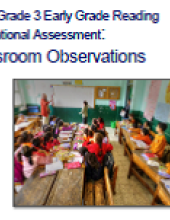
This report presents key findings of a national, stratified random sample of classroom observations of Grade 3 reading instruction in Ministry of Education (MOE) schools. Classroom observation was a component activity of the 2nd national Early Grade Reading Assessment (EGRA) for Grade 3 implemented in April 2014. The classroom observations were completed in a random sub-set of 39 schools from the larger EGRA sample of 200 schools: 40 primary schools from each of five sub-national regions encompassing 25 of Egypt’s 27 governorates.1 One Grade 3 class, randomly selected, was observed in each school. Each classroom observation applied a formal instrument to the observation of a full class period of Grade 3 Arabic reading plus separate interviews with the observed teacher, school principal and librarian. All observations were conducted by trained MOE staff with significant experience of both the ministry’s Early Grade Reading Program and reading assessment. Schools were not informed in advance of the classroom observation.
Assoc. Photo (Port.)
egypt3.png
Country
Resource Type
Resource Language
Month and Year

Task Order 27: Egypt Grade 3 Early Grade Reading Assessment (EGRA) Group Assessment Report (English and Arabic Versions)

Submitted by admin on
Description/Abstract
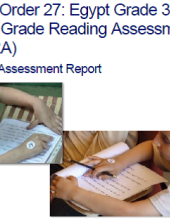
The purpose of this pilot was two-fold: 1) examining the reliability of the group assessment tool to measure the construct of early grade reading; 2) determining whether or not the group assessment could be used as a partial replacement for the individual EGRA.
Assoc. Photo (Port.)
egypt2.png
Country
Resource Type
Month and Year

Egypt Grade 3 Early Grade Reading 2nd National Assessment (English and Arabic Versions)

Submitted by admin on
Description/Abstract
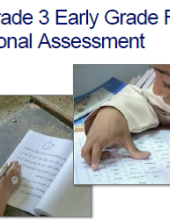
This report presents key findings of the 2nd national assessment of Grade 3 reading skills in primary schools of the Ministry of Education (MOE) in Egypt. This mid-line assessment reports early progress and student achievements after three years’ implementation of the MOE Early Grade Reading Program nationwide, albeit only one year at Grade 3 level. The MOE program, initiated in Grade 1 during the 2011/12 school year, added enhanced reading instruction to Grade 2 in 2012/13 and then to Grade 3 in 2013/14. This 2nd national assessment measures the improvement in Arabic reading proficiency of this first cohort of MOE students to receive successive years of improved reading instruction in Grades 1-3. The findings of this mid-line assessment provide timely results and empirical measures of the initial progress and reading outcomes of the MOE’s Reading Program since the national Early Grade Reading Assessment (EGRA) baseline for Grade 3 in 2013.
Assoc. Photo (Port.)
egypt1.png
Country
Resource Type
Resource Language
Month and Year

Benchmarks for Early Grade Reading Skills in Egypt

Submitted by admin on
Description/Abstract
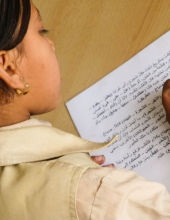
In spring 2013, USAID supported the MOE to conduct the first national baseline assessment of early grade reading skills. Findings of this national Grade 3 EGRA were presented to the MOE in June 2013 in a policy workshop. The workshop initiated USAID support to establish target benchmarks for improved reading skills in Grade 3 of MOE schools.
Assoc. Photo (Port.)
Egypt.png
Country
Resource Type
Month and Year

Early Primary Mathematics Education in Arab Countries of the Middle East and North Africa

Submitted by admin on
Description/Abstract
MENA countries are facing significant challenges in providing access to quality education for children in the early grades. However, it is important to note that the situation in the MENA region is not so different from that in other regions of the Global South: quality and learning are not being achieved. In MENA countries, achievement in math is not only associated with the effectiveness of teaching and learning, but also with providing an equitable system of education for all children. This paper presents the state of mathematics education in the MENA region and suggests means to improve it according to the pertinent cultural and social context.
Assoc. Photo (Port.)
Screen Shot 2017-02-21 at 4.17.46 PM.png
Resource Language
Month and Year
Publisher Or Client
Deutsche Gesellschaft für Internationale Zusammenarbeit (GIZ) GmbH

Scale-Up of Early Grade Reading Programs

Submitted by admin on
Description/Abstract
In response to the growing need to improve learning outcomes, USAID's 2011 Education Strategy focused on improving the teaching and learning of reading in early grades. Its goal of 100 million children showing improved reading skills testified to USAID’s commitment to investing in and measuring improvements in learning outcomes. As a result, USAID education programs with a focus on early grade reading have become the norm, with such programs implemented in approximately 20 countries during the five years since the adoption of the education strategy. In the last couple of years, the lessons of successful pilots are being applied on increasing scale in numerous countries. Taking successful pilot projects to scale and helping education systems implement their national reading strategies at scale have therefore become the primary challenges faced by USAID and other supporters of educational improvement in the developing world. The challenges of realizing large-scale impact, and of seeing that impact sustained, are not new to development. However, they are being approached with renewed interest and attention in the education sector. This paper examines seven countries where interventions to improve early grade reading are being taken to scale - some with project support, some through government initiative. Management Systems International's framework for taking projects to scale, and the framework defined in the Brookings Institute's Millions Learning report are used to examine how scale has been and is occurring in these selected countries.
Assoc. Photo (Port.)
Sus doc image.JPG
Resource (File)
Resource Type
Resource Language
Month and Year
Publisher Or Client
USAID

Education Finance in Egypt: Problems and a Possible Solution

Submitted by admin on
Description/Abstract
Egypt, currently in the throes of major political change, will likely undergo reforms of various sorts in the next few years. Some of these reforms are likely to give local entities, including schools, greater control over education finances. In 2007, the Government of Egypt began to decentralize some non-personnel recurrent finances from the center—the Ministry of Education and the Ministry of Finance (MOF)—to lower-level jurisdictions, including schools, using a number of simple and transparent enrollment- and poverty-based funding formulas. By 2010, a sizable amount of capital expenditure was also being transferred to lower levels of the system via similar equity- based funding formulas. Prior to these formula-based decentralization efforts, a large amount of education-related non-personnel recurrent finances had already been moving from the MOF to the muderiyat, education offices at the governorate level of the system. Analysis of these latter allocations reveals that they are highly inequitable on an inter-governorate per-student basis, ranging from EGP 966 per student in New Valley to EGP 25 per student in 6th of October. This paper examines the nature and potential causes of this inequity and espouses a way in which these funds could be transferred using an equity-based funding formula that holds harmless those muderiyat that would lose absolute amounts of money under such a more equitable distribution scheme.

Assoc. Photo (Port.)
healy ed finance Egypt.jpg
Country
Resource Type
Resource Language
Month and Year
Publisher Or Client
RTI Press

Classroom-up policy change: Early reading and math assessments at work

Submitted by admin on
Description/Abstract
This article reviews the development of the EGRA and EGMA, which are locally tailored, timely assessments designed to directly inform policy and instruction for learning improvement, particularly for countries on the lower end of the income spectrum. The history of the design and implementation of the tools as well as case studies of their use in Egypt and Kenya, are a useful counterbalance to the experience of the more traditional international large-scale assessments (ILSAs) documented in this special issue—in particular for understanding the needs of countries struggling to transform ‘education for all’ into ‘learning for all’.

Assoc. Photo (Port.)
publications icon purchased sm.png
Country
Resource Type
Resource Language
Month and Year
Publisher Or Client
Research in Comparative and International Education

Actionable Data for a More Literate World: Using large-scale assessment to improve results

Submitted by admin on
Author
Description/Abstract
This presentation, delivered at the MENA region All Children Reading workshop in Rabat, provides an overview of results to date in the region and introduces the early grade reading barometer.
Assoc. Photo (Port.)
Resource Type
Resource Language
Month and Year
Publisher Or Client
All Children Learning