Briefs

Linking Learning to Employment: An Answer to the Global Search for Education Quality and Relevance?

Submitted by admin on
Description/Abstract
Current approaches to secondary school are producing high numbers of dropouts and low numbers of students well prepared for college and careers. Given global demand for better education quality and relevance, a reform movement in the US that blends rigorous academic learning and applied technical study may be of interest to other countries. Yet the transport of a successful approach from one country to another must be carefully considered and implemented, with attention paid to local political economy and education system variables. This policy brief discusses the successful US approach—called Linked Learning—and RTI International's approach to adapting it for other country contexts.
Assoc. Photo (Port.)
rti press 1.png
Resource (File)
Country
Sub-topic
Resource Type
Month and Year

Improving Learning Outcomes through Mother Tongue-Based Education

Submitted by admin on
Description/Abstract
This four-page brief provides an overview of the learning and other advantages of providing educational instruction in mother tongue, or familiar, languages. The brief also contains information on factors to consider when developing a mother tongue-based education program.
Assoc. Photo (Port.)
language use.png
Country
Resource Type
Resource Language
Month and Year
Publisher Or Client
USAID

National Baseline Assessment for 3Rs (Reading, Writing, and Arithmetic) in Tanzania (Summary Brief)

Submitted by admin on
Description/Abstract
Reading, writing, and arithmetic are the focus of the 3Rs campaign, a derivative of the Big Results Now initiative enacted by the Government of Tanzania in 2013. As one of the six focal areas anticipated to elevate Tanzania from a low- to middle-income country, education, particularly primary education, is receiving increased attention. In July 2013, planning commenced for the National Baseline Assessment for 3Rs (Reading, Writing, and Arithmetic) Using Early Grade Reading Assessment (EGRA), Early Grade Mathematics Assessment (EGMA), and Snapshot of School Management Effectiveness (SSME). The assessment was conducted in October of the same year. The purpose of the assessment was to establish the baseline achievement levels of Grade 2 students, specifically with regard to their foundational skills in reading, writing, and arithmetic. This brief summarizes the results of the national baseline
Assoc. Photo (Port.)
tz brief.png
Resource (File)
TZ 3Rs Brief .pdf
Resource Type
Resource Language
Month and Year
Publisher Or Client
USAID

Reading Skills and Gender: An Analysis

Submitted by admin on
Description/Abstract
A brief summary of EGRA results across countries (through 2011) highlighting differences in achievement by gender.
Assoc. Photo (Port.)
gender brief.png
Country
Resource Type
Resource Language
Month and Year
Publisher Or Client
USAID

PhilEd Data: Analytical support for early grade reading in the Philippines. 2014 Summary of Results.

Submitted by admin on
Description/Abstract
The 2014 early grade reading assessment (EGRA) research, conducted under the USAID Blanket Purchase Order “EdData II” (DEP/AME Task Order no. 15) held by RTI International, was a follow on to the work done in 2013 to support the nation’s mother-tongue based multilingual education program (MTB-MLE) by conducting national and regional baseline assessments. This brief provides a summary of reading achievement in four languages--Ilokano, Maguindanaoan, Hiligaynon, Sinugbuanong Binisaya--as measured by EGRA, and findings about implementation of MTB-MLE in the Philippines from interviews and classroom assessments.

Assoc. Photo (Port.)
PhilEdData 2014 brief.png
Resource (File)
Country
Resource Type
Resource Language
Month and Year
Publisher Or Client
USAID

Proposing Benchmarks for Early Grade Reading in Malawi

Submitted by admin on
Description/Abstract
A two day workshop on November 12 and 13, 2014 brought together 26 education stakeholders, including representatives of the Department for Inspection and Advisory Services, The Department of Basic Education, the Department for Teacher Education and Development, the Malawi Institute for Education, Domasi College of Education, Teacher Training Colleges, and the Centre for Education, Research and Training. Staff from the USAID Malawi Early Grade Reading Activity also participated as did representatives of USAID/Malawi.
Assoc. Photo (Port.)
Resource (File)
Malawi benchmarks.pdf
Country
Resource Type
Resource Language
Month and Year
Publisher Or Client
USAID

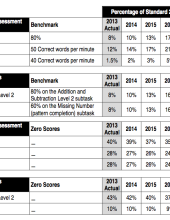
Policy Brief on the National Early Grade Literacy and Numeracy Survey in Jordan: 2013/2014 Intervention Pilot Program

Submitted by admin on
Description/Abstract
This brief discusses an intervention in Jordan which was developed following the 2012 EGRA and EGMA revealed that Jordanian children in the early grades were not reading with comprehension or doing mathematics with understanding. As a result, the MoE Curriculum Team and the Senior Reading and Mathematics Supervisors, to develop an intervention pilot research program that would support teachers in providing deliberate, structured, and developmentally appropriate daily practice in foundational skills for reading and mathematics.
Assoc. Photo (Port.)
Country
Resource Type
Resource Language
Month and Year
Publisher Or Client
USAID

Proposing Benchmarks for Early Grade Reading and Mathematics in Tanzania

Submitted by admin on
Description/Abstract
In November 2013, the Ministry of Education and Vocational Training (MoEVT), with support from the U.S. Agency for International Development (USAID) and technical assistance by RTI International, conducted the National Baseline Assessment for the 3Rs (Reading, Writing, and Arithmetic) Using Early Grade Reading Assessment (EGRA), Early Grade Mathematics Assessment (EGMA), and Snapshot of School Management Effectiveness (SSME) in Standard 2 in Tanzania. The purpose of this study was to provide data that can be translated into an evidence base to inform policy decisions and interventions. The baseline assessment also provides rich performance and contextual data that can be used for comparison with midline and endline studies after the introduction of new reforms or interventions under the 3Rs campaign or the larger Big Results Now (BRN) initiative. This brief describes the workshop and presents the benchmarks.
Assoc. Photo (Port.)
benchmarks .png
Resource Type
Resource Language
Month and Year
Publisher Or Client
USAID

Policy Brief on the National Early Grade Literacy and Numeracy Survey in Jordan: 2014/2015 Remedial Pilot Research Activity

Submitted by admin on
Description/Abstract
This brief discusses Jordan's remedial pilot research program which was designed to assist teachers in improving the performance of those children who had fallen behind the general performance level of the rest of the class. The program focused on Arabic reading and mathematics in grades 1, 2, and 3. The rationale of the program is that children who are not performing at the general level of the class can benefit from additional instructional support that is aimed at their individual level of learning.
Assoc. Photo (Port.)
jordan brief.png
Country
Resource Type
Featured projects
Resource Language
Month and Year
Publisher Or Client
USAID

USAID/Uganda School Health and Reading Program: Early Grade Reading Assessment Results

Submitted by admin on
Description/Abstract
This brief discusses the results from the EGRAs conducted as of January 2016 in Uganda under the School Health and Reading Program (SHRP). Results to date indicate that in virtually every language, increases in reading skills beyond those found in controls schools are taking place – and that teachers are changing the way they are teaching reading.
Assoc. Photo (Port.)
Country
Resource Type
Resource Language
Month and Year
Publisher Or Client
USAID