Senegal

Country Code
SEN

Survey of Children's Book Purchasing Habits in Senegal: Findings Report

Submitted by admin on
Description/Abstract
Étude sur les habitudes de consommation de livres pour enfants au Sénégal : Rapport des résultats. The Survey on Children's Books Consumer Habits in Senegal seeks to provide detailed information on the behaviors and preferences of potential consumers of these books. The results will allow book publishers to draw useful lessons to better guide their offerings of supplementary reading materials. L'Étude sur le pouvoir d’achat en livres pour enfants cherche à renseigner de manière détaillée sur les comportements et les préférences des consommateurs potentiels de ces livres. Les résultats permettront aux éditeurs de livres de tirer les leçons utiles pour mieux orienter leurs offres en ouvrages complémentaires. Cette étude a été menée dans la dernière semaine de juillet 2023 par une équipe qui a mis en oeuvre une méthodologie articulée autour d’entretiens à l’aide de questionnaires détaillés avec les cibles suivantes : parents ou tuteurs, responsables d’écoles privées, libraires (détaillants et distributeurs de livres), gestionnaires de bibliothèques municipales, ONG, centres communautaires, collectivités territoriales et autres secteurs.
Assoc. Photo (Port.)
TR04 Senegal Port.PNG
Country
Resource Type
Featured projects
Resource Language
Month and Year
Publisher Or Client
USAID

The role of Middle Tier Leadership in Supporting Improved Foundational Literacy and Numeracy [CIES 2024]

Submitted by admin on
Description/Abstract
This presentation delivered at the CIES 2024 conference describes key implementation strategies used in USAID/MOE Government to Government Component of RELIT Program.
Assoc. Photo (Port.)
relit port.PNG
Country
Resource Type
Featured projects
Resource Language
Month and Year
Publisher Or Client
USAID

Senegal-Bilingual Education: An “irreversible option” Context, Pedagogy, and Communication [CIES 2024 Presentation]

Submitted by admin on
Description/Abstract
This presentation delivered at the CIES 2024 conference in Miami describes the bilingual reforms in Senegal and how they are supported through local language specialists (via the local organization ARED) and community engagement. For successful bilingualism, there are a number of challenges to be met in several areas. Reforming the curriculum to address the scope and sequence of national languages in the curriculum, with gradual introduction to French as a second language requires considerable shift in the status quo. Naturally, new textbooks and teaching materials need to be developed, but which languages? At present, 6 languages are taken into account in the reform promoted by the government, but there is a need we need to think more broadly about the gradual introduction of other languages, and their readiness to be used in formal instruction. Under the current reform program, RELIT—Renforcement de la Lecture Initiale pour Tous—is led by the government in collaboration with implementing partners supported by USAID. A detailed program of language mapping and community consultations has helped to lay the groundwork for community acceptance of national language instruction and identifying which language will be used in each school based on the majority language in the community. Preparing communities for such a significant change also involves community consultations and a large social and behavior change communications campaign. While these broad changes are critical to the larger ecosystem of school reform, ultimately teachers need to implement the reforms, and therefore a significant task is upskilling teachers in using these national languages for instruction. Some teachers also need to improve their skills in speaking and reading these languages, which have largely been oral languages until recently. Policy and curricular reforms therefore need to take into consideration teacher recruitment, teacher preparation and placement in schools. Such issues of curriculum, societal attitudes, and teacher training are relatively easily anticipated. However, there are a host of smaller details that only implementation of such a significant program can reveal. Should the curriculum include teaching cursive writing in national languages, which has always been the norm in French, even though no cursive forms yet exist for certain letters of the languages? For instruction in both national languages and French, should materials be developed in separate volumes, or do both languages appear side-by-side in textbooks and learning materials? What messages resonate with communities, who may resist national language instruction? And how best to bring teachers on board with such a monumental change? This presentation will discuss the processes and findings of multiple action research activities in the context of the RELIT program.
Assoc. Photo (Port.)
ARED port.PNG
Resource (File)
Country
Resource Type
Featured projects
Resource Language
Month and Year
Publisher Or Client
USAID

Senegal-Bilingual Education - an “irreversible option” Context, Pedagogy, and Communication [CIES 2024 Presentation]

Submitted by admin on
Description/Abstract
This presentation delivered at the CIES 2024 conference in Miami describes the bilingual reforms in Senegal and how they are supported through local language specialists (via the local organization ARED) and community engagement
Assoc. Photo (Port.)
ARED port.PNG
Resource (File)
Country
Resource Type
Featured projects
Resource Language
Month and Year
Publisher Or Client
USAID

An alternative model of continuous teacher professional development for better learning outcomes in Senegal [CIES 2024 Presentation]

Submitted by admin on
Author
Description/Abstract
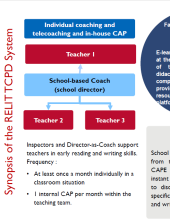
Presentation for CIES 2024 panel: Disrupting the Status Quo of Continuous Teacher Professional Development: Alternative Models for Improved Learning Outcomes. This presentation describes the Senegal RELIT programme's teacher professional development process.
Assoc. Photo (Port.)
RELIT TPD Port.PNG
Resource (File)
Ablaye CIES 2024.pdf
Country
Resource Type
Featured projects
Resource Language
Month and Year
Publisher Or Client
USAID

Summary report of the Regional Institutional Capacity Assessment Process and Results (Diourbel, Fatick, Kaffrine Kaolack, Kedougou, Louga, Matam, Saint Louis, Tambacounda)

Submitted by admin on
Description/Abstract
In French, with an English Executive Summary. Senegal is embarking on an ambitious reform program with the objective of improving learning outcomes for all students by more systematically using regional mother tongues as bridges to proficient literacy in French. The Renforcement de la Lecture Initiale pour Tous (RELIT) activity made possible by the American people through USAID is supporting the National Education Ministry (MEN) in the development of the materials, pedagogy, assessments, and teacher training needed to implement the MOHEBS. The institutional capacity development elements of RELIT are by design meant to complement these other interventions. RELIT is approaching institutional capacity in terms of the knowledge and skills of actors in key positions at each level of the system, but more importantly also in terms of how those levels relate to each other and the institutional environments within which all the concerned actors operate. This relates to how their jobs are defined, how their responsibilities are assigned and resourced, and what explicit or tacit incentives or disincentives they encounter in the day-to-day fulfillment of those responsibilities. Additionally, RELIT recognized from the beginning that investments to improve institutional capacity are dependent on the engagement and willingness of the actors involved to identify their needs and, on the basis of those needs, jointly plan with RELIT the actions that will best address them. Therefore, RELIT has taken the participatory approach described below to assessing and addressing institutional capacity development needs in the education system in Senegal. This report describes the result of institutional capacity self-assessment activities in the regions involved in RELIT.

Assoc. Photo (Port.)
RELIT portrait.PNG
Country
Resource Type
Featured projects
Resource Language
Month and Year
Publisher Or Client
USAID

Can the Middle Tier Drive Foundational Learning at Scale?

Submitted by admin on
Author
Description/Abstract
An integral part of a decentralized education system hierarchy is the “middle tier” comprising subnational actors in charge of education delivery at the regional, provincial, state, district, municipality, city, or circuit and cluster levels. The general roles and responsibilities of the middle tier are described in research on district leadership in OECD countries. Their responsibilities range from planning, monitoring, and implementing reforms at the subnational and school levels, to ensuring school-based accountability through data and evidence, to innovating, supporting, and monitoring improvements in teaching and learning in schools through instructional leadership and fostering professional learning communities at the district and school levels. While rigorous academic evidence may be lacking on the ability of middle managers to bring about improvements in foundational literacy and learning outcomes at scale in LMICs, we have theoretical and programmatic evidence on (1) their role in instructional leadership, (2) the importance of building their capacity to drive teaching and learning, and (3) the importance of trust and support within the education system that fosters learning at scale. Thumbnail Credit: Pakistan Reading Program/IRC
Assoc. Photo (Port.)
Picture4_0.jpg
Resource (File)
Resource Type
Resource Language
Month and Year
Publisher Or Client
Center for Global Development / Bill and Melinda Gates Foundation

Strengthening sector capacity for Student Learning Assessment in the context of bilingualism in Senegal [CIES 2023 Presentation]

Submitted by admin on
Description/Abstract
This presentation on development of an assessment system under Senegal's new bilingual policy includes an explanation of the bilingual policy in Senegal and plans for development of a national assessment system including use of the ANLAS methodology (Analysis of National Learning Assessment Systems)
Assoc. Photo (Port.)
INEADE portrait.JPG
Resource (File)
Country
Resource Type
Month and Year
Publisher Or Client
RTI International

Navigating Aid Alternatives: Government-to-Government funding partnerships in Jordan, Senegal, Nepal [CIES 2023 Panel Presentations]

Submitted by admin on
Description/Abstract
Since 2010, USAID has increased funding to partner country institutions by 50% [1], and the current administration’s localization agenda suggests that the government-to-government (G2G) modality may be increasingly frequent. Implementing partners operating in countries with a G2G arrangement, must pay careful attention to the meaning of technical assistance and system strengthening for scale and sustainability. This topic was covered by three presentations in a panel session, including: (1) Driving government ownership of a new language policy through a Government-to-Government partnership: The case of Senegal; (2) Government-to-Government programs to improve student learning: The case of Nepal; and (3) The case of Jordan
Assoc. Photo (Port.)
G2G portrait.JPG
Country
Resource Type
Month and Year

System Supports for Effective Large-Scale Reading Interventions (Learning at Scale)

Submitted by admin on
Description/Abstract
Learning outcomes are low and instruction is poor in many low- and middle-income countries (LMICs). These shortcomings are particularly concerning given the substantial learning loss due to COVID-19 from which many systems are suffering. The Learning at Scale study identified eight of the most effective large-scale education programs in LMICs and now is examining what factors contribute to successful improvements in learning outcomes at scale (see list of programs on last page of this brief). These programs were selected based on their demonstrated gains in reading outcomes at-scale, from either midline or endline impact evaluations. The study addresses three overarching research questions, focused on understanding (1) the components of instructional practices (Brief 1), (2) instructional supports (Brief 2), and (3) system supports (Brief 3) that lead to effective instruction. This brief focuses specifically on system supports. It addresses the following research question: What system supports are required to deliver effective training and support to teachers and to promote effective classroom practices?
Assoc. Photo (Port.)
Brief3.png
Resource (File)
BRIEF-3- System Support.pdf
Resource Type
Resource Language
Month and Year
Publisher Or Client
Center for Global Development, Bill and Melinda Gates Foundation