Global

Learning to Read: The Power of the 5T's

Submitted by admin on
Description/Abstract
Learning to read is a critical foundational skill in the early grades. The Government of Uganda in partnership with the Literacy Achievement and Retention Activity funded by the United States Agency for International Development (USAID) is working to improve early grade reading. This activity is implemented by RTI International, an independent, nonprofit research institute dedicated to improving the human condition.
Assoc. Photo (Port.)
Country
Resource Type
Resource Language
Month and Year
Publisher Or Client
USAID

What works in early reading materials

Submitted by admin on
Description/Abstract
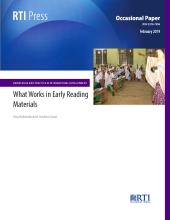
Access to books is key to learning to read and sustaining a love of reading. Yet many low- and middle-income countries struggle to provide their students with reading materials of sufficient quality and quantity. In this paper, we seek to capture the practices RTI has developed and refined since 2008, particularly in response to the challenges inherent in contexts with high linguistic diversity and low operational capacity for producing and distributing instructional materials. These practices constitute our approach to developing and producing instructional materials for early grade literacy. We also touch upon effective planning for printing and distribution procurement, but we do not consider the printing and distribution processes in depth in this paper. We expect this volume will be useful for donors, policymakers, and practitioners interested in improving access to cost-effective, high-quality teaching and learning materials for the early grades.
Assoc. Photo (Port.)
What Works in Early Reading Materials_cover.jpg
Country
Resource Type
Resource Language
Month and Year
Publisher Or Client
RTI Press

Is It Possible to Improve Learning at Scale? Reflections on the Process of Identifying Large-Scale Successful Education Interventions

Submitted by admin on
Description/Abstract
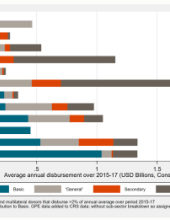
Improving learning outcomes at scale is hard. That may seem obvious, but only recently have policymakers and donors become aware of just how dire—and broad—the learning crisis is. Most of their efforts to improve learning have been pilot programs, and although in some cases it has been possible to improve outcomes at this small scale, it is an entirely different challenge at scale, which can involve thousands of schools—the level at which change must happen to fix the crisis.
Assoc. Photo (Port.)
scale.png
Country
Month and Year

Guiding Teachers Rather than Scripting Them

Submitted by admin on
Description/Abstract
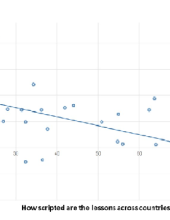
It is difficult to imagine an effective teacher who does not have mastery of the content nor command of the pedagogical skills needed to teach literacy. Yet many teachers, particularly in low- and middle-income countries, lack these very skills. In those same countries, students exit school without the essential capabilities they need. How can we help teachers to teach more effectively?
Assoc. Photo (Port.)
scripted.png
Country
Resource Language
Month and Year

Annotated bibliography of scientific-stature publications produced by RTI’s International Education Division with internal research and development funding, by year, 2016–2019

Submitted by admin on
Author
Description/Abstract
This annotated bibliography, originally created as a supplement to a research poster, compiles the output from an RTI internal research and development (IR&D) award. Each fiscal year, RTI considers staff-submitted proposals for innovative products or services that would advance a field of research but are not likely to be covered by external sources, and selects some to receive IR&D grants. Beginning in 2016, staff of RTI’s International Education division took on the challenge of significantly increasing the unit’s internal funding, production, and publication of peer-reviewed research. The urgency was driven by three significant factors: (1) Omission from meta-analyses—During the previous 10 year period, several broadly distributed retrospectives were published on “what works” in learning assessment and improvement—none of which covered RTI’s extensive experience, because it was available only as gray literature (primarily reports for the United States Agency for International Development, or USAID). Thus, a decade of learning from the administration and analysis of Early Grade Reading and Mathematics Assessments (EGRA and EGMA), in particular, was not well accounted for. (2) Sustainable Development Goals (SDGs)—In 2015, the global community adopted the SDGs and began determining metrics to monitor progress. Unless RTI moved to publish its findings on potential use of alternative assessments, including EGRA and EGMA, country-driven approaches to measurement for low- and lower-middle-income countries could be excluded from options for monitoring and tracking progress toward the new global goals. (3) Absence of external funding—The primary sponsor of the relevant project work, USAID, did not have funding to support following up with additional analyses, particularly those involving multicountry comparisons. The IR&D award responded to these gaps. As led by Dr. Amber Gove, the primary intent of the effort was to ensure that the Institute would lead the field in using and disseminating EGRA and EGMA data, the majority of which RTI had collected and analyzed. The IR&D funding covered multiple years, and the result by late 2019 was 16 peer-reviewed publications, with several more submitted and under review. Some key lessons learned during the process—as reflected in the listed works—were: (1) Start with client-funded reports and analyses; (2) pair first-time authors with more experienced writers; (3) ask key questions across countries and/or languages; (4) collaborate with colleagues from other organizations; and (5) prioritize broad (open) access. More information: Amber Gove, e-mail: agove@rti.org; Twitter: @AmberGove
Assoc. Photo (Port.)
Screen Shot 2020-01-09 at 11.39.32 AM.png
Resource (File)
Country
Resource Language
Month and Year
Publisher Or Client
RTI International

Contextualizing the goals of social and emotional learning curricula and materials

Submitted by admin on
Author
Description/Abstract
Programs to promote social and emotional learning (SEL) risk making assumptions about the global relevance of core competences. Because scholarship is lacking about SEL in many parts of the world, new approaches are needed to contextualize the goals of SEL programs in a realistic time frame. Previous work in anthropology and developmental psychology can help us predict which competences are likely to be valued, given the sociodemographic characteristics of a society. In rural environments where subsistence agriculture is common, for example, communities are likely to value social responsibility, respect, and obedience. Attention should look beyond the needs of the here and now, however, to speculate what competences today’s children will require in the future. Looking at the current variation of competences within a society—for example, the values that teachers, but not parents, place on confidence and curiosity—can help identify immediate pathways for developing new competences. In all of these considerations, the goals of an SEL program must be negotiated with the communities themselves in order to ensure relevance, effectiveness, and acceptance. The hope is that such considerations can help prevent global homogenization of SEL programs, instead ensuring that they genuinely meet the needs of the communities they aim to serve.
Assoc. Photo (Port.)
7 jukes portrait.png
Resource Type
Resource Language
Month and Year
Publisher Or Client
NISSEM Global Briefs

Instructional Strategies for Mathematics in the Early Grades

Submitted by admin on
Author
Description/Abstract
This document is intended for program and curriculum experts interested in implementing evidence-based early grade mathematics programs. It was developed by the authors of this document, who are mathematics teaching and learning experts with extensive experience adapting evidence-based practices in low and middle-income contexts. Our collective field and research experience, combined with the existing evidence base, led us to focus on four instructional strategies that are key to effective mathematics instruction: 1. Respecting developmental progressions 2. Using mathematical models to represent abstract notions 3. Encouraging children to explain and justify their thinking 4. Making explicit connections for children between formal and informal math While these four instructional strategies are very important, they are not the only instructional strategies that can result in improved learning outcomes. Effective early grade mathematics teachers draw from an extensive repertoire of evidence-based instructional strategies and strive to create a learning environment the supports that development of positive mathematical identities.
Assoc. Photo (Port.)
Screen Shot 2019-11-12 at 9.51.44 AM.png
Resource (File)
Country
Resource Type
Resource Language
Month and Year
Publisher Or Client
Mathematics Working Group

EGMA Toolkit en Español

Submitted by admin on
Description/Abstract
La Evaluación de Matemáticas en los Primeros Grados (EGMA) Toolkit
Assoc. Photo (Port.)
EGMA spanish.jpeg
Resource (File)
Country
Resource Type
Resource Language
Month and Year
Publisher Or Client
RTI International