Global

Monitoring, Evaluation, Research, Learning and Adapting Online course

Submitted by admin on
Description/Abstract
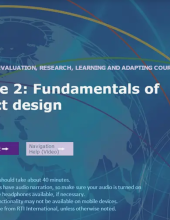
RTI’s Monitoring, Evaluation, Research, Learning, and Adapting (MERLA) Community of Practice is proud to launch a free course geared towards the international development community. The course is designed for individuals of all practices (monitoring and evaluation, project management, business development, policy planning) and is intended to provide a foundation for MERLA basics. The five modules cover topics including fundamentals of program design, developing a project logic model (e.g. Theory of Change, Results Framework, etc), designing performance indicators, developing data collection instruments, and much more! No certificate is provided. The course is licensed under Creative Commons CC-BY-SA.
Assoc. Photo (Port.)
merla course.PNG
Country
Resource Type
Resource Language
Month and Year
Publisher Or Client
RTI International

MERLA Course Navigation Guidelines

Submitted by admin on
Description/Abstract
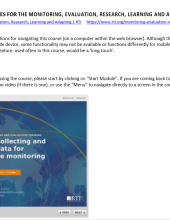
These navigation guidelines can be used with the MERLA course developed by RTI International for open access. https://www.rti.org/monitoring-evaluation-research-learning-and-adapting
Assoc. Photo (Port.)
Course nave.png
Resource (File)
Country
Resource Type
Month and Year
Publisher Or Client
RTI

eResources Review Toolkit

Submitted by admin on
Description/Abstract
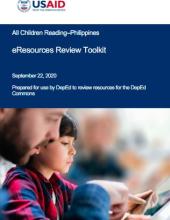
This toolkit was developed for the All Children Reading Philippines project to support Department of Education staff in developing and reviewing electronic resources for the DepEd Commons (online OER repository).
Assoc. Photo (Port.)
err_toolkit.JPG
Resource (File)
Country
Resource Type
Month and Year
Publisher Or Client
USAID

Do’s and Don’ts of Improving Teaching Through Instructional Support: Findings from a Multi-country study of coaching and communities of practice

Submitted by admin on
Description/Abstract
RTI’s multi-country study examines a range of instructional support packages that include a variety of designs for coaching and communities of practice across all of RTI’s existing programs in order to determine what modes of coaching support are most effective. This includes coaches at both the school level and external to the school, as well as government officers compared with project hired coaches. This research is able to compare the relative effectiveness of coaching approaches with educational support provided by communities of practice meetings held at the school or the school cluster level. These findings have provided existing and future programs with best practices for how to more effectively implement coaching support structures at scale.This presentation was delivered by RTI at CIES (April 2020) as part of a panel focused on how literacy improvement efforts work at scale, and what types of coaching designs and behaviors impact teacher pedagogy more effectively than others.
Assoc. Photo (Port.)
RTI_Uganda_SHRPLARA.png
Resource (File)
Country
Resource Type
Resource Language
Month and Year

Mobile Learning and Numeracy: Filling gaps and expanding opportunities for early grade learning [Arabic]

Submitted by admin on
Description/Abstract
The present study on Mobile Learning and Numeracy examines how mobile learning (m-learning) could influence and improve numeracy education at early grade levels (ages 4-10) especially in low-income countries. Key questions to guide the research include: 1) What are the benefits and challenges of integrating mobile learning into early grade numeracy education? 2) What is the role of a teacher with regard to mobile learning and numeracy education? 3) How can the community and the parents actively contribute to/participate in the child’s numeracy education with the use of mobile devices? and 4) How can mobile technology be used effectively in measuring/assessing numeracy gains? The conclusions and recommendations of this study have been informed by an international working group that met over two days during the first International Numeracy Conference in Berlin in December 2012. We would like to acknowledge the following participants of this working group for their thoughtful contributions: Michaela Brinkhaus (BMZ); Dorothea Coppard (GIZ); Melanie Stilz (Konnektiv Büro für Bildung und Entwicklung); Jens von Roda-Pulkowski (KfW); Abigail Bucuvalas (Sesame Workshop); Mr. Kann Puthy (Primary Education Department, MoEYS Cambodia); Edward Barnett (DFID).
Assoc. Photo (Port.)
Screen Shot 2020-06-24 at 5.41.40 PM.png
Country
Resource Type
Resource Language
Month and Year
Publisher Or Client
GTZ

Virtual Assessment and Making the Right Technology Choices (Presentation)

Submitted by admin on
Author
Description/Abstract
This presentation was held by Carmen Strigel during the second webinar of the Basic Education Coalition EdTech working group on April 27, 2020. The presentation is about using Tangerine for student self-study and self-assessment as well as family outreach. The presentation also introduces a new tool developed by RTI on considering access, user engagement, and content in making the right technology choices for your audience.
Assoc. Photo (Port.)
Webinar_pptintro_Strigel_27Apr20.png
Country
Resource Type
Resource Language
Month and Year

Measurement of Inequality in Learning Levels [Conference Presentation]

Submitted by admin on
Description/Abstract
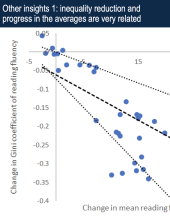
The presentation summarizes a paper by Tim Slade and Luis Crouch on the measurement of learning inequality before and after a successful reading project. The paper concludes that at least for the case studied, the project improved not only the averages but also reduced the inequality. The paper was prepared under the auspices of a conference on "Learning at the Bottom of the Pyramid" organized by IIEP and Dan Wagner of U Penn. This is the presentation that was delivered at vCIES 2020.
Assoc. Photo (Port.)
Screen Shot 2020-05-06 at 10.03.24 PM.png
Resource (File)
Country
Resource Type
Resource Language
Month and Year
Publisher Or Client
NA

Going Virtual: Content Delivery Decision-making Tool

Submitted by admin on
Author
Description/Abstract
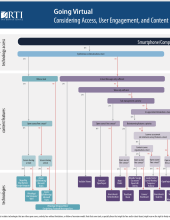
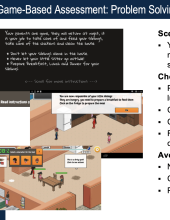
This tool was created to support projects who are considering delivering educational content remotely. The decision tree supports multiple aspects of instructional design and accessibility to suggest specific authoring tools and delivery platforms.
Assoc. Photo (Port.)
Screen Shot 2020-05-06 at 1.26.15 PM.png
Resource (File)
Country
Resource Type
Resource Language
Month and Year
Publisher Or Client
RTI International

Towards the Development of An Assessment of Employability Skills

Submitted by admin on
Author
Description/Abstract
As the world faces higher and higher unemployment rates among its youth, there is increasing interest in evaluating whether schools are adequately preparing their youth to enter the workforce. Do early school leavers (those leaving by Grade 9) possess the “foundational” and “employability” skills needed to effectively enter the workforce? Assessment instruments for literacy and mathematics appropriate to the end of the primary cycle do exist. However these tend to be in depth, large scale, regional or national assessments and not the rapid assessments that EGRA/EGMA are. In addition, these tools only measure some foundational skills, such as reading and math. Previous investigation on employability skills identified three “clusters” of commonly cited skills in the international literature: cognitive, interpersonal, and intrapersonal skills. These three clusters align favorably with the three domains specified by the Committee on Deeper Learning and 21st Century Skills, convened by the US-based National Research Council, as well as other prominent models. A subset of these skills could be assessed, in combination with foundational skills such as literacy and mathematics, in order to ascertain whether or not youth of secondary school age (i.e. around 15–18 years of age) are finishing their tenure in formal schooling with at least a modicum of “work readiness” skills. This report describes a framework for understanding and measuring employability skills.
Assoc. Photo (Port.)
employability_port.png
Resource (File)
Country
Resource Type
Resource Language
Month and Year
Publisher Or Client
RTI International

Assessing Soft Skills in Youth Through Digital Games [Presentation]

Submitted by admin on
Description/Abstract
Presentation for the 2019 ICERI conference (Seville, Spain.)
Assoc. Photo (Port.)
Screen Shot 2020-04-09 at 12.37.45 PM.png
Country
Resource Type
Resource Language
Month and Year