Literature Reviews and Desk Studies

Desk Review of Uzbek Language Arts and Mathematics Student Textbooks and Teacher Guides

Submitted by admin on
Author
Description/Abstract
The U.S. Agency for International Development (USAID) Uzbekistan Education for Excellence Program, implemented by RTI International, conducted the Teaching and Learning Material (TLM) Uptake Study to inform immediate- and medium-term revisions to the TLMs developed by both the Program and the Ministry of Preschool and School Education (MoPSE). This desk review forms part of the TLM Uptake Study. Under the desk review, we evaluated the quality of the teacher guides (TGs) and student textbooks (STBs) developed for the Uzbek Language Arts (ULA) and Mathematics courses for grades 1–4 during the piloting of these materials in schools.
Assoc. Photo (Port.)
Pages from Desk Review of ULA and Mathematics Student Textbooks and Teacher Guides.jpg
Country
Featured projects
Month and Year
Publisher Or Client
USAID

Annotated bibliography of scientific-stature publications produced by RTI’s International Education Division with internal research and development funding, by year, 2016–2019

Submitted by admin on
Author
Description/Abstract
This annotated bibliography, originally created as a supplement to a research poster, compiles the output from an RTI internal research and development (IR&D) award. Each fiscal year, RTI considers staff-submitted proposals for innovative products or services that would advance a field of research but are not likely to be covered by external sources, and selects some to receive IR&D grants. Beginning in 2016, staff of RTI’s International Education division took on the challenge of significantly increasing the unit’s internal funding, production, and publication of peer-reviewed research. The urgency was driven by three significant factors: (1) Omission from meta-analyses—During the previous 10 year period, several broadly distributed retrospectives were published on “what works” in learning assessment and improvement—none of which covered RTI’s extensive experience, because it was available only as gray literature (primarily reports for the United States Agency for International Development, or USAID). Thus, a decade of learning from the administration and analysis of Early Grade Reading and Mathematics Assessments (EGRA and EGMA), in particular, was not well accounted for. (2) Sustainable Development Goals (SDGs)—In 2015, the global community adopted the SDGs and began determining metrics to monitor progress. Unless RTI moved to publish its findings on potential use of alternative assessments, including EGRA and EGMA, country-driven approaches to measurement for low- and lower-middle-income countries could be excluded from options for monitoring and tracking progress toward the new global goals. (3) Absence of external funding—The primary sponsor of the relevant project work, USAID, did not have funding to support following up with additional analyses, particularly those involving multicountry comparisons. The IR&D award responded to these gaps. As led by Dr. Amber Gove, the primary intent of the effort was to ensure that the Institute would lead the field in using and disseminating EGRA and EGMA data, the majority of which RTI had collected and analyzed. The IR&D funding covered multiple years, and the result by late 2019 was 16 peer-reviewed publications, with several more submitted and under review. Some key lessons learned during the process—as reflected in the listed works—were: (1) Start with client-funded reports and analyses; (2) pair first-time authors with more experienced writers; (3) ask key questions across countries and/or languages; (4) collaborate with colleagues from other organizations; and (5) prioritize broad (open) access. More information: Amber Gove, e-mail: agove@rti.org; Twitter: @AmberGove
Assoc. Photo (Port.)
Screen Shot 2020-01-09 at 11.39.32 AM.png
Resource (File)
Country
Resource Language
Month and Year
Publisher Or Client
RTI International

Measures of quality through classroom observation for the Sustainable Development Goals: Lessons from low-and-middle-income countries

Submitted by admin on
Description/Abstract
Background paper prepared for the 2016 Global Education Monitoring Report Education for people and planet: Creating sustainable futures for all With the adoption of the United Nations General Assembly’s Sustainable Development Goals (SDGs), global education agencies are grappling with how quality can and should be measured for global reporting purposes. Several factors at the education system, school, and classroom levels shape education quality, including the limited information available at the global level about what is happening in the classroom. Such information can only come through observation-based measures that record teacher practices, either through routine monitoring conducted by system actors or through surveys. Classroom observation is used extensively in not only teacher education and professional development, but also in evaluation studies. However, there are fewer cases where classroom observations are used for system monitoring purposes—particularly in low- and middle- income countries. This paper reviews what has been learned from observation instruments in low- and middle-income countries and what opportunities (i.e., scope) there are to systematize these countries to that they can monitor quality at both the school and system levels.
Assoc. Photo (Port.)
gmr.png
Resource (File)
Country
Resource Language
Month and Year
Publisher Or Client
UNESCO Global Monitoring Report

Report on Language of Instruction in Senegal

Submitted by admin on
Description/Abstract
This report summarizes applicable research on education in multilingual contexts and on the use of L1-based, bilingual instruction in particular. It also briefly presents the education and sociolinguistic environment in Senegal, as well as a summary of relevant national language education programs in the country. Lastly, the report makes recommendations aimed at supporting a transition toward the use of national languages for instruction in primary schools.
Assoc. Photo (Port.)
Senegal.png
Resource (File)
Senegal LOI paper_FINAL.pdf
Country
Resource Language
Month and Year
Publisher Or Client
USAID

Early Primary Mathematics Education in Arab Countries of the Middle East and North Africa

Submitted by admin on
Description/Abstract
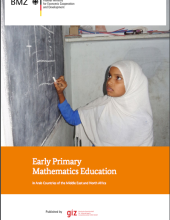
MENA countries are facing significant challenges in providing access to quality education for children in the early grades. However, it is important to note that the situation in the MENA region is not so different from that in other regions of the Global South: quality and learning are not being achieved. In MENA countries, achievement in math is not only associated with the effectiveness of teaching and learning, but also with providing an equitable system of education for all children. This paper presents the state of mathematics education in the MENA region and suggests means to improve it according to the pertinent cultural and social context.
Assoc. Photo (Port.)
Screen Shot 2017-02-21 at 4.17.46 PM.png
Resource Language
Month and Year
Publisher Or Client
Deutsche Gesellschaft für Internationale Zusammenarbeit (GIZ) GmbH

West Bank Case Study Report

Submitted by admin on
Author
Description/Abstract
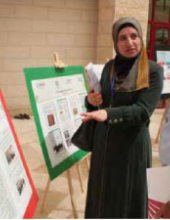
The purpose of this case study is to illuminate how and why US Agency for International Development (USAID) education programs in the West Bank and Gaza were able to achieve the lasting impact in basic, higher, and non-formal education despite the considerable political and environmental challenges. This study attempts to illuminate the pathways to sustained reform, the underlying reasons for the programs’ success, and the key lessons learned. It focuses far more on the how and why of program impact than on the “what” of program content.
Assoc. Photo (Port.)
Capture.PNG
Resource Language
Month and Year
Publisher Or Client
USAID

Mobile Learning and Numeracy: Filling gaps and expanding opportunities for early grade learning

Submitted by admin on
Description/Abstract
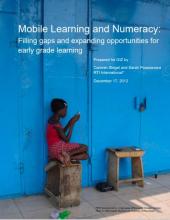
The present study on Mobile Learning and Numeracy examines how mobile learning (m-learning) could influence and improve numeracy education at early grade levels (ages 4-10) especially in low-income countries. Key questions to guide the research include: 1) What are the benefits and challenges of integrating mobile learning into early grade numeracy education? 2) What is the role of a teacher with regard to mobile learning and numeracy education? 3) How can the community and the parents actively contribute to/participate in the child’s numeracy education with the use of mobile devices? and 4) How can mobile technology be used effectively in measuring/assessing numeracy gains? The conclusions and recommendations of this study have been informed by an international working group that met over two days during the first International Numeracy Conference in Berlin in December 2012. We would like to acknowledge the following participants of this working group for their thoughtful contributions: Michaela Brinkhaus (BMZ); Dorothea Coppard (GIZ); Melanie Stilz (Konnektiv Büro für Bildung und Entwicklung); Jens von Roda-Pulkowski (KfW); Abigail Bucuvalas (Sesame Workshop); Mr. Kann Puthy (Primary Education Department, MoEYS Cambodia); Edward Barnett (DFID).
Assoc. Photo (Port.)
mnumeracy_port.JPG
Country
Resource Language
Month and Year
Publisher Or Client
GIZ

Nepal Education Sector Early Grade Reading Assessment Report

Submitted by admin on
Description/Abstract
USAID/Nepal is interested in developing a program to help improve reading outcomes in the early grades of basic education. To inform the program design, a rapid education sector assessment was conducted to better understand past, current, and planned policies, practices, programs, innovations, and initiatives targeted towards early grade reading. This assessment aimed to identify strengths, weaknesses, and key leverage points to improve children’s reading outcomes within the institutional context of Nepal’s education system. The assessment was conducted over a two-month period by a team of researchers and staff from RTI International, including Mr. Joseph DeStefano, Senior Researcher; Dr. Frank Healey, Senior Researcher; Ms. Sharon Loza, Project Management Specialist; and Dr. Wendi Ralaingita, Education Researcher. Significant support was also provided by Dr. Vishnu Karki, Consultant; Dr. Yogendra Yadava, Local Language Expert; Jayanti Subba, Education Specialist, USAID/Nepal; and Mitch Kirby, USAID, Senior Education Advisor. The assessment was carried out by desk study and a two-week field visit from May 7 to May 19, 2012. This report reflects findings from the assessment.
Assoc. Photo (Port.)
Negral sector assessment.jpg
Resource (File)
Country
Resource Language
Month and Year
Publisher Or Client
USAID

Early Reading: Igniting Education for All. A report by the Early Grade Learning Community of Practice

Submitted by admin on
Description/Abstract
Learning to read is a fundamental part of the first few years of primary education for early and sustained success in school. Yet, in many developing countries, a distressing number of students are not learning to read at all during these critical first years of schooling. On September 8, International Literacy Day, the Center for Universal Education (CUE) at Brookings and the International Reading Association hosted a discussion on how ensuring literacy in the early grades can help to fulfill the promise of quality education for all. Amber Gove of RTI International presented the findings from the attached report “Early Reading: Igniting Education for All,” which represents the work of a community of practice that has been developing and refining assessment tools, piloting interventions, and sharing practices for scaling up these proven methods of improving literacy. Following the presentation, USAID Director of Education David Barth and International Reading Association President Patricia Edwards and Jamaica Teachers Association General Secretary Adolph Cameron joined a panel discussion on the paper’s findings. This revised version, with additional data and evidence from early reading interventions, was released in May 2011.
Assoc. Photo (Port.)
igniting.jpg
Country
Resource Language
Month and Year
Publisher Or Client
RTI International

Effective Teaching and Education Policy in Sub-Saharan Africa (Report)

Submitted by admin on
Author
Description/Abstract
This report, which is broadly tasked with presenting evidence on the state of teacher effectiveness in sub-Saharan Africa, represents an attempt to bridge the gap between what has hitherto been a sustained focus on teacher characteristics or student outcomes and a more holistic conceptualization of effective teaching, one that also emphasizes teachers' actual instructional practice and pedagogical moves. To do so, the report draws on data and findings germane to teacher effectiveness from international databases and assessments and critically supplements these data with recent findings from donor-funded projects and evaluations that specifically attempt to observe teachers' classroom instruction. The second section of the report presents evidence from the educational plans and policies of 11 sub-Saharan African countries and shows that these often focus on teacher characteristics, classroom inputs, professional guidelines, and (to some extent) teaching practices. A third section of the report describes four barriers to focusing more on effective teaching (as opposed to effective teachers and successful teaching) in sub-Saharan African countries. The report concludes with policy recommendations and considerations.
Assoc. Photo (Port.)
Effective teaching.png
Resource (File)
Country
Resource Language
Month and Year
Publisher Or Client
USAID