Planning

Scaling Access & Impact: Realizing the Power of EdTech (Executive Summary)

Submitted by admin on
Description/Abstract
Omidyar Network commissioned Scaling Access & Impact: Realizing the Power of EdTech to evaluate what might be necessary to enable, scale, and sustain Equitable EdTech on a national basis. We examined initiatives in Chile, China, Indonesia, and the USA that demonstrate how EdTech reached a broad spectrum of students. Download the executive summary to learn more about some of the events, actions, and initiatives that have contributed to the equitable scaling of EdTech as well as help inform policies using the highest-impact interventions.
Assoc. Photo (Port.)
edtech ecosystems jpg.jpg
Resource (File)
Resource Type
Resource Language
Month and Year
Publisher Or Client
Omidyar Network
Strengthening the Textbook Production Chain in Morocco: Study Conclusions and Recommendations Appendix B: A Review of the Domain of Electronic Textbooks

Submitted by admin on
Description/Abstract
This is Part 3 of a four-part comprehensive evaluation of the public textbook procurement system in Morocco. It is an overview of the challenges and opportunities of school-based digital teaching and learning, intended to provide a framework for policymakers in Morocco who are considering further investments in information and communication technology (ICT) for learning in government schools. Specifically, it addresses the area of digital textbooks. The overview poses questions that policymakers should ask and provides examples of how other countries have responded to such questions.
Assoc. Photo (Port.)
3_English_Textbooks Morocco_Digital.jpg
Resource (File)
Country
Resource Type
Resource Language
Month and Year
Publisher Or Client
USAID/Morocco

IE Selected Publications (2015 - 2018)

Submitted by admin on
Description/Abstract
This is a list of select peer-reviewed publications by International Education staff between 2015 and 2018. For some of the publications, links to information about the documents and related resources can be found on this websiate. Where possible, the DOI has been included in the attached brief.
Assoc. Photo (Port.)
publications2.jpg
Resource (File)
Country
Resource Type
Resource Language
Month and Year
Publisher Or Client
RTI International

Weakest Part of Poorly-Performing Educational Systems: An Argument for Focus on “Teaching at the Right Level” and Improved Foundation-Year Performance

Submitted by admin on
Author
Description/Abstract
n roughly thirty-five to forty countries that are expanding education very quickly, experts have noticed that learning problems originating in the earliest grades are showing as a massive over-enrolment. In Grade 1, it is not unheard of for ratios of enrolment to population of appropriate age to be as high as 150 percent. This problem is not typical of upper-middle or high-income countries, where the issue has been resolved. Nor, does it seem to affect the very poorest countries where massive enrolment expansions have not yet taken place, and so “don’t even have the problem yet.” Instead, the typical countries showing over-enrolment tend to be those that have received a great deal of funding and attention from development agencies and have expanded enrolment quickly in the last decade or two. This piece looks at the evidence of the enrolment bulge starting in Grade 1. It shows there is a set of inter-related problems occuring, including the lack of "Teaching at the Right Level," that is leading to high enrolment figures, but low levels of learning. The Insight concludes by stating that given the inefficiency signified by the foundation-years over-enrolment, “Teaching at the Right Level” could be an investment that, if tied to proper accountability measures, could essentially pay for itself, and lead to improved foundations for learning in the later grades, and (meaningful) completion of primary school.
Assoc. Photo (Port.)
RISE Crouch.png
Resource (File)
Country
Resource Type
Resource Language
Month and Year
Publisher Or Client
RISE Programme

Information for Education Policy, Planning, Management, and Accountability in West Bank and Gaza: Final Report of Findings of the Data Gap Analysis of the Palestinian Ministry of Education and Higher Education

Submitted by admin on
Description/Abstract
The purpose of the data gap analysis is to help the Palestinian Ministry of Education and Higher Education to identify ways to improve the integration and utilization of its data systems for policy, planning, and management, as well as reporting and feedback to the public and stakeholders. With funding through the United States Agency for International Development (USAID), RTI International (www.rti.org) fielded a three-person team to survey Ministry offices, assess existing data systems and applications, and debrief the Ministry and USAID on summary findings.
Assoc. Photo (Port.)
west bank.png
Resource (File)
Resource Type
Month and Year

West Bank Case Study Report

Submitted by admin on
Author
Description/Abstract
The purpose of this case study is to illuminate how and why US Agency for International Development (USAID) education programs in the West Bank and Gaza were able to achieve the lasting impact in basic, higher, and non-formal education despite the considerable political and environmental challenges. This study attempts to illuminate the pathways to sustained reform, the underlying reasons for the programs’ success, and the key lessons learned. It focuses far more on the how and why of program impact than on the “what” of program content.
Assoc. Photo (Port.)
Capture.PNG
Resource Language
Month and Year
Publisher Or Client
USAID

The Early Grade Reading Assessment: From Design to Dissemination

Submitted by admin on
Description/Abstract
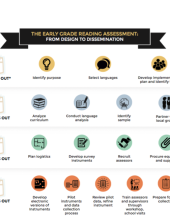
An infographic describing the key steps and timeline involved in conducting an Early Grade Reading Assessment (EGRA).
Assoc. Photo (Port.)
Screen Shot 2016-11-30 at 3.08.20 PM.png
Resource (File)
Country
Resource Type
Resource Language
Month and Year
Publisher Or Client
UNESCO Institute for Statistics

2015 Nigeria Education Data Survey (NEDS) Education Profile

Submitted by admin on
Description/Abstract
This document is based on the structure of previous education profiles that traditionally use Demographic and Household Survey (DHS) data to characterize children’s participation in primary and secondary schooling and adults’ schooling attainment and literacy. Previously, these standardized profiles were used for cross-country comparisons. However, in the context of Nigeria, past DHS data, combined with the 2015 NEDS, allows a longitudinal perspective of the same indicators. The 2015 NEDS profile also provides more information than previous profiles on the mechanisms used to sample, collect, and analyze the household data and should be used as a reference for the national and 37 state/Federal Capital Territory reports that provide graphical representation of the data.
Assoc. Photo (Port.)
neds 2.png
Resource (File)
Country
Resource Type
Resource Language
Month and Year
Publisher Or Client
USAID

Using the EGRA Calculator for Study Design and Budget Estimates

Submitted by admin on
Author
Description/Abstract
This presentation was prepared and presented at the USAID workshop/webinar “Release of the EGRA Toolkit, Second Edition: Updated Guidance and Tools for Conducting Early Grade Reading Assessments,” Bethesda, Maryland, April 27, 2016. It discusses the design and intended use of the EGRA Calculator.
Assoc. Photo (Port.)
Country
Resource Type
Month and Year
Publisher Or Client
USAID

User Guide for the EGRA Calculator

Submitted by admin on
Description/Abstract
This user guide accompanies the Excel-based EGRA Calculator to offer tips and suggestions for each step in the calculator to help the user enter appropriate and accurate information.
Assoc. Photo (Port.)
Resource (File)
Country
Resource Type
Month and Year
Publisher Or Client
USAID