Teacher Coaching

Guía Pedagógica para tutores educativos de cuarto a sexto primaria y primero básico

Submitted by admin on
Description/Abstract
Esta Guía Pedagógica para tutores educativos de cuarto a sexto primaria y primero básico fue elaborada por la Asociación de Cooperación para el Desarrollo Rural de Occidente (CDRO) en Guatemala, como parte del programa de subvenciones ¡Éxito! de Educación Básica de Calidad para la Transición (Basic Education Quality and Transitions -BEQT). El propósito de esta Guía pedagógica es ser un instrumento orientador a las y los tutores educativos, para reforzar los aprendizajes en las áreas de lectoescritura y matemáticas de niños y niñas de cuarto a sexto primaria y de primero básico, con el propósito de ir mejorando y nivelando las competencias de aprendizaje para que tengan éxito en el proceso de transición al ciclo básico.
Assoc. Photo (Port.)
Guía Pedagógica para Tutores_CDRO.PNG
Country
Resource Type
Featured projects
Resource Language
Month and Year
Publisher Or Client
USAID

Guía de Trabajo: Consejería comunitaria y apoyo psicosocial para la atención a niños y jóvenes

Submitted by admin on
Description/Abstract
Guía de Trabajo para Maestros: Consejería comunitaria y apoyo psicosocial para la atención a niños y jóvenes. Este libreto de trabajo fue elaborado por el equipo técnico del Centro de Investigaciones Educativas de la Universidad del Valle de Guatemala, socio implementador de Educación Básica de Calidad para la Transición (Basic Education Quality and Transitions - BEQT, por sus siglas en inglés).
Assoc. Photo (Port.)
Consejería Comunitaria Workbook.PNG
Country
Resource Type
Featured projects
Resource Language
Month and Year
Publisher Or Client
USAID

Guía sobre los Fondos del Conocimiento (Funds of Knowledge Guide)

Submitted by admin on
Description/Abstract
Esta es una guía informativa para maestros sobre Fondos del Conocimiento y su aplicación en el aula. Los Fondos del Conocimiento hacen referencia al cúmulo de habilidades, experiencias y conocimientos de los estudiantes adquiridos en la vida cotidiana. En esta guía se enfatiza que este tipo de referentes son significativos, pues ayudan a los maestros para aprender sobre sus estudiantes y sus hogares, para reconocer fundamentos particulares de conocimiento aplicables en un entorno escolar. Esta guía fue elaborada por el equipo técnico del Centro de Investigaciones Educativas de la Universidad del Valle de Guatemala, socio implementador de Educación Básica de Calidad para la Transición (Basic Education Quality and Transitions - BEQT, por sus siglas en inglés).
Assoc. Photo (Port.)
FdC Guía.PNG
Country
Resource Type
Featured projects
Resource Language
Month and Year
Publisher Or Client
USAID

Guía sobre el Diseño Universal para el Aprendizaje (DUA)

Submitted by admin on
Description/Abstract
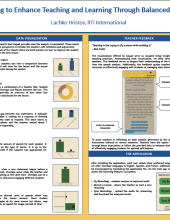
Esta es una guía informativa para maestros sobre el Diseño Universal para el Aprendizaje (DUA). El término DUA alude a un marco científicamente válido para guiar la práctica educativa que: a) proporciona flexibilidad en las formas en las que se presenta la información y en las que el estudiante demuestra su conocimiento de acuerdo a su motivación; b) reduce las barreras adaptándose al estudiante y manteniendo altas expectativas para todos los estudiantes en el aula. Esta guía fue elaborada por el equipo técnico del Centro de Investigaciones Educativas de la Universidad del Valle de Guatemala, socio implementador de Educación Básica de Calidad para la Transición (Basic Education Quality and Transitions - BEQT, por sus siglas en inglés).
Assoc. Photo (Port.)
DUA Guide.PNG
Country
Resource Type
Featured projects
Resource Language
Month and Year
Publisher Or Client
USAID

Loquat - Machine Learning to Enhance Teaching and Learning Through Balanced Classroom "Talk Time"[CIES 2024 Poster Presentation]

Submitted by admin on
Author
Description/Abstract
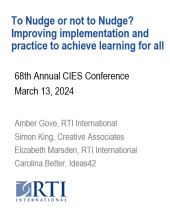
RTI’s latest mobile EdTech product, "Loquat", uses language-agnostic speech activity detection to determine when someone is talking. It then passes the detected speech to a voice type classifier to establish who is currently speaking. This allows the app to be used in different countries and settings, regardless of the instructional language. The mobile app, built for Android devices, is designed to be easy and intuitive. It provides timely classroom support for teachers located in rural or urban areas who may not have access to a mentor or coach. The app can also be used as part of a standard coaching session where the coach helps the teacher with techniques in improving their talk time balance in the classroom.  To use Loquat, the teacher records the audio of the entire lesson or choses a particular activity to be recorded. Then, they upload the recording through the app, to the Loquat server. After the audio recording of a lesson or activity is fully processed and analyzed, there are various reports available to the teacher. Each of these reports aims to aid the teacher in initiating self-reflection, applying immediate corrective actions, and improving talk time balance in their classroom (e.g., proportion of teacher talk time versus student talk time, individual talk time versus group talk time). Loquat is designed as a tool that empowers the teacher to take immediate action thus allowing students to grow and improve their learning outcomes. The app uses modern cloud architecture and serverless, scalable infrastructure, to process the audio. It only saves the data files used for building the graphs and charts used on the device reports. All classroom recordings are removed from the servers after analysis. There is no identification of voice or voice to text transcription. We have the Loquat application interface and user documentation in 3 languages, English, French, and Spanish. We want to present results and summary of the collected feedback from user testing in Guatemala and Senegal. There are three other pilots scheduled for 2023. Those include testing pilots in Ghana, Bangladesh, and Tanzania. Our vision for Loquat is that it experiences future iterations to include language detection but also provide additional functionality, like voice models identification or affective models that help not only assess talk time but also time on task, classroom climate, language, and content. We are also interested in exploring other uses of the application with emphasis on inclusivity in parent teacher meetings and communities of practice.
Assoc. Photo (Port.)
Screenshot 2024-09-23 at 11.31.23 AM.png
Resource (File)
RTI_CIESPoster_8Mar24.pdf
Country
Resource Type
Month and Year

To Nudge or Not to Nudge: Improving implementation and practice to achieve learning for all [CIES 2024 Presentation]

Submitted by admin on
Description/Abstract
The theme of CIES asks our society of academics and practitioners to confront the ways in which education is a space of debate and contestation, and how stakeholders both internal and external to education systems seek to effect change (or maintain the status quo). The behavioral science perspective is not new to international education. It has often been presented from different research perspectives, including teacher mental models of teacher beliefs (Saberwal et. al., 2018), and the social aspects of educational change (Fullan, 2015). However, recent interest has shifted focus on the understanding of education systems change using a behavioral science lens (Ajani 2022). This perspective is important as education systems programming is frequently designed without a true understanding of how individuals will respond to change (Jeevan and Hwa, 2022). The presentations present studies which examine teachers, caregivers, and instructional practice and change within an education system. What new insights do we have and how might they influence policy and implementation for education systems change? This deck includes the following presentations and authors: From access to learning to nudging: Why behavioral science might be the next new best thing in education improvement programs (Amber Gove, RTI International), More of this and less of that: How a behavioral science lens suggests alternative approaches to education program design & implementation (Simon King, Creative Associates), Peer-to-Peer Learning: The Power of Social Networks in Adoption of New Pedagogies (Elizabeth Marsden, RTI International), and Supporting Caregivers of Young Children in South Africa to Engage in Play (Carolina Better, Ideas42).
Assoc. Photo (Port.)
Cover Nudge portrait.png
Resource Type
Resource Language
Month and Year

Jordan - Arriving at a National Scale CPD Program [CIES 2024 Presentation]

Submitted by admin on
Description/Abstract
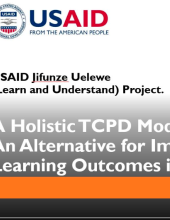
It was only over a decade ago that data on dismal learning outcomes in low- and middle-income countries (LMICs) shook the international education field out of its complacency with rising enrollment rates. The organizations and researchers that led this protest catalyzed a global shift toward prioritizing effective learning as the ultimate goal of education. However, acts of protest or disruption occur in a single point in time, whereas the transformations they advocate for are the labor of many years. Such is the case of the call to action to address the learning crisis. In the past decade, donor agencies like USAID have partnered with ministries of education in LMICs to design and implement programs at scale based on evidence of what works to improve foundational skills. A recent retrospective on the past ten years of USAID early grade reading programming (EnCompass LLC & MCI [2021]. Ten Years of USAID Early Grade Reading Programming: A Retrospective) estimates that USAID programs have improved reading outcomes for more than 7 million children and acknowledges tangible progress in the agency and its partners’ understanding of effective early reading instruction. The study also found that despite significant accomplishments, even the best-designed programs were hindered in their effectiveness by factors related to education systems’ low capacity to implement best practices at scale. Similarly, the Learning at Scale study, funded by the Bill & Melinda Gates Foundation, is examining some of the most effective large-scale early learning programs of the last ten years to understand the elements of their success. Learning at Scale researchers point out that improving learning at scale is hard because it usually requires working through the complex realities of government systems. Therefore, while the first chapter of the “learning crusade” yielded important lessons on what works to improve learning, there is still a lot to be learned about how to apply this knowledge to build effective government systems that ensure learning for all children. Case in point are government systems for continuous teacher professional development (TPD). It is well-known that better teaching is one of the fundamental interventions for improved learning outcomes. There is also a growing evidence base on the characteristics of effective TPD programs, as curated through initiatives like Learning at Scale and The Science of Teaching, also funded by the Gates Foundation. Among these characteristics are trainings that emphasize practice over theory and coaching programs based on structured coaching tools and frequent interaction with teachers. Another teacher support element that can be important to program success is school-based teacher communities-of-practice, which enable peer-to-peer feedback and opportunities to reflect on the ongoing application of instructional approaches. Both Learning at Scale and the retrospective study on USAID early reading programming observe a trend toward shorter but more frequent teacher training events that take place at the local level, in contrast to the massive national trainings of the past. The use of online content for teacher training is also on the rise, though preliminary findings from Learning at Scale suggest that an initial face-to-face training event continues to be essential. However, being able to identify the ingredients of effective teacher support does not automatically equate with an understanding of how to build a continuous TPD system that incorporates them. Neither does it mean that a TPD system built entirely on evidence-based best practices is guaranteed to succeed in improving learning outcomes. As more LMICs advance toward instituting standards and structured career ladders for the teaching profession, and toward developing mechanisms to increase the equity and efficiency of teacher training and support, it becomes increasingly important to identify effective models for implementing continuous TPD at scale. the panel will feature a USAID program in Jordan that exemplifies the desired result: a national-scale, comprehensive TPD model that is aligned with a broader policy on the teacher career path and is linked to a robust assessment data system that reinforces accountability for learning. It is the only program with solid evidence of positive changes in teaching practices that led to significant improvements in student outcomes.
Assoc. Photo (Port.)
jordan port.PNG
Resource (File)
RAMP 2024 CIES Jordan.pptx
Country
Resource Type
Featured projects
Month and Year

Implementing a new teacher professional development system in Tanzania: old habits die hard [CIES 2024 Presentation]

Submitted by admin on
Description/Abstract
In Tanzania, learning outcomes in early grades have remained stubbornly below expectations. Over a decade ago, the Tanzanian Institute for Education recognized that the curriculum for foundational learning needed to change. Textbooks were updated to reflect a more phonics-based strategy and the existing teacher workforce needed to be re-skilled. The Ministry of Education developed a framework for Continuous Professional Development for Practicing Teachers which focused on close-to-school delivery of new professional content. Unfortunately, the framework was not fully implemented, and instead large-scale face-to-face trainings remained the norm. Two USAID early learning programs at scale in Tanzania (one implemented from 2016 to 2021 and one that is currently ongoing) have focused on implementing the Ministry’s teacher professional development (TPD) framework to overcome three significant challenges: (i) ensuring that content did not get diluted by face-to-face cascade training; (ii) providing an incentive for teachers to apply content; (iii) ensuring that content could be adapted to context. Change is disruptive; old habits die hard – more so when there are financial incentives to retain the status quo. Moving from large scale ineffective face-to-face programs to a more holistic localized approach to TPD was met with protest and it has taken time to overcome the resistance from teachers. The first program adopted cluster-based delivery of training, with 4-5 schools in a cluster and local administrators or head teachers delivering the abbreviated training. Teachers no longer received per diems for attending centralized training. The cluster-based training was extended down to school-based communities of learning. These sessions provided an opportunity for teachers to share how they implemented new strategies in their classrooms – they provided contextualization to the content. However, not all schools or clusters had teachers who were able to adapt the content. The program introduced the idea of coaching, initially by Ward Education Officers (WEO) and then by head teachers, exemplary teachers, and eventually, peers. This allowed more experienced and knowledgeable colleagues to observe a teacher and provide feedback through a constructive dialogue. Because coaching is unfamiliar to the administrative structure in Tanzania it had to be included in the job descriptions of administrators and included in staff annual performance assessments. Despite initial resistance, this process has provided a clear incentive for teachers to apply the content that is administered in the training. Finally, to ensure training is not diluted in the translation through cascades, the follow-on USAID program introduced virtual delivery of key messages. To accommodate teachers with feature phone capabilities only, teachers access content through interactive voice instruction, calling a toll-free number and selecting to listen to a 2 minute “lesson”. With WEO support, over 90% of teachers complete a 5-lesson course. The course is aligned to content discussed at the Community of Learning and is reinforced through classroom observations. Using data collected at the beginning and end of each school year for the past two years, we show how this holistic approach to delivering professional development content has led to improved teaching practice and this in-turn has contributed to improved learning outcomes.
Assoc. Photo (Port.)
tpd port.PNG
Resource Type
Resource Language
Month and Year
Publisher Or Client
USAID Jifunze Uelewe

Teacher’s Guide for Remote Learning During School Closures and Beyond (Filipino)

Submitted by admin on
Description/Abstract
Over 91% of the total student population worldwide has been affected due to school closures caused by COVID-19, according to UNESCO. How can the system ensure education of the country that every student has equal access to quality education during the crisis? Important role of teachers. Help students cope with and understand the uncertainty caused by the pandemic. Encourage students to continue learning despite the closure of schools. This guide is for teachers. Support to students needs to continue while physical attendance at schools is completely or partially prohibited. Able to engage their students in various distance learning methods.
Assoc. Photo (Port.)
Teacher’s Guide for Remote Learning During School Closures and Beyond.png
Country
Resource Type
Featured projects
Resource Language
Month and Year

Uzbekistan Teacher Support System Study

Submitted by admin on
Author
Description/Abstract
In Year 2 (October 2020–September 2021), the Program designed and implemented a Status of Instruction Study (SIS) to shed light on teachers’ knowledge, attitudes and beliefs, skills, and behaviors; the resources available at the school level and for the targeted subjects; and how these resources are used. The Program also designed a Teacher Support System Study (TSSS) to examine the existing teacher support system and identify teacher support challenges and opportunities. The TSSS results will be used to create a Program TPD approach. The TSSS data collection process was integrated into the second phase of the SIS data collection process, which occurred in mid-2021. This was done because both studies targeted the same respondents: teachers, school directors, and methodologists. The TSSS, like the SIS, was originally intended to include in-person interviews. However, because of the prolonged difficulties caused by the coronavirus disease 2019 (COVID-19) pandemic, data collection was done remotely. This report presents the TSSS methodology and findings from online surveys administered to more than 4,100 teachers, 183 school directors, and 131 methodologists from all regions of Uzbekistan, including the Republic of Karakalpakstan and Tashkent City.
Assoc. Photo (Port.)
tss report port.PNG
Resource (File)
Country
Resource Type
Featured projects
Resource Language
Month and Year