Jordan

Country Code
JOR

School Readiness Program Prepares Children for Grade One

Submitted by admin on
Author
Description/Abstract
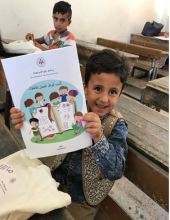
Success story about a recent kindergarten initiative under USAID's Early Grade Reading and Mathematics Project to help children and parents prepare to enter school.

Assoc. Photo (Port.)
ramp.png
Resource (File)
Country
Resource Language
Month and Year

Jordan Remedial Study: Mathematics Diagnostic Assessment Tool and Stimulus Sheet

Submitted by admin on
Description/Abstract
In 2013–14, in response to the success of a reading and mathematics intervention, the Ministry of Education in Jordan developed and piloted a remedial program to provide differentiated (focused) support to the lowest performing children. Because the pedagogical approaches of the reading and mathematics activities were very similar, teachers were able to apply remedial activities in both subjects, and thus, children benefited in both reading and mathematics In Jordan, the remedial pilot activity included two teacher administered tools: (a) a “coarse-grain” screening tool used to identify children in need of remedial support and (b) a “fine-grain” diagnostic tool administered to each child identified by the coarse-grain tool as needing remedial support. To ensure efficacy—in particular, of the coarse grain tool’s ability to correctly identify students—the tools were piloted. In the pilot, the coarse-grain screening tool was administered to all students in the pilot classrooms. The students in the class were then ranked based on their performance on the coarse-grain tool. The fine-grain tool was then administered to every fourth or fifth student (depending on class size) on the list arranged in order of performance. Students who performed better on the coarse-grain tool were consistently identified as performing at a higher level by the fine-grain tool, and students who performed more poorly on the coarse-grain tool were determined to be performing at a lower level by the fine-grain tool. The attached resources are the Mathematics Diagnostic Assessment Tool and the Pupil Stimulus Sheets in Arabic used as part of the remedial pilot program.
Assoc. Photo (Port.)
Country
Resource Language
Month and Year

Jordan Remedial Study: Reading Diagnostic Assessment Tool and Stimulus Sheet

Submitted by admin on
Description/Abstract
In 2013–14, in response to the success of a reading and mathematics intervention, the Ministry of Education in Jordan developed and piloted a remedial program to provide differentiated (focused) support to the lowest performing children. Because the pedagogical approaches of the reading and mathematics activities were very similar, teachers were able to apply remedial activities in both subjects, and thus, children benefited in both reading and mathematics In Jordan, the remedial pilot activity included two teacher administered tools: (a) a “coarse-grain” screening tool used to identify children in need of remedial support and (b) a “fine-grain” diagnostic tool administered to each child identified by the coarse-grain tool as needing remedial support. To ensure efficacy—in particular, of the coarse grain tool’s ability to correctly identify students—the tools were piloted. In the pilot, the coarse-grain screening tool was administered to all students in the pilot classrooms. The students in the class were then ranked based on their performance on the coarse-grain tool. The fine-grain tool was then administered to every fourth or fifth student (depending on class size) on the list arranged in order of performance. Students who performed better on the coarse-grain tool were consistently identified as performing at a higher level by the fine-grain tool, and students who performed more poorly on the coarse-grain tool were determined to be performing at a lower level by the fine-grain tool. The attached resources are the Reading Diagnostic Assessment Tool and the Pupil Stimulus Sheets in Arabic used as part of the remedial pilot program.
Assoc. Photo (Port.)
Country
Month and Year

Jordan Remedial Study: Reading Teachers' Guide

Submitted by admin on
Description/Abstract
In 2013–14, in response to the success of a reading and mathematics intervention, the Ministry of Education in Jordan developed and piloted a remedial program to provide differentiated (focused) support to the lowest performing children. Because the pedagogical approaches of the reading and mathematics activities were very similar, teachers were able to apply remedial activities in both subjects, and thus, children benefited in both reading and mathematics In Jordan, the remedial pilot activity included two teacher administered tools: (a) a “coarse-grain” screening tool used to identify children in need of remedial support and (b) a “fine-grain” diagnostic tool administered to each child identified by the coarse-grain tool as needing remedial support. To ensure efficacy—in particular, of the coarse grain tool’s ability to correctly identify students—the tools were piloted. In the pilot, the coarse-grain screening tool was administered to all students in the pilot classrooms. The students in the class were then ranked based on their performance on the coarse-grain tool. The fine-grain tool was then administered to every fourth or fifth student (depending on class size) on the list arranged in order of performance. Students who performed better on the coarse-grain tool were consistently identified as performing at a higher level by the fine-grain tool, and students who performed more poorly on the coarse-grain tool were determined to be performing at a lower level by the fine-grain tool. The attached resources are the Reading Teachers' Guide in Arabic used as part of the remedial pilot program.
Assoc. Photo (Port.)
Resource (File)
Country
Resource Language
Month and Year

Jordan Remedial Study: Mathematics Teachers' Guide (Arabic)

Submitted by admin on
Description/Abstract
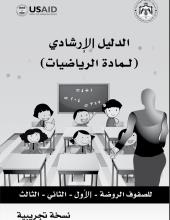
In 2013–14, in response to the success of a reading and math intervention, the Ministry of Education in Jordan developed and piloted a remedial program to provide differentiated (focused) support to the lowest performing children. Because the pedagogical approaches of the reading and mathematics activities were very similar, teachers were able to apply remedial activities in both subjects, and thus, children benefited in both reading and mathematics. The attached document is the Mathematics Teachers' Guide in Arabic.
Assoc. Photo (Port.)
jordan math TG.jpeg
Resource (File)
Country
Resource Language
Month and Year

Jordan Remedial Study: Mathematics Teachers' Guide

Submitted by admin on
Description/Abstract
In 2013–14, in response to the success of a reading and mathematics intervention, the Ministry of Education in Jordan developed and piloted a remedial program to provide differentiated (focused) support to the lowest performing children. In Jordan, the remedial pilot activity included two teacher administered tools: (a) a “coarse-grain” screening tool used to identify children in need of remedial support and (b) a “fine-grain” diagnostic tool administered to each child identified by the coarse-grain tool as needing remedial support. To ensure efficacy—in particular, of the coarse grain tool’s ability to correctly identify students—the tools were piloted. In the pilot, the coarse-grain screening tool was administered to all students in the pilot classrooms. The students in the class were then ranked based on their performance on the coarse-grain tool. The fine-grain tool was then administered to every fourth or fifth student (depending on class size) on the list arranged in order of performance. Students who performed better on the coarse-grain tool were consistently identified as performing at a higher level by the fine-grain tool, and students who performed more poorly on the coarse-grain tool were determined to be performing at a lower level by the fine-grain tool. The attached resource is the mathematics teachers' guide in Arabic used as part of the remedial pilot program.
Assoc. Photo (Port.)
Resource (File)
Country
Month and Year

Measuring regional progress toward early grade reading and mathematics targets in a national application of LQAS as part of the RAMP Initiative in Jordan.
Submitted by admin on
Description/Abstract
Presentation delivered at CIES 2017 (Atlanta). CIES Panel title: Measuring regional progress toward early grade reading and mathematics targets in a national application of LQAS as part of the RAMP Initiative in Jordan. RTI International (RTI) and its partners are implementing the United States Agency for International Development (USAID) and United Kingdom’s Agency for International Development (UKAID) funded Early Grade Reading and Mathematics Initiative (RAMP). RAMP is a nationwide initiative of the Jordanian Ministry of Education (MoE) designed to improve the reading and mathematics skills of students in kindergarten 2 through grade 3 (K2–G3). RAMP, which will be carried out over five years, expects to deliver improved reading and mathematics instruction to all public school students in Jordan in grades K2–G3—about 400,000 students. Central to the RAMP approach is developing reflective practice at all levels of the education system. At the classroom level, teachers use screening and diagnostic tools developed by the initiative for reading and mathematics to gain a better sense of the developmental level(s) of the students in their class and in response, to use research based pedagogical approaches and materials to respond to these needs. At the national level the MoE uses biannual national surveys that include the Early Grade Reading Assessment (EGRA) and Early Grade Mathematics Assessment (EGMA) to measure progress toward national benchmarks. RAMP is exploring the efficiency of the Lot Quality Assurance Sampling (LQAS) methodology in providing regional structures (Field Directorates) with regular information on the progress by schools and Field Directorates toward achieving the national benchmarks for early grade reading and mathematics. In addition, the LQAS based assessments will also contribute to the development of school reports. This panel will discuss the first national implementation of the LQAS based assessment conducted in May 2016 (Brombacher, 2016). The first presentation will provide background to the RAMP initiative, the centrality of reflective practice at all levels of the system to improving performance in early grade reading and mathematics, and the role that the LQAS based assessments will play in providing regional structures with the information that they need to monitor and support progress toward the national benchmarks. The second presentation will describe the development of the instruments used in the LQAS assessment activity, the implementation of the first national LQAS based assessment, the findings of the study, and a range of important lessons learned. The third and final presentation will describe the response of the MoE to the national implementation. The presentation will also deal with the anticipated institutionalization of the approach into the roles and responsibilities of the ministry supervisors. The panel contributes to the conference theme, “Problematizing (In)Equality: The Promise of Comparative and International Education”, as it examines the implementation of an efficient and cost-effective mechanism for national and regional education structures to identify the schools and regions that are in greatest need of support – allowing the structures to deploy limited resources in a cost effective way.
Assoc. Photo (Port.)
CIES Slide.png
Resource (File)
Country
Resource Type
Resource Language
Month and Year

Equity Identification at Baseline

Submitted by admin on
Description/Abstract
Presentation delivered at CIES 2017 (Atlanta). A systematic way to use baseline evaluation studies to help define and identify disadvantaged schools in an intervention program.
Assoc. Photo (Port.)
Untitled.png
Resource (File)
Country
Sub-topic
Resource Type
Resource Language
Month and Year

Scale-Up of Early Grade Reading Programs

Submitted by admin on
Description/Abstract
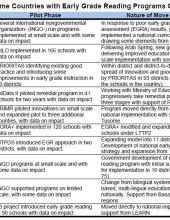
In response to the growing need to improve learning outcomes, USAID's 2011 Education Strategy focused on improving the teaching and learning of reading in early grades. Its goal of 100 million children showing improved reading skills testified to USAID’s commitment to investing in and measuring improvements in learning outcomes. As a result, USAID education programs with a focus on early grade reading have become the norm, with such programs implemented in approximately 20 countries during the five years since the adoption of the education strategy. In the last couple of years, the lessons of successful pilots are being applied on increasing scale in numerous countries. Taking successful pilot projects to scale and helping education systems implement their national reading strategies at scale have therefore become the primary challenges faced by USAID and other supporters of educational improvement in the developing world. The challenges of realizing large-scale impact, and of seeing that impact sustained, are not new to development. However, they are being approached with renewed interest and attention in the education sector. This paper examines seven countries where interventions to improve early grade reading are being taken to scale - some with project support, some through government initiative. Management Systems International's framework for taking projects to scale, and the framework defined in the Brookings Institute's Millions Learning report are used to examine how scale has been and is occurring in these selected countries.
Assoc. Photo (Port.)
Sus doc image.JPG
Resource (File)
Resource Type
Resource Language
Month and Year
Publisher Or Client
USAID

Incentives to teach, incentives to read: A pilot of symbolic incentives for teachers and students in Jordan

Submitted by admin on
Description/Abstract
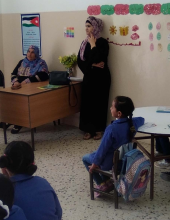
Motivation is key to behavior change in teaching and learning processes. Motivated teachers are thought to be more likely to be willing to experiment with different instructional approaches in the classroom. Motivated students are hypothesized to put forth extra effort during learning activities. These assumptions posit that incentives, or rewards based on evidence of behavior change, may have a role to play in enhancing the motivation of teachers and students. This report presents findings from a short-term incentive pilot program conducted in one governorate in Jordan. During this pilot, students in treatment schools were offered a symbolic (non-monetary) incentive if they read at least 24 books at home over the 8-week implementation period. Teachers were offered a symbolic incentive if they received high scores from coaches during most (at least 50%) of their observed classroom lessons. This report presents findings from this pilot program.
Assoc. Photo (Port.)
lee Jordan incentives.png
Resource (File)
Country
Resource Type
Resource Language
Month and Year
Publisher Or Client
USAID