Indonesia

Country Code
IDN

Scaling Access & Impact: Realizing the Power of EdTech (Executive Summary)

Submitted by admin on
Description/Abstract
Omidyar Network commissioned Scaling Access & Impact: Realizing the Power of EdTech to evaluate what might be necessary to enable, scale, and sustain Equitable EdTech on a national basis. We examined initiatives in Chile, China, Indonesia, and the USA that demonstrate how EdTech reached a broad spectrum of students. Download the executive summary to learn more about some of the events, actions, and initiatives that have contributed to the equitable scaling of EdTech as well as help inform policies using the highest-impact interventions.
Assoc. Photo (Port.)
edtech ecosystems jpg.jpg
Resource (File)
Resource Type
Resource Language
Month and Year
Publisher Or Client
Omidyar Network

Cultivating Dynamic Educators: Case studies in teacher behavior change in Africa and Asia

Submitted by admin on
Description/Abstract
Cultivating Dynamic Educators: Case Studies in Teacher Behavior Change in Africa and Asia responds to growing recognition by international education professionals, policy makers, and funding partners of the need for qualified teachers and interest in the subject of teacher professional development (also referred to as “teacher behavior change”). The book responds to important questions that are fundamental to improving teaching quality by influencing teaching practice. These questions include: How do we provide high-quality training at scale? How do we ensure that training transfers to change in practice? What methods are most cost-effective? How do we know what works? The book includes case studies from seven countries--Ethiopia, India, Indonesia, Malawi, Nigeria, Philippines and Zambia--describing different approaches to teacher behavior change and illustrates how specific implementation choices were made for each context. Individual chapters document lessons learned as well as methodologies used for discerning lessons. The key conclusion is that no single effort is enough on its own; teacher behavior change requires a system-wide view and concerted, coordinated inputs from a range of stakeholders.
Assoc. Photo (Port.)
TBC book front coer.jpg
Resource Type
Resource Language
Month and Year
Publisher Or Client
RTI Press

Using Activity Theory to Understand Teacher Peer Learning in Indonesia

Submitted by admin on
Description/Abstract
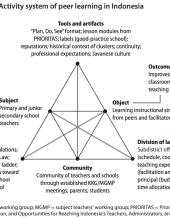
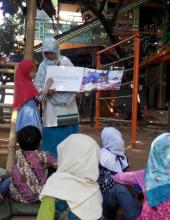
Chapter 7 of Edited Volume: Pouezevara, S. R. (Ed.) (2018). Cultivating dynamic educators: Case studies in teacher behavior change in Africa and Asia. (RTI Press Publication No. BK-0022-1809). Research Triangle Park, NC: RTI Press. DOI: 10.3768/rtipress.2018.bk.0022.1809 This case study explores the methods and implementation considerations of peer-learning approaches to changing teaching practice in the Indonesian context, where cluster-based training is deeply embedded in the education system. These clusters were leveraged by USAID/PRIORITAS to disseminate professional development through a structured lesson-study approach. To understand more about how teachers were learning to improve their practice through peer mentoring, data were collected through interviews and school visits in August 2016. The main purpose of the case study was to understand the scope and implementation considerations of school-based and peer-to-peer approaches to teacher behavior change, with particular focus on improving reading instruction. We particularly have tried to uncover the implementation factors that influenced the possibility of success of peer mentoring in Indonesia under USAID/PRIORITAS, including issues of intrinsic and extrinsic motivation, readiness for self-directed learning, and the relative importance of the foundation laid by the preexisting school- cluster structure described in the Methodology section.
Assoc. Photo (Port.)
activity theory.jpg
Country
Resource Type
Resource Language
Month and Year
Publisher Or Client
RTI Press

Indonesia 2014 EGRA and SSME Instruments

Submitted by admin on
Description/Abstract
Indonesia 2014: The National Early Grade Reading Assessment (EGRA) and Snapshot of School Management Effectiveness (SSME) Survey Instruments
Assoc. Photo (Port.)
indo.png
Resource (File)
Country
Resource Language
Month and Year

USAID PRIORITAS Final Project Report, Volume I: Main Report

Submitted by admin on
Description/Abstract
The USAID PRIORITAS project began in May 2012 with the aim of achieving expanded access to improved quality basic education (IR1). The intermediate results (IRs) that the project aimed to achieve are as follows: * strengthened instruction in schools in targeted districts (IR1-1) * improved education management and governance in targeted schools (IR1-2) * strengthened coordination between all levels of the Government of Indonesia (GOI) and education institutions (IR1-3). This report covers the duration of the project, from May 2012 to September 2017.
Assoc. Photo (Port.)
PRIORITAS final report cover.jpg
Country
Resource Type
Resource Language
Month and Year

USAID PRIORITAS Program to Improve the Quality of Basic Education

Submitted by admin on
Author
Description/Abstract
This presentation describes the USAID/Indonesia PRIORTIAS program (2012-2017), including the development of leveled reading books for 13,000 schools.
Assoc. Photo (Port.)
prioritas presentation.png
Resource (File)
Country
Resource Type
Resource Language
Month and Year
Publisher Or Client
USAID

Literacy Award presented to 19 USAID-partner regencies, municipalities

Submitted by admin on
Author
Description/Abstract
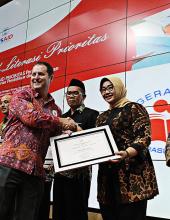
Referencing the USAID/PRIORITAS project. From the News Desk of the Jakarta Post, Jakarta | Tue, March 21, 2017 | 02:36 pm, "The Culture and Education Ministry and the US Agency for International Development (USAID) presented literacy awards to 19 regencies and municipalities for having improved student literacy in the areas...."
Assoc. Photo (Port.)
2017_03_21_23859_1490080828._large.jpeg
Country
Resource Language
Month and Year
Publisher Or Client
Jakarta Post

Scale-Up of Early Grade Reading Programs

Submitted by admin on
Description/Abstract
In response to the growing need to improve learning outcomes, USAID's 2011 Education Strategy focused on improving the teaching and learning of reading in early grades. Its goal of 100 million children showing improved reading skills testified to USAID’s commitment to investing in and measuring improvements in learning outcomes. As a result, USAID education programs with a focus on early grade reading have become the norm, with such programs implemented in approximately 20 countries during the five years since the adoption of the education strategy. In the last couple of years, the lessons of successful pilots are being applied on increasing scale in numerous countries. Taking successful pilot projects to scale and helping education systems implement their national reading strategies at scale have therefore become the primary challenges faced by USAID and other supporters of educational improvement in the developing world. The challenges of realizing large-scale impact, and of seeing that impact sustained, are not new to development. However, they are being approached with renewed interest and attention in the education sector. This paper examines seven countries where interventions to improve early grade reading are being taken to scale - some with project support, some through government initiative. Management Systems International's framework for taking projects to scale, and the framework defined in the Brookings Institute's Millions Learning report are used to examine how scale has been and is occurring in these selected countries.
Assoc. Photo (Port.)
Sus doc image.JPG
Resource (File)
Resource Type
Resource Language
Month and Year
Publisher Or Client
USAID

Indonesia 2014: The National Early Grade Reading Assessment and Snapshot of School Management Effectiveness Survey: Report of Findings

Submitted by admin on
Description/Abstract
In partnership with the Ministry of Education and Culture (MOEC), the Ministry of Religious Affairs (MORA), and the United States Agency for International Development (USAID/Indonesia), RTI International administered the two surveys to 4,812 grade 2 students, equally divided between boys and girls and equally allocated across the four proposed “regions” of (1) Sumatra and its adjacent islands; (2) Java and Bali; (3) Kalimantan, Sulawesi, and its adjacent islands; and (4) the “MNP” region, consisting of Maluku, East Nusa Tenggara (Nusa Tenggara Timur [NTT]), West Nusa Tenggara (Nusa Tenggara Barat [NTB]), and Papua islands (Eastern Region).
Assoc. Photo (Port.)
indonesia egra.jpg
Resource (File)
Indonesia_EGRA_SSME.pdf
Country
Resource Type
Resource Language
Month and Year
Publisher Or Client
USAID

An Investigation into the Teacher Deployment and Teacher Continuing Professional Development Programs in Indonesia

Submitted by admin on
Author
Description/Abstract
This study examines why some districts performed better than others in implementing their Teacher Deployment Plans. The TDP engaged selected districts to analyze data to quantify and qualify their teacher deployment issue, to identify the means by which they could address their teacher deployment issue—merging schools, creating multi-grade schools, transferring teachers, recruiting teachers, and/or reassigning teachers—and to help them develop a detailed TDP plan that, when implemented, would address the teacher deployment issue. This study examines why some districts performed better than others in implementing their TDP plans.
Assoc. Photo (Port.)
Indonesia photo PRIORITAS website2_0.jpeg
Country
Resource Type
Resource Language
Month and Year
Publisher Or Client
USAID