Costs and Cost Effectiveness

Uganda Early Years Study: Final Report

Submitted by admin on
Description/Abstract
The British Department for International Development (DFID) has partnered with the Ugandan Ministry of Education and Sports (MoES) to conduct empirical research on inefficiencies in the Ugandan education system. This research will help the Ministry better understand the severity, causes, and consequences of an enrolment bulge in early primary classes in Uganda. Specifically, this study is investigating the magnitude of repetition in primary 1. It encompasses a nationally representative sample of pupils, and uses information from interviews with pupils, parents/guardians, and teachers.
Assoc. Photo (Port.)
uganda school.jpg
Resource (File)
Country
Resource Type
Resource Language
Month and Year

Weakest Part of Poorly-Performing Educational Systems: An Argument for Focus on “Teaching at the Right Level” and Improved Foundation-Year Performance

Submitted by admin on
Author
Description/Abstract
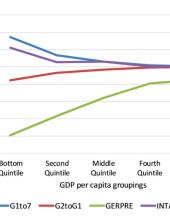
n roughly thirty-five to forty countries that are expanding education very quickly, experts have noticed that learning problems originating in the earliest grades are showing as a massive over-enrolment. In Grade 1, it is not unheard of for ratios of enrolment to population of appropriate age to be as high as 150 percent. This problem is not typical of upper-middle or high-income countries, where the issue has been resolved. Nor, does it seem to affect the very poorest countries where massive enrolment expansions have not yet taken place, and so “don’t even have the problem yet.” Instead, the typical countries showing over-enrolment tend to be those that have received a great deal of funding and attention from development agencies and have expanded enrolment quickly in the last decade or two. This piece looks at the evidence of the enrolment bulge starting in Grade 1. It shows there is a set of inter-related problems occuring, including the lack of "Teaching at the Right Level," that is leading to high enrolment figures, but low levels of learning. The Insight concludes by stating that given the inefficiency signified by the foundation-years over-enrolment, “Teaching at the Right Level” could be an investment that, if tied to proper accountability measures, could essentially pay for itself, and lead to improved foundations for learning in the later grades, and (meaningful) completion of primary school.
Assoc. Photo (Port.)
RISE Crouch.png
Resource (File)
Country
Resource Type
Resource Language
Month and Year
Publisher Or Client
RISE Programme

The Equity Implications of Household Contributions to Education: Evidence from Nigeria's Education Household Survey 2015

Submitted by admin on
Author
Description/Abstract
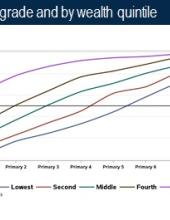
Presentation delivered at CIES 2017 (Atlanta.) In 2004, the Federal Government of Nigeria passed the Universal Basic Education Act. In order to support State governments to implement this Act, a Federal Intervention Fund was established and financed by a 2% deduction from the Consolidated Revenue Fund. This UBE fund allocates funds equally to States, on a matching basis, to fund school construction, textbook provision, teacher training and other equity activities. This presentation looks at evidence from the 2010 and 2015 national household surveys on education to examine whether this Federal fund has improved educational opportunities for the poorest quintile and whether the fund has affected household expenditures on education. The presentation concludes that the middle quintiles have benefited most from the fund, that the richest quintile has opted out of Government education and into private education, whilst the poorest quintile remains financially unable to meet basic requirements of school uniforms and school supplies.

Assoc. Photo (Port.)
NEDS 2015 Learning by SES.jpg
Resource (File)
CIES_2017_Rodd(Final).pptx
Country
Resource Type
Resource Language
Month and Year

The Power of Instructional Support: Using Existing Systems to Change Teacher Behavior in Kenya

Submitted by admin on
Author
Description/Abstract
Presentation delivered at CIES 2017 (Atlanta). Instructional support is essential in the process of creating and supporting instructional change. Educational quality improvement is the elusive goal for many recent literacy improvement programs and strategies. Many programs focus on the inputs of improved textbook ratios, rapid and massive teacher professional development provision, and the provision of ICT support for this system. The Tusome Early Grade Reading Activity, implemented in Kenya from 2014 through 2019, is designed to fundamentally depend on the power and quality of the existing government personnel that were ostensibly assigned to provide instructional support to teachers. The Curriculum Support Officer function, in place in Kenya for decades, was structured to help teachers improve the quality of teaching by providing classroom based support, cluster based training, and ongoing instructional feedback. As is common in many countries in the region who suffer from limited human resources at the local level, these officers are often assigned administrative duties both at odds and distracting from their core instructional support function. Tusome’s work to support the Government of Kenya to revitalize this function and do so in a national manner was both ambitious and somewhat risky. This presentation share the results of Tusome’s efforts with the government to utilize the curriculum support officers as coaches within Tusome with a frank assessment of what process was most effective and which strategies were less effective. It also shares the experiences in Tusome of how a targeted ICT investment in tablets and a structured tool for the officers to use in classrooms created an environment where instructional support was both possible but also more exciting than it previously was. The Tusome National Tablet Program, utilized on a daily basis by these coaches, was designed over several years to integrate within government systems, to be easily implementable by coaches, but also to provide actionable real time data to the education system’s leadership on how teachers were implementing Tusome. The coaching system has provided each of Kenya’s more than 1200 coaches and curriculum support officers with tablets and training how to use them, to support classroom observation and feedback. The presentation shares the results of this over the 2015 and 2016 academic years. Not only have these officers supported up to 20,000 classrooms in a month, but they have also collected structured literacy assessment data from up to 60,000 students at a national level on a monthly basis. This data is collected on an interactive dashboard that Kenyan education leadership is able to use on a consistent basis to change behavior and support large scale instructional reform. The presentation focuses on the possibilities that this instructional support system has for Tusome, increased accountability within the system, and overall quality improvement at the national level for Kenya.
Assoc. Photo (Port.)
Picture1.jpg
Country
Resource Type
Featured projects
Resource Language
Month and Year

Comparisons of public and private schooling in Nigeria 2015 Nigeria Education Data Survey

Submitted by admin on
Description/Abstract
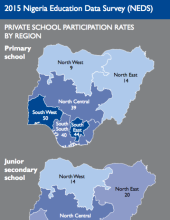
This infographic provides key statistics related to public versus private school in Nigeria, based on the NEDS 2015 data set.
Assoc. Photo (Port.)
NEDS infographic.png
Resource (File)
Country
Resource Type
Resource Language
Month and Year
Publisher Or Client
USAID

Education Finance in Egypt: Problems and a Possible Solution

Submitted by admin on
Description/Abstract
Egypt, currently in the throes of major political change, will likely undergo reforms of various sorts in the next few years. Some of these reforms are likely to give local entities, including schools, greater control over education finances. In 2007, the Government of Egypt began to decentralize some non-personnel recurrent finances from the center—the Ministry of Education and the Ministry of Finance (MOF)—to lower-level jurisdictions, including schools, using a number of simple and transparent enrollment- and poverty-based funding formulas. By 2010, a sizable amount of capital expenditure was also being transferred to lower levels of the system via similar equity- based funding formulas. Prior to these formula-based decentralization efforts, a large amount of education-related non-personnel recurrent finances had already been moving from the MOF to the muderiyat, education offices at the governorate level of the system. Analysis of these latter allocations reveals that they are highly inequitable on an inter-governorate per-student basis, ranging from EGP 966 per student in New Valley to EGP 25 per student in 6th of October. This paper examines the nature and potential causes of this inequity and espouses a way in which these funds could be transferred using an equity-based funding formula that holds harmless those muderiyat that would lose absolute amounts of money under such a more equitable distribution scheme.
Assoc. Photo (Port.)
healy ed finance Egypt.jpg
Country
Resource Type
Resource Language
Month and Year
Publisher Or Client
RTI Press

Low cost private schools for the poor: What public policy is appropriate?

Submitted by admin on
Description/Abstract
Recent attention has focused on the existence of non-government schools that cater to children from low-income families. These schools can now be found in the majority of developing countries, many of which have a prescribed public policy to provide free public education. This raises the question, why would a low-income family choose to send a child to a fee-paying school if a place in a free school were available? This paper will report on case studies of low-fee schools in Jamaica, Kenya, Tanzania, Ghana, Indonesia and Pakistan and will assess the reasons for their increased demand. In the past, some have argued that development assistance agencies should limit assistance to public school sector. Others have argued that the public sector is inadequate and in many ways has failed in its ambitions to provide a minimum quality for every child. This paper will consider what public policy should be toward low-cost private schools, including the policy of development assistance agencies which seek to assist low and middle income countries as well as the appropriate public policy for national and local governments. The paper will conclude with several recommendations. One recommendation is that although children from low-income families attend non-government schools, they continue to be citizens; hence they should not be excluded from poverty assistance strategies. A second recommendation is to expand government statistical functions so that non-government schools are regularly included in the calculations of enrollment rates. Lastly, the paper does not recommend voucher or other program of publically financed school choice on the grounds that the public sector should remain the main conduit for public schooling. It does, however, raise questions as to the limits of the public sector in delivering high quality schooling and whether these limits should be more candidly acknowledged.
Assoc. Photo (Port.)
publications icon purchased sm.png
Country
Resource Type
Resource Language
Month and Year
Publisher Or Client
International Journal of Educational Development

Tech’n Teachers: Assembling the jigsaw puzzle - but do we even know the picture?

Submitted by admin on
Author
Description/Abstract
This presentation was given at the 2015 Game Change Summit of the United Methodist Church in Nashville, TN. The presentation takes the audience along a journey of 2 different technology initiatives that involve teachers in Samoa and Kenya and share with you some of the pieces we have found, and where we think some are still missing. While there are many more, the presentation focused on each initiative’s main puzzle pieces – the key design elements of education objective, content, technology, training, cost and scale, as well as monitoring and evaluation.
Assoc. Photo (Port.)
technteachers.jpg
Resource (File)
Country
Resource Type
Resource Language
Month and Year
Publisher Or Client
RTI International